
Simanaitis Says
On cars, old, new and future; science & technology; vintage airplanes, computer flight simulation of them; Sherlockiana; our English language; travel; and other stuff
FERRARI 330 GTS—A SUPERLATIVE CAR FROM COMPLEX TIMES
BY THE LATE 1960S, AUTOMOBILES had to fess up to their emissions. California was first with tailpipe standards for the 1966 model year; in 1967 the state established its Air Resources Board. Tailpipe standards went federal for model year 1968; the U.S. Environmental Protection Agency came along two years later.
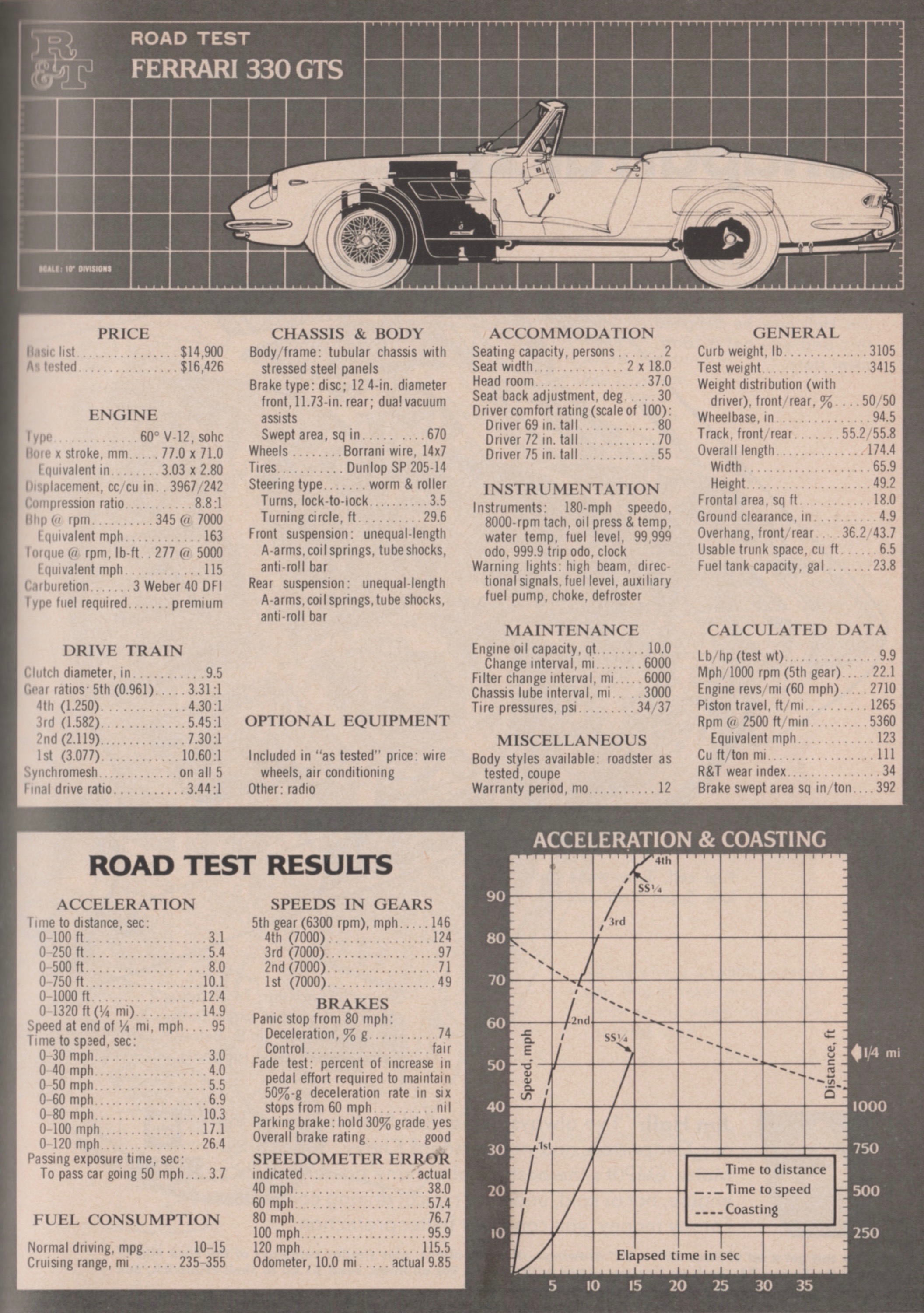
The Ferrari 330 GTS tested in R&T August 1968 was a rolling… no, make that an exuberantly purring example of this. Here are tidbits from that road test.

This and other images from R&T, August 1968.
In Regulational Limbo. “Ferraris,” R&T said, “are somewhat in limbo at this time as far as sales in the U.S. are concerned. The test car was officially a 1967 model as are all Ferraris now being sold new here; it showed vestiges of ‘safety’ thinking, being the first Ferrari tested to have 3-point seat belts, but it appears to be some time away before Ferrari can conform to the safety and emission regulations.”

The 60-degree V-12 displaces 3967 cc (thus Ferrari nomenclature: 330 cc per cylinder).
R&T continued, “The Bayh Bill exempts only manufacturers of less than 500 cars per year and Ferrari builds more cars than that, so he will have to conform to the safety regs. There is no escape from the emission standards, though the 1970 ones should be much more favorable to the Ferrari sort of engine than the present ones.”
Crashworthiness Testing. R&T related a tale of crash testing that’s particularly Italianesque: “It seems that the Pininfarina people were doing such a test with a radio-controlled Ferrari, the radio equipment being carried in a Fiat running alongside the Ferrari. Somehow the electronic driver drove the Ferrari a little too fast, the little Fiat couldn’t keep up and the Ferrari got out of radio range, whereupon it crashed through a fence and came to a grinding halt somewhere in an adjacent farm—hardly the crash the testers planned!”
Agg!

Different horses for different courses.
“In the meantime,” R&T said, “let’s hope the supply of 1967 Ferraris holds up. Cars like this are right at the top of the state of the art and should be required driving for not only the Detroit moguls but the Washington lawmakers.”
Hear! Hear!
R&T’s Reasoning. The magazine reported, “Though the 330 GTS is a luxurious car—ours even had air conditioning—it’s a Ferrari sports car through and through. One whir of the starter and the famous V-12 comes to life, sounding like some sort of cross between an electric motor, a turbine, and a reciprocating engine. In easy driving there is no mechanical knock, no induction roar, no feel of cylinders firing—nothing but 24 tappets clicking away and a rather distant purr from the twin tailpipes.”
Handling. “Out on the road,” R&T recounted, “once the driver has the feel of things, he feels he could do almost anything with this car. The steering is light enough without power assist (it will be available soon) and as precise as any, but not particularly quick. It’s one of those nice neutral-handling chassis with plenty of torque to bring the rear end out at any time and the sticky Dunlop SPs on 7-in. rims give a great combination of sheer cornering power, good road feel and overall driveability.”
Braking Only So-So. “Our reaction to the 330’s brakes,” R&T reported, “is not so positive… When cool—and this will be 99% of the time—they are slightly erratic in action and not properly balanced for a really fast stop. Once warmed up by hard use they pull straight and give a 90%-g deceleration rate, indicating that they were planned strictly for hard driving. Surprisingly enough, they are also over-assisted…. Just to be fair, the test car had very few miles on its odometer and perhaps the brakes would improve with a few thousand miles bedding-in.”
Disc Brake Parking. By the way, R&T cited “Ferrari solves parking brake problem by use of cable-actuated clamp (left).”

This problem was unique to disc braking: The geometry of drum alignment gave a self-energizing capability amenable to cable actuation.
Bodywork and Top. Pininfarina’s contribution was “a superbly rigid, totally rattle-free body built of steel panels over a 3-dimensional tubular frame. The soft yellow paint job of our test car was flawless, and atop the body is a black fabric top very much like the Fiat 124 Spider’s—also a Pininfarina body…. The top goes up and down just as easily as the Fiat’s—release two clamps over the windshield and fold it back.”

Miata drivers today recognize the easy routine; Morgan owners enjoy the fiddling.
Other Amenities. R&T recounted, “Among other amenities of this model are the very comfortable, generously proportioned leather seats with the most easily adjustable backrests we have experienced, and electric window lifts that are typically European-slow. That Ducellier outfit that makes all the European window lifts sure could learn a thing or two from the Americans.”

A Caveat. What’s more, R&T tossed in “comfortable (at least for moderately-sized people)…” The only quantification of this lurks in the Data Panel’s “Driver comfort rating (scale of 100)”: 80, 70, and 50 for driver heights of 69, 72, and 75 in., respectively.
Hmm…. Maybe if I just keep the top down.… ds
© Dennis Simanaitis, SimanaitisSays.com, 2023
 Simanaitis Says
The oft-repeated wisecrack is that a [insert British sports car name] seats two, but it takes three to put the top up.
My Morgan top can be put up by one person, two is easier. But thanks to my dermatologist’s commands, the top just stays up these days.
My Ferrari knowledge, other than wide reading, hails from a pair of friends; one owning a masterfully restored sound to begin with ’63 Lusso and ’59 Pinanfarina coupe, the other a ’58 Berlinetta and ’57 Testarossa. But the Prancing Horse road cars have always puzzled. On one hand, they obviously drive well, because marketing alone not enough to keep second-tier product alive so long. However, Enzo Ferrari’s only interest in the road cars, largely sold to playboys and girls wanting the latest thing, was to fund racing, because they were never remotely rustproofed, used dash instruments and switch gear from Fiats, and those long experienced with the three-liter V-12 say it not uncommon to require rebuild after 30-35,000 miles.
Meanwhile, my girl’s 2001 Miata top goes up and down easily–steady, this a public site — almost as readily as the Fiat 124 Spiders i sold in my callow youth. BTW, it amused us when people would come into the dealership asking to see a “Spider convertible.”
Kurt Vonnegut was a Saab salesman before offering the same novel 14 times, bless ‘im.