
Simanaitis Says
On cars, old, new and future; science & technology; vintage airplanes, computer flight simulation of them; Sherlockiana; our English language; travel; and other stuff
HAVE A GRINDER WITH A FRAPPE
THE RECENT WORD GENIUS titled “10 Words Only People From New England Will Understand” evoked memories of my undergrad years some six decades ago at Worcester Poly. Anyone familiar with the school or the city will recognize it’s pronounced “Woostah.” And anyone enjoying New England will concur with the WORD GENIUS list. Here are several favorites, including a new one to me.

Leaf Peepers. New to me, WORD GENIUS writes, “ ‘Leaf peeper’ refers to tourists who come to New England to drive slow, eat doughnuts, and look at the changing leaves throughout the fall season. New England has a lot of pride in its beautiful fall foliage and leaf peepers are a welcome tradition. The nickname is said with affection.”
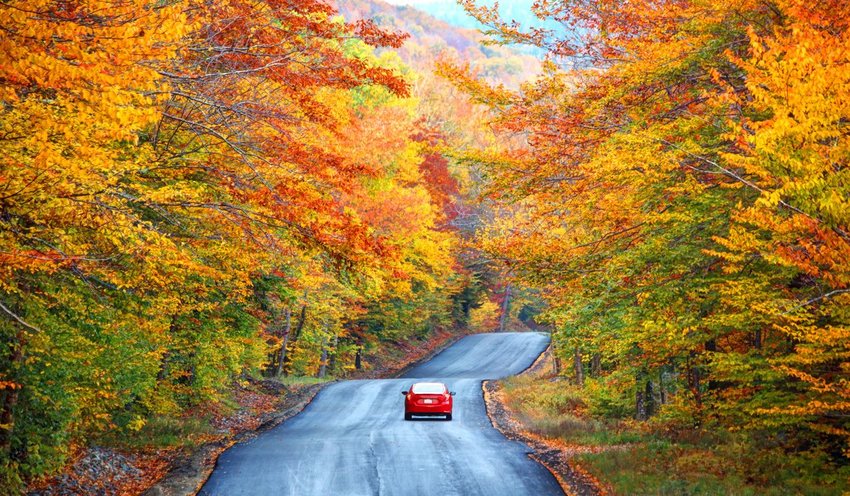
Image from WORD GENIUS.
It reminds me of “those folks come from away.” The musical Come From Away suggests that use of this phrase extends Down East all the way to Gander, Newfoundland.
Rotary. WORD GENIUS says, “Instead of a roundabout (the traffic control where you drive in a circle, exiting and entering on a curve), New Englanders call it a rotary. And there are a lot of them.”
I’ve also heard of them as “traffic circles.” Indeed, there’s a Traffic Circle Neighborhood of Long Beach, California. Its SimanaitisSays description appeared as “Long Beach Traffic Circle/Skidpad.”

Mud Season. “Any New Englander,” WORD GENIUS writes, “will tell you it’s ‘mud season’ with a groan of pain. Existing after the dead of winter but before spring, ‘mud season’ is cold and gray, but that’s just warm enough that the ground turns to mud. The mud gets everywhere—in the car, in every establishment or home you walk into, on your clothes—and it’s just cold enough so the mud sometimes freezes, only to melt again and get everywhere.”
I recall as well that home utility rooms (i.e., where washer/dryers reside) are often called “mud rooms,” because their entryway gives a place to strip off and leave the galoshes.
Grinder. WORD GENIUS writes, “The special sandwich that has meat, veggies, and cheese on a long roll is traditionally known as a ‘sub’ (unless you’re eating a ‘hoagie’ in Pennsylvania). In New England, it’s called a grinder for unknown reasons.”
I checked for origins in Merriam-Webster and followed the lead to Sam Dean’s article in Bon Appétit, February 1, 2013:“The Origin of Hoagies, Grinders, Subs, Heroes, and Spuckies.” Sam wrote, “Grinder: You’re most likely to find one of these in New England, though the more common ‘sub’ has taken over most of the terrain. ‘Grinder’ shares some flimsy nautical roots with the sub—some claim that it was named for ‘grinders,’ Italian-American slang for dockworkers (who were often sanding and grinding rusty hulls to repaint them)—but the more widely attested origin is about the sandwich itself. Subs, with their Italian bread and piles of fixings, were harder to chew through than your typical ham and cheese on white bread. That toothsomeness got translated into ‘grinder,’ since that’s what your teeth had to do to get through a bite.”

Image from TasteAtlas.
Sam continued, “A note for nitpickers: at certain points in New England grinder history, grinders have been hot, while subs stayed cold, but that’s come and gone over the decades.”
Frappe. WORD GENIUS writes, “In most of the United States, milkshakes are made with ice cream, milk, and syrup, or flavoring. In New England, a ‘milkshake’ is only milk and syrup (but it’s not just chocolate milk—it’s shaken and frothed until light and foamy). A ‘frappe’ (pronounced ‘frap’) is the thicker version that includes ice cream.”

Image from Boston Magazine.
Yes, I recall grinders and frappes at The Highlander down the hill from the WPI campus. George Barnes mentions it in the Telegram & Gazette, February 9, 2020: “The Highlander, at 118 Highland St., also was a popular spot for decades. It closed in 1970s due to financial problems. E. Paul Tinsley later ran Curley’s, an Irish pub, and Shannon’s II Restaurant there before selling the business to Rob Ahlquist of Shrewsbury, who opened The Sole. The Reading Lamp Bookstore next door in 1968 was owned by Soter’s wife, Evelyn. The neighborhood attracted people from throughout Worcester, but especially students from nearby Worcester Polytechnic Institute.”
Yep. It was The Highlander where I first enjoyed scrod, what Wikipedia describes as “a small cod or haddock, and sometimes other whitefish, used as food. It is usually served as a fillet, though formerly it was often split instead.”

This culinary delight prompted the following risque tale: A guy gets into a taxi and says, “Take me someplace where I can get scrod.” The driver says, “You know, I’ve been driving a hack for 17 years and this is the first time anyone asked for it in the future pluperfect subjunctive.”
Yes, they were good years in Woostah. ds
 Simanaitis Says
Other unique North Easters I’ve experienced:
Bang a ’Uey – make a u-turn.
Bubblah – drinking fountain
P-town – Provincetown
Bugs or Cocks – Lobster
Go Down Cellar – visit the basement
Packie – liquor store
Johnny – open back hospital gown