
Simanaitis Says
On cars, old, new and future; science & technology; vintage airplanes, computer flight simulation of them; Sherlockiana; our English language; travel; and other stuff
NOW WE’VE GOT A WORD FOR THAT
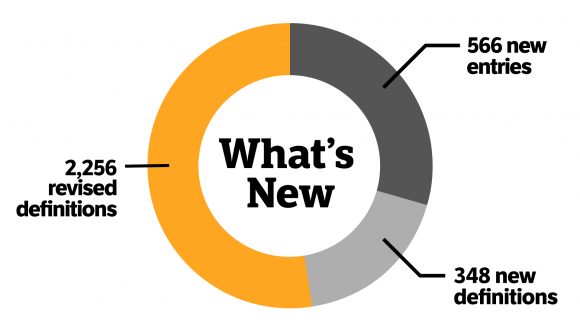
THE WEBSITE DICTIONARY.COM ANNOUNCES ITS “New Words Drop! Get the First Look at Our Fall 2023 Collection of Dictionary Additions,” September 5, 2023. Wishing to be au courant on matters lexicographic, I offer tidbits here about several of my favorites.
“Godwin’s Law. noun. an adage of internet culture stating that as any discussion or debate grows longer, there is a proportionate increase in the probability that someone will invoke a comparison to Hitler or the Nazi party. Named after U.S. lawyer and author Mike Godwin (born 1956), who formulated the adage in 1991.”
“Bloatware. noun. Computers. unwanted software that is preinstalled on a newly bought device, especially when it negatively impacts the device’s performance.”
Indeed, I am a victim of bloatware: Every time I fire up my Dell, Microsoft annoys me with offers to enroll/upgrade in one thing and another that have nothing to do with my GMax (the laptop’s primary use).
“Mountweazel. noun. a decoy entry in a reference work, such as a dictionary or encyclopedia, secretly planted among the genuine entries to catch other publishers in the act of copying content.”
“Yes, we’ve got some. No, we’re not going to tell you what they are.”
I am familiar with maps having phony cities, and my reference mentions Lillian Virginia Mountweazel in the New Columbia Encyclopedia. It also says, “However, modern judicial scholarship suggests a fat lot of good it did.”
Which brings us to new words associated with Artificial Intelligence.
“Generative AI. noun. Computers. artificial intelligence that is designed to process prompts from users and respond with text, images, audio, or other output that is modeled on a training data set.”
“Chatbot. noun. a computer program designed to respond with conversational or informational replies to verbal or written messages from users.”
“GPT. abbreviation. Computers, Digital Technology. generative pre-trained transformer: a type of machine learning algorithm that uses deep learning and a large database of training text in order to generate new text in response to a user’s prompt.”

“Hallucinate. verb. Computers, Digital Technology. (of a machine learning program) to produce false information contrary to the intent of the user and present it as if true and factual.”
“Be prepared to starting hearing and reading about this with increasing frequency—including in discussions of how AI researchers still don’t fully understand how it happens.”
“LLM. abbreviation. Computers. large language model: a type of machine learning algorithm trained on extremely large data sets of existing language and designed to generate new, naturalistic responses to prompts.”
Enough on A.I. Let’s see an old favorite.
“Paraprosdokian. noun. a sentence or expression in which the second part provides an unexpected resolution or contrast to the first part, as in I’d like to see you again, but I’ve lost my glasses.”
This is another word with SimanaitisSays heritage. My favorite is Henny Youngman’s “Take my wife—please!”
“Nepo Baby. noun. a celebrity with a parent who is also famous, especially one whose industry connections are perceived as essential to their success.”
Note, by the way, the “one/their” syntax in this definition. And see the following.
Revisions. Changes in the wording of definitions reflect changes in society. As an example, the latest gender awareness has prompted a dictionary-wide change: “In this most recent update, our lexicographers made dictionary-wide changes to remove binary-gendered phrases like his or her and he or she, which had appeared in hundreds of entries. In many cases, such phrases were replaced with their, they, or similar words. In other cases, entries were simply rewritten to avoid using a pronoun at all.”
“This change,” lexicographer K.E. Callaway writes, “was made for two reasons: inclusivity and usage. On the inclusivity side, his or her does not include people who use other pronouns. In terms of usage, they is simply much more common as a generic pronoun than he or she, including in spoken and all but the most formal types of written English.”
“In fact,” Callaway continues, “this has been the case for decades (even though people rarely notice it in speech).”
I agree: “he or she” has a legalistic sound to it. Also I’ve become used to the word “their” evolving into a singular/plural identity. “A folk singer often provides their own guitar accompaniment.”
English, after all, is a living language. ds
© Dennis Simanaitis, SimanaitisSays.com, 2023
 Simanaitis Says