
Simanaitis Says
On cars, old, new and future; science & technology; vintage airplanes, computer flight simulation of them; Sherlockiana; our English language; travel; and other stuff
FORMULA ONE—A HALF-CENTURY AGO
IT SURE SOUNDS FAMILIAR: Jonathan Thompson wrote about a driver performing “perfectly all year long… staying up front so consistently that his challengers were demoralized.” Jon was reviewing the 1972 season and its dominance by Emerson Fittipaldi and his John Player Special Lotus 72D. The “R&T Bonus Feature” also had paintings by automotive artist extraordinaire Werner Bührer of 13 cars from the 12 participating teams in 1972. Here are these wonderful illustrations, together with tidbits gleaned from Thompson and Bührer.

The Leader. Like eight other teams, Lotus depended upon the Ford Cosworth DFV (Double Four Valve) V-8s . Only BRM and Matra (both V-12s), and Ferrari and Tecno (both flat-12s) were exceptions.

The Front Runners. Jon observed, “The invincibility of the Jackie Stewart/Tyrrell combination was a thing of the past; although Stewart ended the season in the same winning style that he had begun it, he had to fight hard just to finish second in the standings.”
A favorite Tyrrell story comes from Rob Walker: These two team owners were often mistook for each other. Ken once told Rob, “When they think I’m you, I invariably give them your autograph.” Rob responded (or so he joked to me), “I always tell them to bugger off.”
Jon noted “Denis Hulme, with the McLaren team achieving fantastic reliability (an 88 percent start/finish ratio)…. It was as if the team’s waning Can-Am proficiency had been diverted to Formula 1.”
“Ferrari’s clockwork performances in the sports car races were not duplicated in Grand Prix events, the 312 B2 being frequently the fastest car but not finishing often enough to give the brilliant Jacky Ickx a chance at the title.”
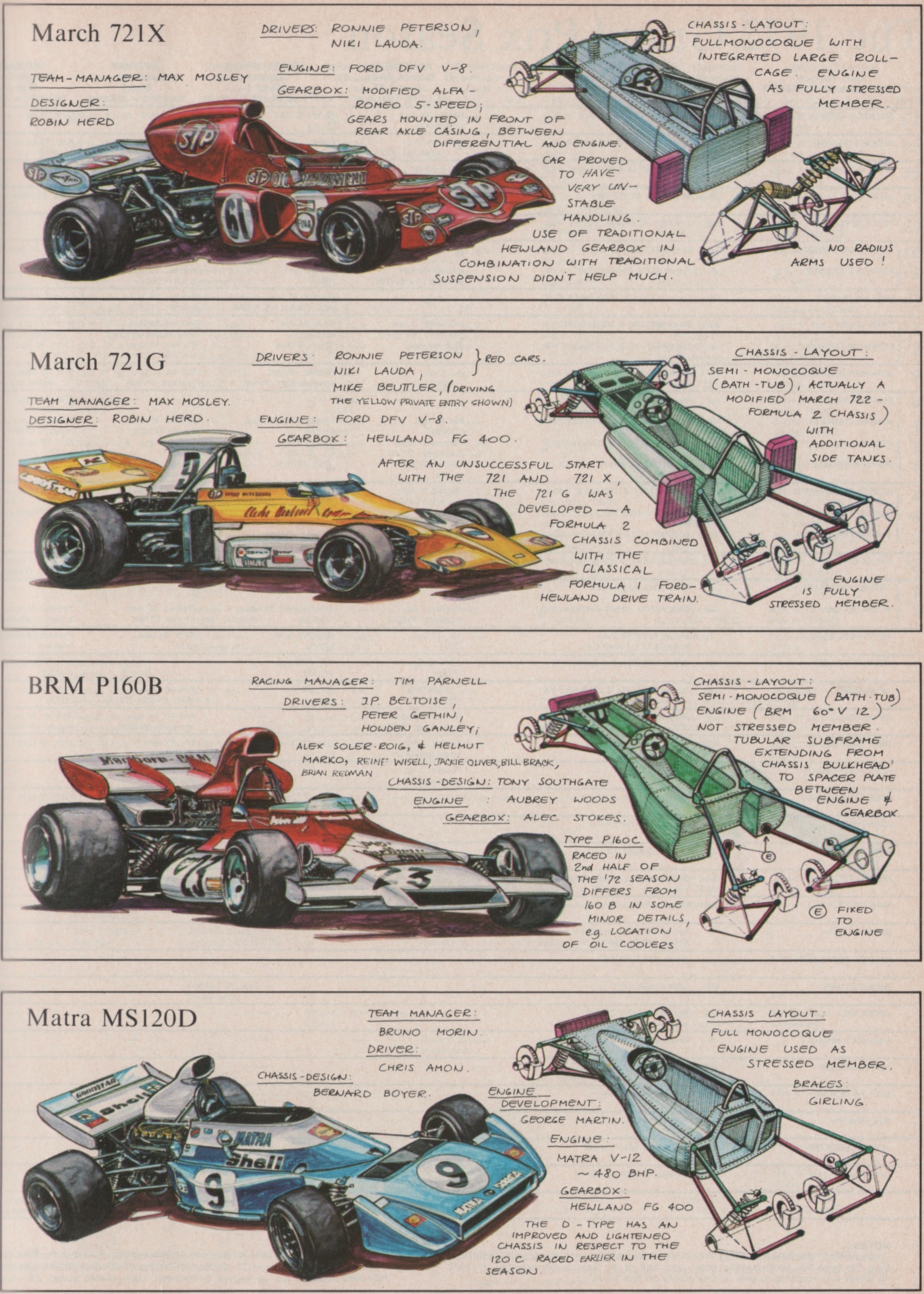
The Midpack. The March 721X proved wanting. Team manager Max Mosley and designer Robin Herd responded by fitting the Ford DFV/Hewland combination into the team’s Formula 2 chassis.
The French Matra is remembered for the best exhaust note ever in F1, known to be audible for miles.

The Rest. Jon reported, “The BRM, Matra, March, Surtees and Brabham teams were only occasionally effective, while the three new makes—the Tecno, the Politoys and the Connew—achieved nothing at all, not even the faint adjective ‘promising’. ”
The Forgotten Three. In fact, these three had fallen off my F1 memory bank completely. Wikipedia notes, “Tecno was an Italian kart and former race car constructor based in Bologna. It won the European Formula Two Championship in 1970 and became a Formula One constructor, participating in 10 grands prix and scoring one championship point.” Count Gregorio Rossi of the Martini company arranged a brief sponsorship of Tecno; later Martini aligned with Brabham.
Politoys, known for its 1/43 car models, approached Frank Williams to build an F1 car, the result being the Politoys-Cosworth. The grandprix.com website describes its brief antics.
Connew Racing Team, commonly known as Connew, according to Wikipedia, “was a short-lived British Formula One constructor. Founded in 1971 by Peter Connew, the team constructed a single car, the PC1.”
Connew had worked as a draftsman, ever so briefly, for John Surtees. After a falling out, Connew decided to build his own F1 car which was to emphasize efficiency and ease of maintenance. A year of chaos followed: A rule change concerning materials precluded Monaco attendance. The car missed the 1972 French Grand Prix when its transporter broke down on the way to Clermont-Ferrand. A cracked suspension member had it withdrawn from the British Grand Prix. Screwed-up entry credentials precluded running the German Grand Prix. The car ran the Austrian Grand Prix until lap 22 when a rear wishbone failed. At end-of-season Brands Hatch, its driver asked that a “kill” switch be fitted to the steering wheel. It killed the ignition on the warmup.
I wonder if F1 enthusiasts of the year 2073—were they to exist—would wonder about Max Verstappen and his Red Bull dominance and the likes of Haas and Alphatauri. ds
© Dennis Simanaitis, SimanaitisSays.com, 2023
 Simanaitis Says
I was completely reliant on R&T to follow road racing — about the only coverage on TV was the annual Grand Prix of Monaco coverage on ABC’s Wide World of Sports, and occasionally the 12 hours of Sebring. Still, R&Ts reports arrived months after the event, so it wasn’t until November 1972 that I got to read about Jacky Ickx’s runaway victory in July in the German GP at Nürburgring. I was in rapture!
I always thought the 312B2 was the best looking of early Ferrari 312s, and tied with the later (albeit deadly) 312T2. (Okay, I admit being jealous of the Lotus 72, which I would describe as the “XKE of Grand Prix”.)
Thank you for reviving this treasured memory, Dennis!
Great find, and special memories. How quickly DFVs, big clumsy wings and monocoques totally changed F1.
Thank you and Werner.
Thank you, Bob. And thank Jon Thompson, rest his soul, for his authorative F1 analyses.
Pingback: Formula 1 – A Half-Century Ago – DEMARAS RACING
Amazing post, Chris. Thanks for sharing. Emerson was the “maverick” that brought F1 into the lives of the Brazilian fans. Suddenly we had something else to be proud of, other than soccer.
On the wall of my dad’s repair shop, there was a huge poster of Emmo’s Lotus, going flat out at Interlagos.
Gosh, all these memories brought tears to my eyes.