
Simanaitis Says
On cars, old, new and future; science & technology; vintage airplanes, computer flight simulation of them; Sherlockiana; our English language; travel; and other stuff
EV VERSUS GASOLINE—IFS, ANDS, BUTS PART 2
YESTERDAY IN PART 1, MICHAEL J. COREN began cogent analyses of EV versus gasoline costs, as first appearing in “Is It Cheaper to Refuel your EV Battery or Gas Tank? We Did the Math in All 50 States,” Washington Post, August 8, 2023. Today in Part 2, he travels through less-than-friendly EV territory.
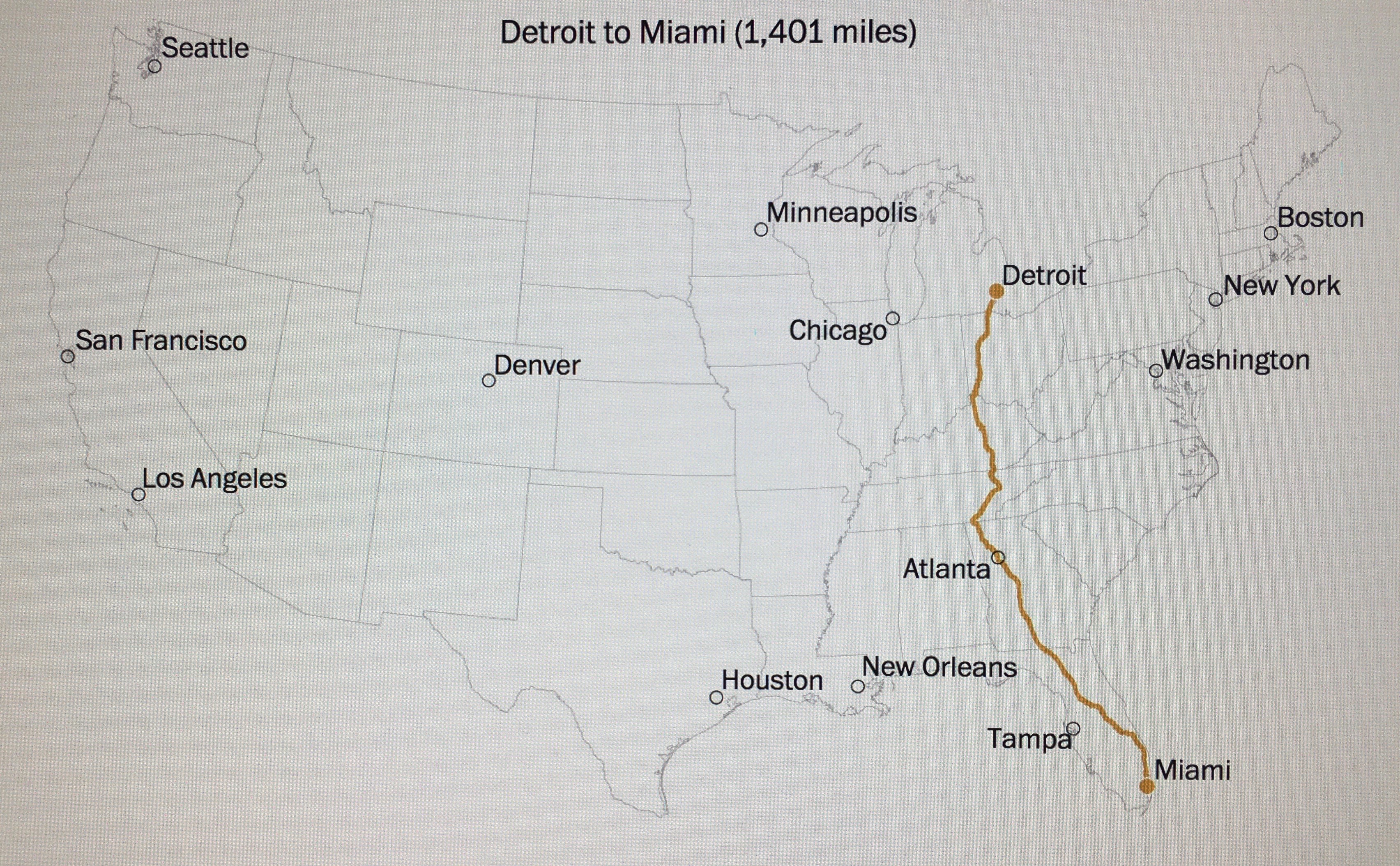
Driving Detroit to Miami. By contrast to relatively EV-populated California highways, Coren observes, “Driving from Motown across the Midwest is not an EV dream. This region has some of the lowest EV ownership rates in the United States. Chargers are not as plentiful. Gasoline prices are low. Electricity is dirtier.”
For this trip, Coren “chose to compare the Toyota Camry with the electric Chevrolet Bolt—relatively efficient vehicles that narrow the difference in fueling costs. To reflect each state’s mix of prices, I measured the distance along the 1,401-mile journey in all six states, and their respective energy costs and emissions.”
“Did the EV hold its edge? Sometimes. But not always,” Coren reports. “If I was refueling at homes or cheap Level 2 commercial stations along the way (an unlikely scenario), the Bolt EV was cheaper to refuel: $41 compared to $142 for the Camry.”
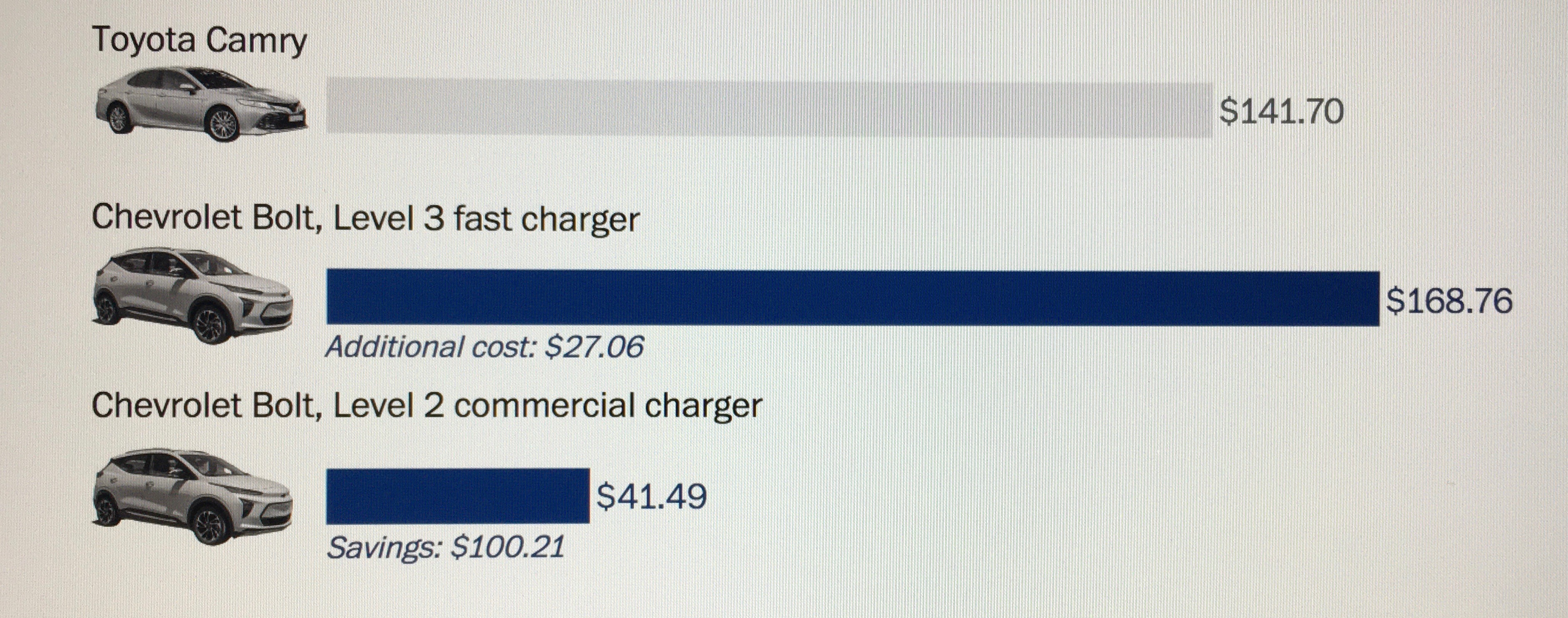
“But,” he says, “fast charging tipped the balance in favor of the Camry. At Level 3 chargers, the retail cost of electricity added up to $169 to complete the trip on batteries, $27 more than the gasoline-powered journey.” And don’t forget the durability tradeoffs of fast charging.
Coren does mention other EV costs that are sometimes ignored: state EV taxes replacing gas taxes, costs of home chargers, transmission losses while recharging (about 10 percent), and the cost of driving to sometimes distant public fueling stations. “These are small but real costs,” Coren is told by specialists.
I recall the inherent 5-percent loss of long-line electrical transmission, but cringe at this 10-percent replenishment loss. Imagine the bruhaha if gasoline pumps routinely spilled 1/10 of a gallon for every gallon rung up(!?).
The Social Cost of Carbon. On the other hand, Coren concludes with “a rough dollar estimate of the damage from adding another ton of carbon to the atmosphere—a tally of heat deaths, flooding, wildfires, crop failures and other costs tied to global warming. Every gallon of gas adds about 20 pounds of carbon dioxide to the atmosphere, equivalent to about 50 cents in climate damage per gallon, researchers estimate.”
“You’re not required to pay this, of course,” Coren notes. “And EVs also don’t solve this problem on their own. For that, we’ll need more cities and neighborhoods where you don’t need a car to visit friends or buy groceries. But electric mobility is essential to helping keep temperature increases below 2 degrees Celsius. The alternative is a price that has become impossible to ignore.”
Coren’s article is a thoughtful piece indeed, well worth reading in its entirety. ds
© Dennis Simanaitis, SimanaitisSays.com, 2023
 Simanaitis Says
If all your miles are done in long distance travel, that’s one thing. But that’s not a typical case.
Let’s consider the cost for charging your car if you have solar panels at home and use the car for “in range” trips 90% of the time (meaning 90% of your recharging is done at home from your net-billing personal electrical system.) Or if you rely on overnight charging from your (solar-panel-less) mains…
Thanks,
>
Tom, thanks, “not a typical case” is an excellent argument for PHEVs. Mine, even though advertised as having a 41 mile battery, will (except in winter) go 50+ miles w/o gasoline. This covers ~90% of my driving. Plus it’s so easy to plug into a (no battery degradation) normal household receptacle. Best of both worlds.
Some say “why carry around that heavy ICE 100% of the time if you don’t need to.” But why carry around a heavy 250 mile battery 100% of the time if only needed for that last 10% of driving? Left unsaid is the critical option of having two ways – not one way – to propel your car.
Wow, if EV vs gasoline can actually be argued, are PHEVs the logical middle way?
Being ignored of course, while re-inventing a national transportation system, is the elephant in the room: it takes perhaps six PHEVs to equal the ecological and power grid consequences of one EV. One reference: https://manhattan.institute/article/electric-vehicles-for-everyone-the-impossible-dream?utm_source=wsj&utm_medium=feature
Another cost consideration: Regeneration does much of the slowing of an EV. I once asked a Tesla mechanic if he had ever replaced a set of brakes. He replied, “We’ll, there was this one gut who takes his on the track”.
That should say, “ Well, there was this one guy…”
Not just EVs.146,000 miles on a trouble free ’07 non plug in Prius. When sold in 2015, Md. state inspection found the original brakes had 50% remaining. (The original battery was fine as well.)
Our kid has our old 2007 Prius. Approaching 175K miles, battery did die at about 160K but there’s a substantial cottage industry refurbing Prius batteries so it wasn’t wildly expensive to get it replaced. The rest of the car is showing its age, but they’re still driving it and at this point expect it to pass 200K before they have to look seriously for a replacement.
We also have a 2014 Prius, a little over 100K. Needs a little work, but not on the hybrid system – just regular older-car stuff.
And, a 2017 Chevy Bolt. A mixed blessing. Very cheap to drive under normal conditions, charging at home overnight for $0.09-12 depending on season, offsetting that through net metering from the next day’s solar production; that’s in a utility that gets at least 1/2 of its energy from renewable or hydro sources. But for trips beyond the round-trip range of the car, the Bolt simply doesn’t charge quickly enough: 40-80% takes about an hour. Trips can be done, but the one I did last weekend (about 500 miles round trip) is about as far as I’m willing to go with it – 6 hours each way, a trip that with the Prius takes 4, due to enroute charging stops – and even then only if I’m alone.
For longer trips, you need a Tesla or something else newer than a Bolt (a mid-2010s design obviously aimed at competing with the Leaf) that can take advantage of the 100-300kw charging rates available now. Or a (P)HEV to dodge all of the enroute charging (Prius only requires one gas stop during the whole trip). That’s all in addition to the high price of fast-charge electricity ($0.48-65/kwh at most stations in central CA).