
Simanaitis Says
On cars, old, new and future; science & technology; vintage airplanes, computer flight simulation of them; Sherlockiana; our English language; travel; and other stuff
BOBSY LORE
I WAS RESEARCHING SOMETHING OR OTHER and the word “Bobsy” popped up. The word “popped” made sense in the context, because the Bobsy that I had in mind happened to be Saab-engined. (Yes, my long-term memory is just fine, thanks.) The Bobsy was a sports racing car earning success in small-bore classes, G (up to 2-liter displacement) and H (850-cc tops).
Here are tidbits on Bobsy lore including personal ones of that Saab-engine example. Quite coincidentally, the 1964 volume of R&T had a “Sports Car Design” feature on the marque in March of that year, together with a full test of a Bobsy Osca in August. My own personal interactions came later in the decade during graduate school days at Western Reserve/Case Western Reserve in my native Cleveland.
All this has narrative coherence: C.W. Smith Engineering Co. was located in Medina, Ohio; C.W.’s nephew Jerry Mong was in charge of design and construction at its Bobsy Division; and Cleveland advertising executive T. King-Hedinger, whose secretary was my first wife, SCCA-raced a Bobsy Saab.
Background. In its August 1964 test, R&T contrasted Italian and English racing: “In Italy, the style of racing is set by such events as the Targa Florio, Giro di Sicila, and, formerly, the Mille Miglia, which put a premium on rugged construction because of their length and uneven Italian roads. On the other hand, English chassis have been developed for short races on circuits such as Goodwood and Silverstone, which are as smooth as pool tables and consist of a series of fast bends.” The Bobsy was designed very much for the latter conditions: light weight, with superlative road holding.
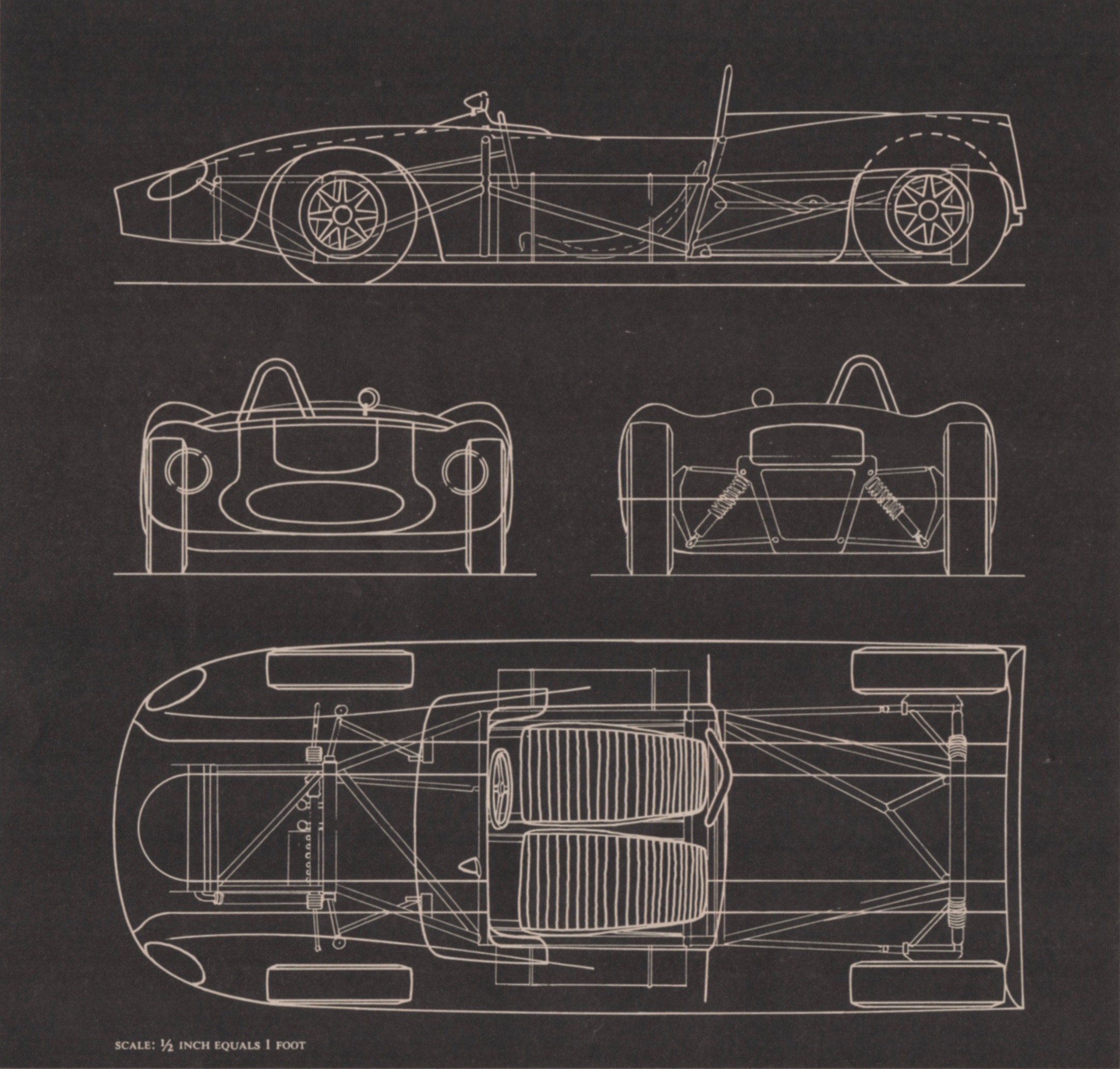
Chassis Design. R&T noted that the Bobsy “follows quite closely the established lines for rear-engined competition sports cars. However, it is distinguished by the extensive use of aluminum in frame and suspension components. In fact, when the car made its first appearance on the West Coast, the aluminum roll bar was queried by the technical inspectors, but notarized specifications for the tubing used dispelled any doubts.”

Track Testing the Bobsy Osca. R&T recounted, “On the track, the car is entirely different from the original Osca [whence its 850-cc powerplant]. Whereas the Osca had a heavy feel so characteristic of Italian competition cars, the Bobsy is exactly the opposite and follows the Lotus/Cooper tradition. The steering is finger-light at speed, and the car will hold its line through a turn without any wheel sawing or other effort on the driver’s part.”
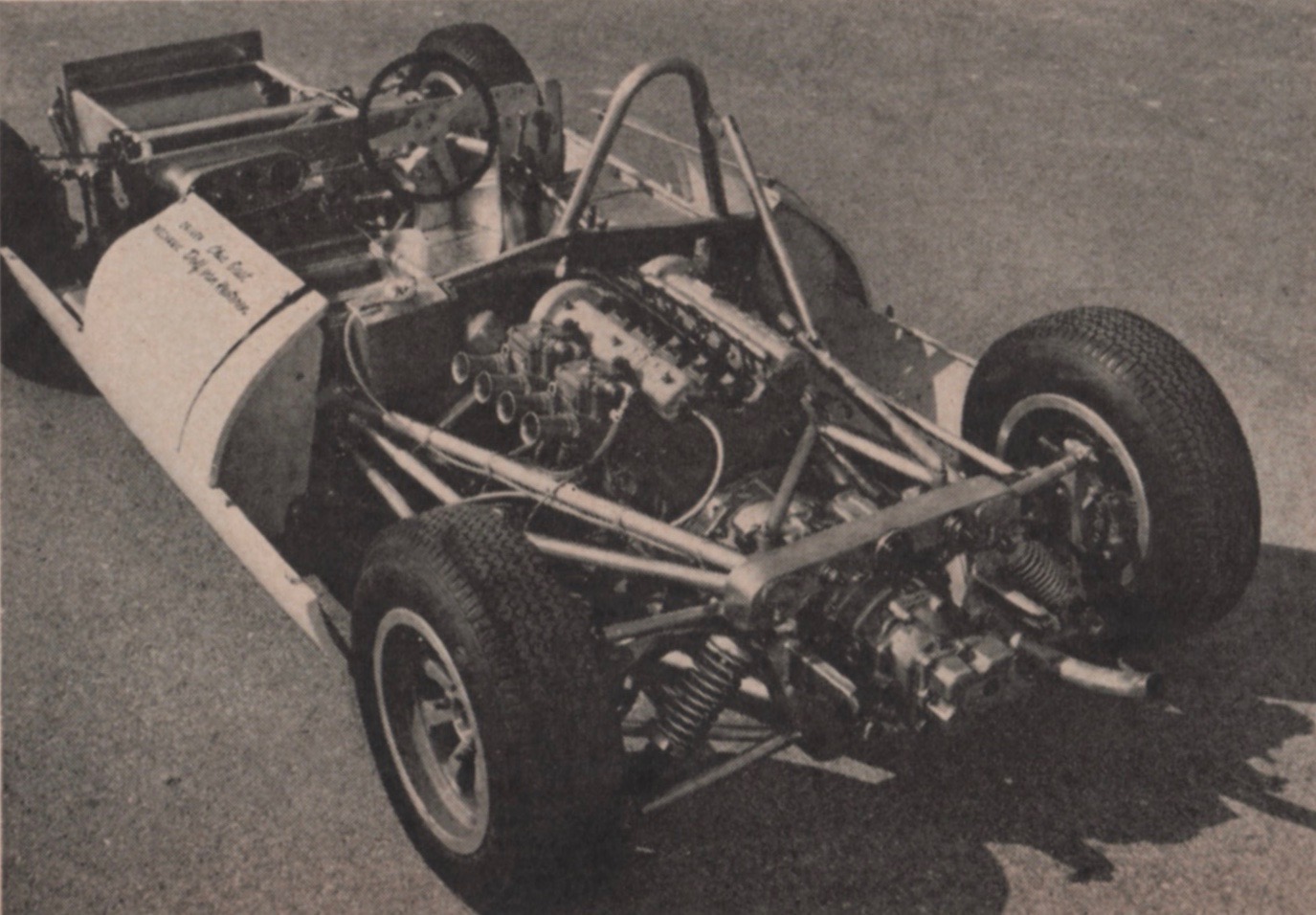
The car carried a Hewland five-speed gearbox hanging aft of the rear-drive centerline. This transmission was renowned for its multiplicity of gearing options with relatively easy refitting for different race circuits.
R&T noted another characteristic (which appears to play a role in my following tale): First gear “makes a good starting gear. As soon as one shifts up to second, first locks itself out, together with reverse.”
Short-geared for Del Mar. Testing took place at the Riverside circuit, a higher-speed circuit than Del Mar, the car’s next venue. “With this gearing,” R&T noted, “the car would reach 101 mph in 5th at 8000 rpm and had to be feathered on the main straight to avoid over-revving.”

The Osca engine’s estimated 85 hp and car’s 1128-lb test weight (with two aboard) gave 0-60 acceleration in 9.3 seconds and quarter-mile results of 84 mph in 17.3 seconds. To put these in perspective, the 289-cu.-in. V-8 Mustang also tested in August 1964 posted 9.0 seconds, 80 mph and 16.5 seconds, respectively.
By contrast, and recalling R&T Wear Index, I can contrast the Bobsy Osca’s 95.3 with the Mustang’s 28.4.
R&T Summary. “Although the Bobsy Osca is one of a kind, it could be reproduced for about $9000. [Figure $89,000 in today’s dollar.] This might seem to be excessive for a class H car, but it is unique and equal to, if not superior to, anything else in its class, and ready to win races from the moment one takes delivery.”
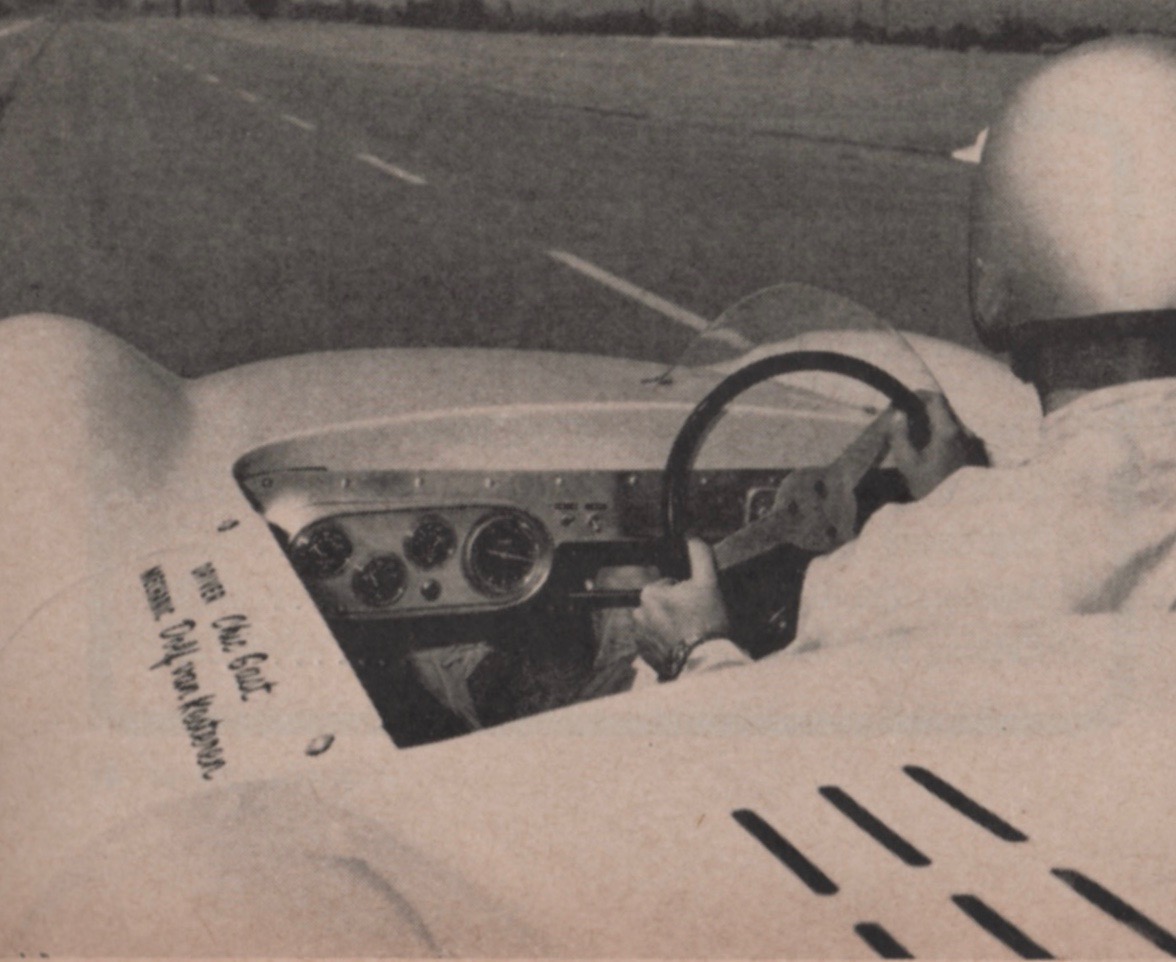
T. King-Hediger’s Bobsy Saab. A successful Porsche 911S pilot, King-Hedinger also tried his hand at H Mod with a Saab-engine Bobsy. I once had the pleasure of crewing for him, with the following tale to relate.
In practice, King-Hedinger managed to spin the car with enough presence of mind to declutch somewhere during this fortunately uneventful exercise so as not to stall the engine. He blipped the Saab’s revs properly as he awaited the course marshal’s signal to reenter the action.
King-Hedinger engaged the Hewland’s 2nd, the car jumped rearward, and the engine stalled.
This he found particularly puzzling. It wasn’t until later when he reflected that the Saab’s two-stroke engine, if inappropriately encouraged, would run backwards, albeit not very well nor for very long.
As they say in Italian, si non e vero, e ben trovato. ds
© Dennis Simanaitis, SimanaitisSays.com, 2023
 Simanaitis Says
Tony King-Hedinger, a name I have not heard for eons. Since you were in Cleveland, did you know my friend Chuck Stoddard?
I certainly knew his name, but never actually met him. I recall his wife Suzy raced too.
Maybe you are thinking of Suzy Dietrich?
Yes. Suzy was active in racing for a long time.
Opps. Slips of Ohio SCCA lore. Thanks for the correx