
Simanaitis Says
On cars, old, new and future; science & technology; vintage airplanes, computer flight simulation of them; Sherlockiana; our English language; travel; and other stuff
AN OLD FRIEND FROM DENVER—THE EAGLEROCK
EACH TIME I CHANGED PLANES IN DENVER, I admired the Alexander Eaglerock. Now I’ve finally got this fetching biplane as a GMax project for Microsoft Flight Simulator. Here are tidbits on the Alexander Eaglerock NC-205Y that adorns Concourse B between Gates B22 and B24 of Denver International.
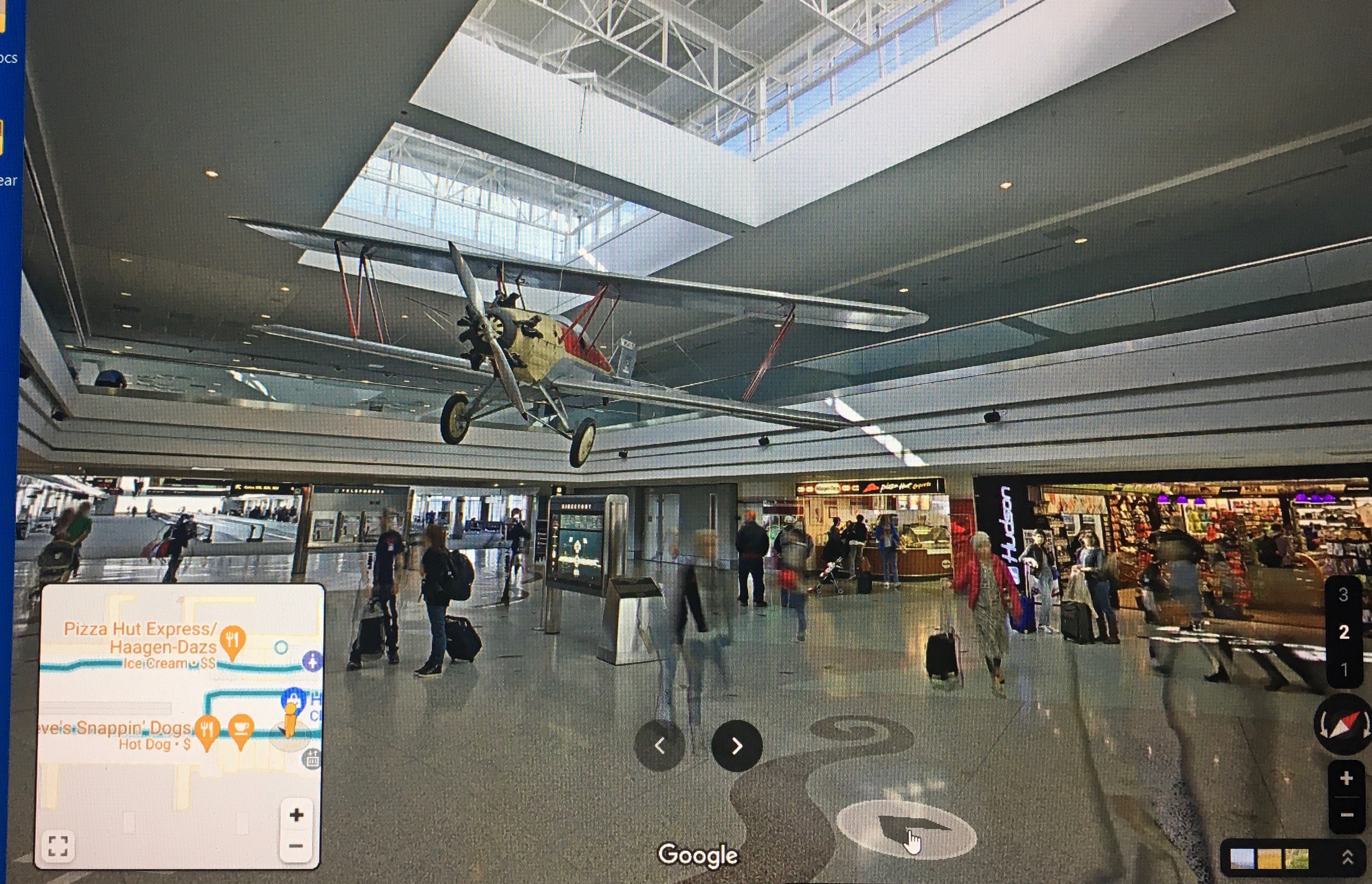
A Local Product. Wikipedia describes, “The Alexander Eaglerock was a biplane produced in the United States in the 1920s by Alexander Aircraft Company of Colorado Springs, Colorado.”

The company was established in 1925 and, briefly, was the world’s largest aircraft manufacturer. It fell to bankruptcy during the Depression in 1932.

A Variety of Eaglerocks. Alexander manufactured 923 aircraft, 893 of which were Eaglerocks, its initial offerings. Wikipedia notes that the Eaglerock “was a fixed-gear three-seater [of which more anon], and was offered in two models, one with a Hispano-Suiza ‘A’ engine of 150 hp (110 kW), priced at US$ 4000, and one with a Wright J-5 Whirlwind, priced at $6500. The Eaglerock was also available fitted with a variety of other engines, of up to 270 hp (200 kW), with prices starting at $2250.” This, figure around $40,000 in today’s dollar.

The “J-5 Motor; (Wright Whirlwind)” is listed with the note “We now have what we believe to be the lowest priced 3-place Whirlwind motored job on the market.”
Some Confusion. First, Wikipedia cites that the Wright Whirlwind family “began with nine-cylinder engines, and later expanded to include five-cylinder and seven-cylinder variants.” And sure enough, there are Whirlwind images displaying nine cylinders (the three-view above, among them) and what sure appears to be five cylinders (NC205Y, for one).

Also, what of this “3-place” claim? Other than swapping its nine cylinders for five, I used the 3-view drawings as definitive. And, though I have no evidence confirming it, the only way I could imagine two passengers in that forward cockpit is to sit them tandem. Alas, I had no way of examining NC205Y’s dual cockpits.

Curiously, I did have a photo of an Eaglerock cockpit, the pilot’s, but its paucity of instruments (magneto switch, altimeter, engine rpm, and fuel pressure or airspeed?) suggested austerity (“lowest priced”?). By contrast, its cable-actuated rudder pedals were rather elaborately crafted.

By the way, an accompanying photo of the forward cockpit showed a sole instrument scaled 100-300(?). I chose instead to include a glove box containing a spare set of goggles.
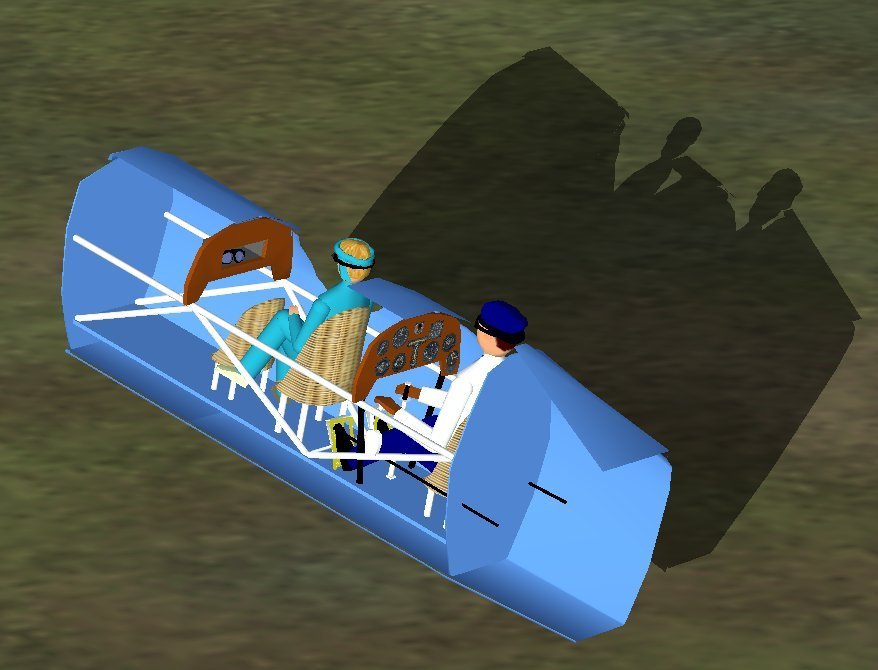
GMax Details. Modeling the Eaglerock was straightforward, one of its challenges being the openings for the Whirlwind’s five cylinders. These are done with Boolean operations, A – B, where A is the nose shape and B is the portion to be excised. Typically, I’ve learned, these have to be done cylinder by cylinder (otherwise, a complex B shape leads to corrupted Boolean operation). Also, cloning a single opening is complicated by aligning its surfaces with existing ones.

I use Brooklands’ grass field in setting contact points. But, of course, buzzing Denver’s Concourse B was de rigueur. ds
© Dennis Simanaitis, SimanaitisSays.com, 2023
 Simanaitis Says
I have been looking fro a smaller wood propeller for wall art. Where would I look?Might put it on the wall next to the Morgan grill covered with badges.John
A neat idea. Apart from the usual online sources, I’d call small local airports. And maybe hobby outlets for a large RC model prop.
My thought is that the forward cockpit normally carried just a single passenger, but Eaglerocks could carry two side-by-side if conditions (such as engine power, passenger weight, density altitude, etc) were favorable. The fore-and-aft openings don’t seem any longer than the pilot’s, and your GMax model has deeper cutouts for easier passenger access and elbow room.
https://thejivebombers.files.wordpress.com/2023/07/img591.jpg?w=499&h=&zoom=2
https://www.facebook.com/colahs/
Any chance of giving your fans a list of your GMax inventory?
Hello, Andrew,
Thanks for your thoughts. I too considered a single bench maybe cabable of squeezing two people. Indeed, the forward cockpit opening is wider/deeper than the pilot’s, as shown on NC205Y. Had I seen your attached tandem pics, I would have opted for the bench. Instead, I got seduced by my single wicker seat for pal Viola.
I’ll post a list of GMax planes here, later today likely.
How long typically does one of these G-Max models take?
Hi, Sabresoftware,
About a month of time-gobbling hobby time for the Eaglerock. Other complex ones, the Curtiss Condor, for instance, perhaps twice that.
How much time-gobbling per day? A couple, three, four hours. It goes by without notice.
I had the best intentions of linking all of my GMax/Microsoft Flight Sim models here, but Gad!, Googling Simanaitis Computer Flight Sim raises 26 of them. Some of the earlier ones mentioned are the 1911 Tatin-Paulin and several Blériots. Two non-plane GMaxs include the Otto Four-Stroke and Schmid land-speed-record car. Real oddities include Bel Geddes airliner and Blériot 125 and De La Meurthe. All in good fun.
I was going to suggest the Dragon Rapide until I found out you’d already built one many moons ago.
I’d be inclined to go sight-seeing in a Santos-Dumont Demoiselle. With GMax, there’d be no hot fluids dripping on me from the engine.
When “building” your digital models, do you compensate their estimated performance for altitude?
In a word, no. The GMax models are geometric ones. Microsoft Flight Sim has complex flight simulation in which one can assign dynamics of an existing fs model. For example, there’s a Curtiss Jenny as a default MSFS model (with, by the way, stunningly good geometric details). Its “.air file” fits just about any biplane of the era. By changes in wgt, cg, hp, and aircraft geometry (wing area, frontal area, etc), you can fine-tune flight dynamics. Other entries in the plane’s .cfg file can adjust top speed, induced drag, etc, to fit the modeled plane’s specs. MSFS has no doubt incorporated air density/altitude adjustments in aspects beyond my ken.
By the way, I once offered a brief tutorial on building a flying brick. That is, a GMax rectangle endowed with whatever flight dynamics one might want. Cessna.
Boeing. Or Wright. All in good fun.