
Simanaitis Says
On cars, old, new and future; science & technology; vintage airplanes, computer flight simulation of them; Sherlockiana; our English language; travel; and other stuff
TANDEM SOLAR CELLS OPTIMIZE THE SUN’S PHOTONS
A NEW GENERATION OF SOLAR-CELL ELECTRICITY can profit from more of the sun’s energy spectrum, as described in “Tandems Have The Power,” by Stefaan Wolf and Erkan Aydin in AAAS Science, July 3, 2023. “Perovskite-silicon tandem solar cells,” they write, “break the 30% efficiency threshold.” Here are tidbits on this achievement, together with my usual Internet sleuthing.

Photovoltaics. The U.S. Energy Information Agency offers a primer in “Solar Explained—Photovoltaics and Electricity.” Briefly, “Sunlight is composed of photons, or particles of solar energy. These photons contain varying amounts of energy that correspond to the different wavelengths of the solar spectrum. When photons strike a PV cell, they may reflect off the cell, pass through the cell, or be absorbed by the semiconductor material. Only the absorbed photons provide energy to generate electricity.”
These latest solar cell designs absorb a greater variety of photons and gain efficiency by doing so.

History. Wikipedia says, “The photovoltaic effect was experimentally demonstrated first by French physicist Edmond Becquerel. In 1839, at age 19, he built the world’s first photovoltaic cell in his father’s laboratory…. In 1883 Charles Fritts built the first solid state photovoltaic cell by coating the semiconductor selenium with a thin layer of gold to form the junctions; the device was only around 1% efficient.”
Wikipedia cites other milestones including 1888 when Russian physicist Aleksandr Stoletov built the first cell based on the outer photoelectric effect discovered by Heinrich Hertz in 1887. And in 1905 when Albert Einstein proposed a new quantum theory of light and explained the photoelectric effect in a landmark paper, for which he received the Nobel Prize in Physics in 1921.”
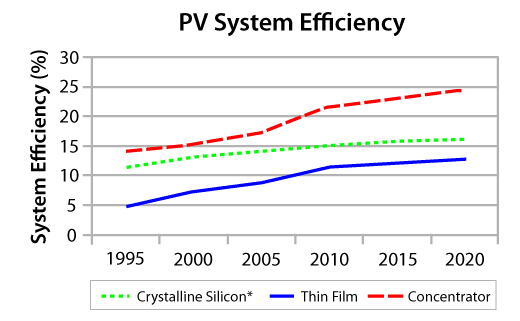
Photovoltaic Efficiencies. Lafayette College describes, “Early silicon solar photovoltaic cells did not, however, have good efficiency.… In 1955, Hoffman Electronics-Semiconductor Division introduced photovoltaic products with only a 2% efficiency, with an energy cost of $1,785/Watt (USD). In 1957, Hoffman Electronics were able to introduce cells with an increased efficiency, at 8%. The same company’s solar cell efficiency was increased to 9% in 1958 and 10% in 1959. The efficiency skyrocketed to 14% in 1960. In 1985, researchers at University of New South Wales, Australia were able to construct a solar cell that has over 20% efficiency. A 20% efficiency solar cell was patented in 1992.”

Tandem Solar Cell Structures. Wolf and Aydin describe in Science, “A tandem solar cell consists of a silicon bottom cell and a perovskite top cell. Perovskite absorbs blue light (high-energy photons) best, whereas silicon absorbs red light (low-energy photons). This combination maximizes the capture and conversion of sunlight into electricity more efficiently than that by single-cell types (single-junction solar cell).”
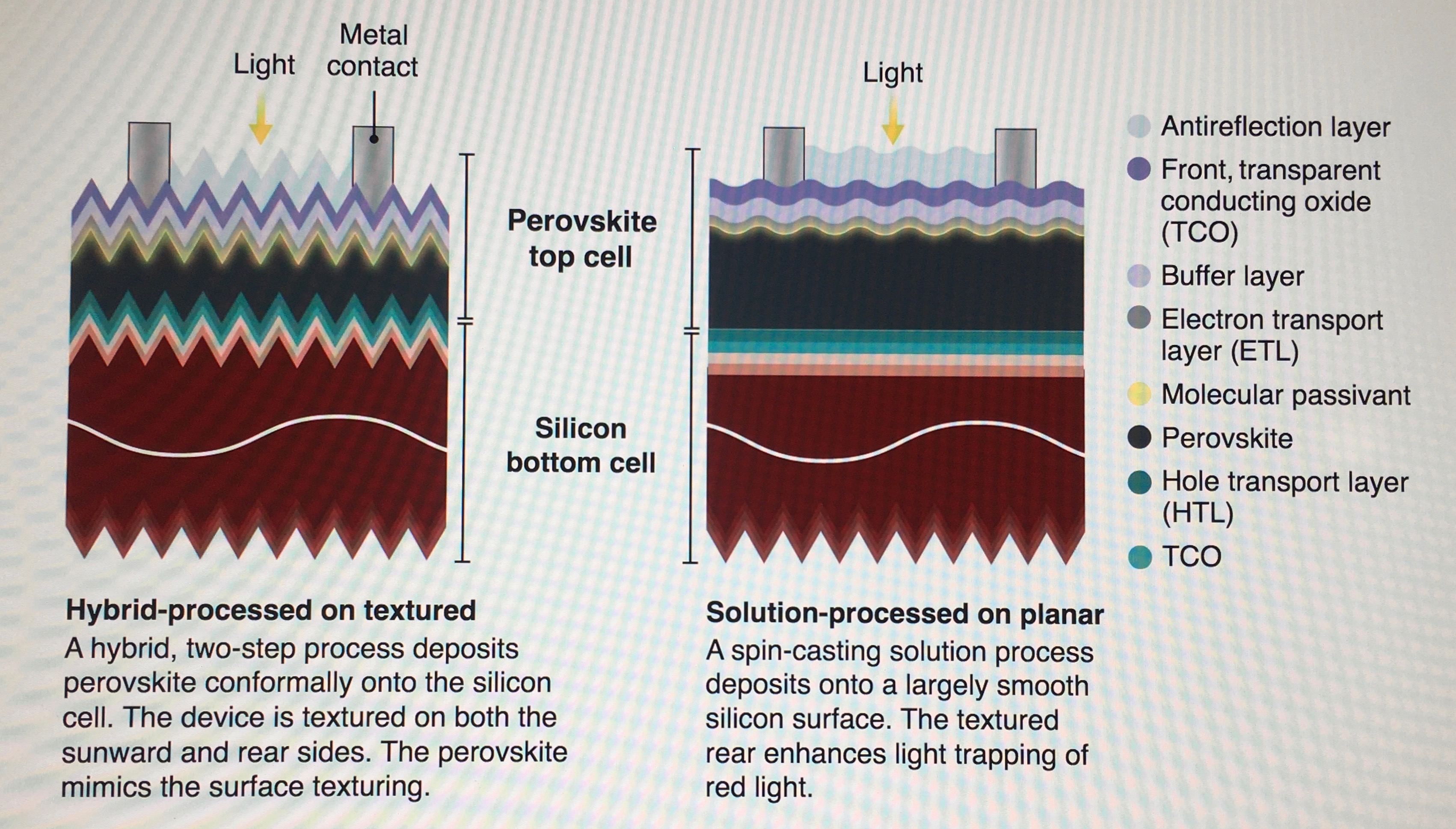
Wolf and Aydin note, “Contact layers are required to extract current from the tandem and need to be engineered toward maximal light-incoupling and minimal charge losses. Two new fabrication methods achieve cells with a power conversion efficiency of >30%. Both position a molecular passivant at the perovskite-electron transport layer interface of the front contact, minimizing charge recombination.”
Silicon Limits. To put these in perspective, Science observes that “Modern commercial silicon solar cells now reach PCEs [Power Conversion Efficiencies] >24%, and the best laboratory cell has a PCE of 26.8%…. However, with a maximum theoretical PCE of 29.4%, practical performance limits for a single-junction silicon PV (a solar cell made from a silicon wafer as light absorber) are in sight.”
Tandem Research To Come. Wolf and Eydin note, “As next steps, it remains important to further improve the performance of perovskite-silicon tandems that could achieve a PCE well above 35%. At the same time, focus is needed on improving device reliability. Arguably, the most critical factor lies in the annual degradation rate under actual outdoor conditions, which for perovskite-silicon tandems remains largely unknown. To be commercially viable, this degradation rate should be on par with mainstream PV technologies, which is less than 1% relative per year.”
There’s the matter of upscaling as well: Science recounts, “Notably, a certified record PCE of 28.6% for a commercial-sized device was recently announced by Oxford PV. To be market competitive, in a high-throughput environment (manufacturing thousands of devices per hour), scaled tandems likely should show a net PCE benefit of at least 3% absolute on average, compared with the best commercial silicon cells (which is a continuously moving target).”
Science is never over. And occasionally it’s an out-and-out competition. ds
© Dennis Simanaitis, SimanaitisSays.com, 2023
 Simanaitis Says
This post filled in an information gap I’d been having. A local weather station measures incoming solar radiation. Peak mid-day readings on a sunny day are about 500 W/m^2 in the winter, and 1,100 in the summer. I could never figure out why homeowners installed such large arrays of solar panels, but the PCE figures your sources provided explain why — only about a fifth of the sunlight is getting converted.
Dennis, five years ago we put 40 solar cells on the barn roof. Put a large heat exchanger in the pond next to the 200+ year old federal house.In the cellar a large heat pump with air condition was installed. Uncle Sam helped pay for it. No problems except when the power company voltage varies, it can turn off the cells.Highly recommend it.John McNulty