
Simanaitis Says
On cars, old, new and future; science & technology; vintage airplanes, computer flight simulation of them; Sherlockiana; our English language; travel; and other stuff
FILLING OUT FORMS PART 2
YESTERDAY, LONDON REVIEW OF BOOKS contributor Jonathan Sawday introduced us to filling out form A. 2042. Today in Part 2, we learn more of this and other bumf in Brit WWI correspondence (the meaning of “bumf” too).
2042 Origins. “The first printing of A. 2042, in 1914, ran to a million copies,” Sawday writes. “It appeared not just in English, but in Hindi, Urdu and Punjabi. Later, it was adopted for the use of American soldiers. As is almost always the case with blank forms, we don’t know who its author or authors were. But its language was carefully crafted. A. 2042 was trying to ventriloquise all ranks of the British army, as well as soldiers from Canada, Australia, South Africa and New Zealand. The tone is relatively classless, though the rather archaic-sounding ‘am going on well’ hints at the colloquial.”
Classless, But…. Sawday observes, “One series of forms, B. 104, was sent to the next of kin of soldiers who had been reported sick, wounded, missing or killed. The families of officers killed in action were notified by telegram; but for the families of enlisted men death arrived more slowly, via a copy of B. 104-82, entitled ‘Notification of Death’ and sent in the post.”

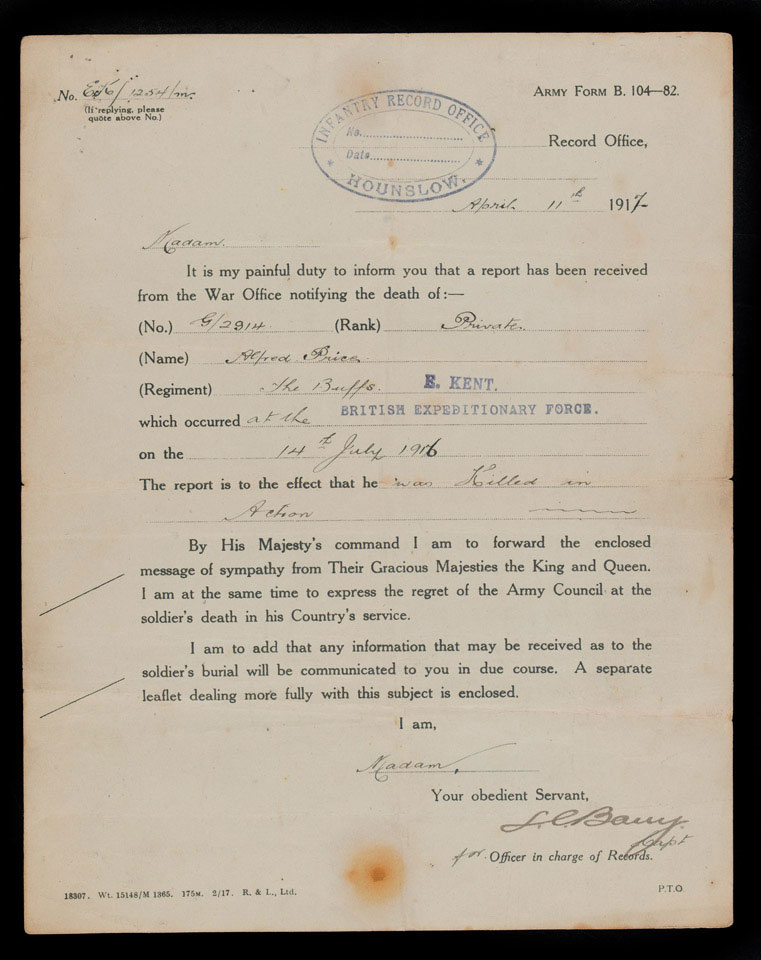
Kipling the Author. Sawday describes, “B. 104-82 was designed to be sent with an ‘enclosed message of sympathy from their Gracious Majesties the King and Queen’. The message’s wording was chosen by Rudyard Kipling and the secretary of state for war, Lord Derby.
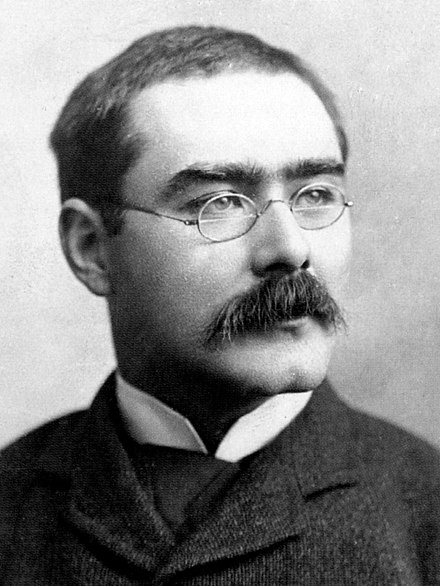
“Kipling,” Sawday says, “wanted to use a form letter with blank spaces, allowing for what he termed ‘M. S. interpolation’, but the proposal was vetoed by Derby on practical grounds. Thwarted, Kipling agonised over the precise shades of meaning the message should convey, writing to Derby on 8 December 1917 that the phrase ‘the country’s service’ was ‘too impersonal for people new to this sense of loss’, whereas using the words ‘his country’ or ‘our country’ ‘brings everyone into the family as it were’ – Kipling’s only son, John, had been posted missing in September 1915.”
Forms Galore. Military paperwork grew, as Sawday notes: “In 1914 the British Expeditionary Force in France set up the Base Stationery Depot, staffed by nine enlisted men led by a junior officer and tasked with distributing logistical paperwork. But as the Western Front fell into stalemate, the volume of printed material needed by the army grew hugely, leading to the establishment of the Army Printing and Stationery Service, or APSS. By the end of the war the APSS was the size of a battalion, mustering nearly a thousand personnel and commanded by a lieutenant colonel.”
Sawday continues, “The section listing army forms in the Classified List and Alphabetical Index of Army Forms and Books (1917) ran to well over a hundred dense pages.… Every day, a front-line unit had to submit multiple reports to its brigade headquarters. At dawn there was a situation and wind report (wind direction was important if gas was being deployed), followed by a strength and casualty return, and an artillery intelligence report. These had to be delivered by 11 a.m. In the afternoon, a further situation and wind report was required, as well as an intelligence report. The day’s paperwork ended in the late evening when a request for the next day’s supply of materials for trench maintenance and construction was submitted. Each of these reports or requests had to be written or typed on the correct blank form.”
Sawday notes, “… there was even a form reminding you to fill in a form: ‘C. 347-1 Reminder, the reply to _______ not having been received’. Commanding officers began to wilt under the barrage: ‘ “Curse all paper” is the fervent cry of every CO out here,’ a battalion commander wrote to his wife in December 1916, and a month later, ‘the Bumf blizzard has commenced to blow in earnest. I have about 5 hours work in front of me answering papers.’ ”
“Bumf,” by the way, as in “bum fodder,” is Brit slang for toilet paper. ds
© Dennis Simanaitis, SimanaitisSays.com, 2023
 Simanaitis Says
Reminds me of a definition I once heard for the ultimate bureaucracy:
“When you spend all your time writing reports explaining why you are getting nothing done”.
Parkinson’s Law is the old adage that work expands to fill the time allotted for its completion. The term was first coined by Cyril Northcote Parkinson, which he had formulated while in the military. He was part of a four man administrative team that was just swamped with work when they learned that one team member was being posted elsewhere. They feared that they would be unable to cope, but found that somehow the workload eased a little. Then another member was transferred out, and again the workload eased further. In the end when he was the only one left there was almost no work to do and he realized that a lot of the work that they had been doing was generated internally within the team.
Apparently asking too much for the War Office to consult also with Siegried Sassoon, Wilfred Owen, Robert Graves.
Touching to see the letter notice of the enlisted man’s death. My grandfather was the subject of such a letter. I don’t even know his name!
Hope you are thriving, Dennis!
Hello, Frank,
Not badly, what with time-gobbling website and GMax. —Dennis