
Simanaitis Says
On cars, old, new and future; science & technology; vintage airplanes, computer flight simulation of them; Sherlockiana; our English language; travel; and other stuff
AIRMAIL TIDBITS PART 2
YESTERDAY WE CELEBRATED the first U.S. airmail. Today in Part 2, a pilot named Lindbergh (yes, that Lindbergh) practices his expertise prior to a considerably longer flight. And others of his trade in the Twenties do just fine economically.
Whence the “Spirit of St. Louis.” The Postal Service recounts, “Before Charles Lindbergh made his record-breaking solo transatlantic flight in 1927, he flew the mail. Lindbergh was the chief pilot for the Robertson Aircraft Corporation, which held the contract to provide airmail service between Chicago and St. Louis beginning April 15, 1926.”

It was on February 2, 1925, that Congress authorized the Postmaster General to contract for airmail service. “By the end of 1926,” the website says, “11 out of 12 contracted airmail routes were operating.”
Postal Pilots Are World’s Best Paid. Chronicle of Flight reported, with dateline USA 1924, “U.S. Post Office airmail pilots, who fly around 60 hours a month on a dangerous job in all weathers and terrain, are undoubtably the best paid in the world. Base pay is from $2000 to $2800 a year (the US average wage is $1300), with increments for experience of up to $3600.”
The CPI Inflation Calculator assesses $3600 in 1924 as equivalent to around $64,400 today. The 1924 U.S. average wage works out to $23,257 today.
Plus Hazard Pay. Chronicle of Flight continued, pilots “are rewarded by the mile, according to the terrain which they have to cover, from 5 cents (flat terrain) to 14 cents (mountains). Four pilots have taken over $4000 in mileage pay alone this year, and one, H.T. Lewis, earned $5582.”
Thus, if at his experience peak, Lewis could have made the equivalent of $164,264 in today’s dollar. However, the Postal Service website observes, “Unpredictable weather, unreliable equipment, and inexperience led to frequent crashes; 34 airmail pilots died from 1918 through 1927. Gradually, through trial and error and personal sacrifice, U.S. Air Mail Service employees developed reliable navigation aids and safety features for planes and pilots.” See “Airways of America—1933” for details on the latter.
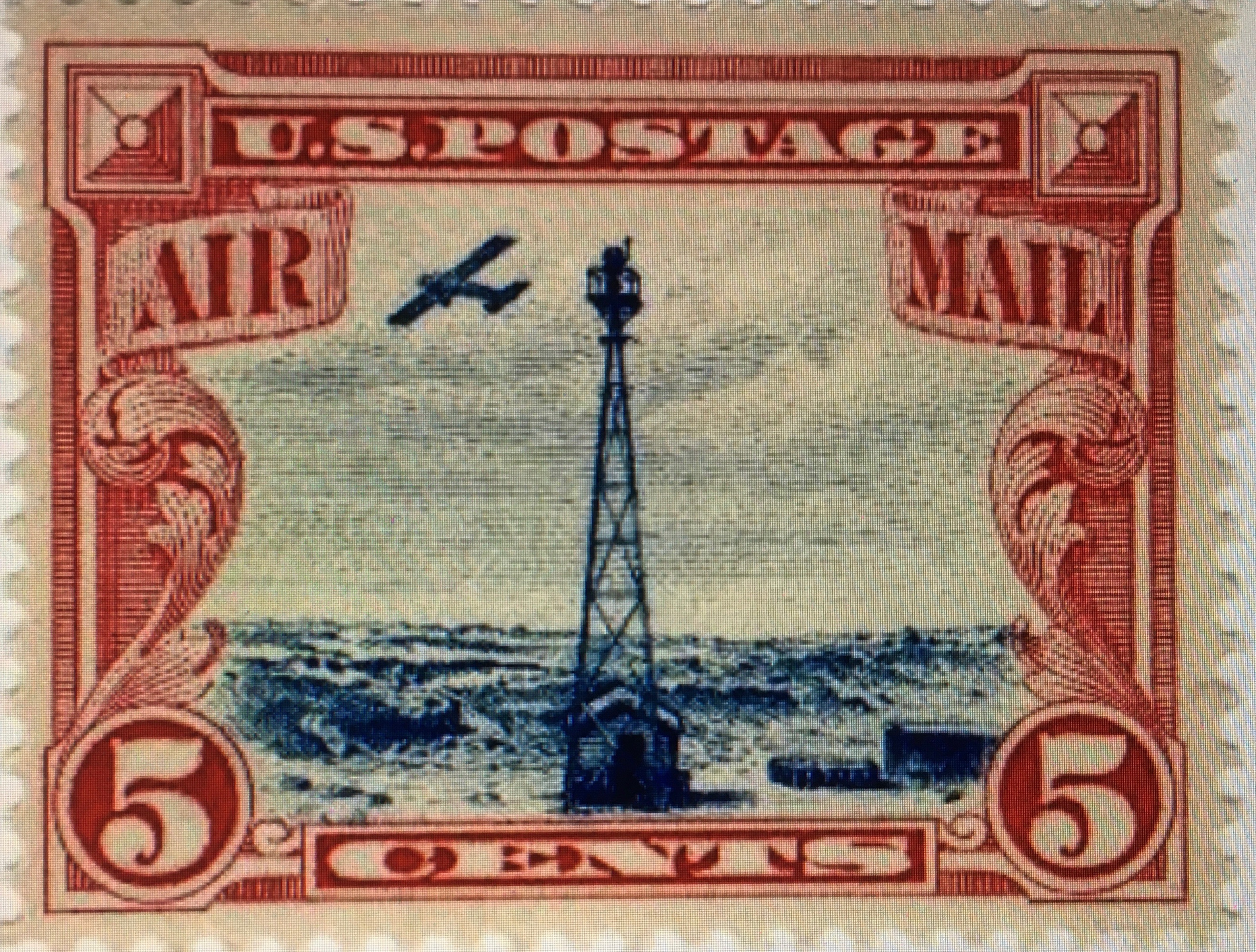
End of an Era. As noted by about.usps.com, “Airmail as a separate class of domestic mail officially ended on May 1, 1977, although in practice it ended in October 1975, when the Postal Service announced that First-Class postage—which was three cents cheaper—would buy the same or better level of service. By then, transportation patterns had changed, and most First-Class letters were already zipping cross-country via airplane. Airmail as a separate class of international mail ended on May 14, 2007, when rates for the international transportation of mail by surface methods were eliminated.” ds
© Dennis Simanaitis, SimanaitisSays.com, 2023
 Simanaitis Says
I do remember those really thin-paper air mail envelopes. How exciting was it to get a letter with that unique border? I knew it was something exotic when I saw the envelope.
Opening an email from across the world just doesn’t have the same thrill. I know it is way more efficient, but it is certainly not as exciting.
My father left me a very large stamp collection. When I was a child around 1955, I was looking for a post card to mail out. Found these neat cards with a bi -plane flying upside down.
Dad was not happy I used his rare “misprint” of the plane.
Ha. Agg. It’s good you didn’t use “some old stamp” to mail it.
We always got letters at Christmas from family in Europe sent by air mail, covered with stickers “Par Avion” & “Mit Luftschiff” though the latter was rare, and not quite correct since the “airships” were long gone by then. Mom had some of those stickers, too, for our letters to them. Things had to be sent air-mail if you wanted them to arrive in less than a couple of months, well into the 1970s.