
Simanaitis Says
On cars, old, new and future; science & technology; vintage airplanes, computer flight simulation of them; Sherlockiana; our English language; travel; and other stuff
ANDERS CELSIUS’S CLEVER IDEA
THE INTERESTING FACTS WEBSITE has the added fun of encouraging further investigation.
For instance, a recent topic was “The Celsius Scale was Originally Backward.” Interesting Facts notes, “Instead of 0 degrees marking the freezing point of water, it instead marked the boiling point, while 100 degrees marked the freezing point. The reason for this arrangement may have been in part to avoid using negative numbers when taking temperature readings. After all, it’s pretty cold in Sweden a majority of the year, and air temperature never gets hot enough to boil water (thank goodness).”

It was Christmas Day 1741 that Celsius, an astronomy prof at Sweden’s Uppsala University, propose this 0-boiling/100-freezing scale. Its use persisted for four years: Interesting Facts observes, “Celsius’ scale, then known as the centigrade (or ‘100-step’) scale, remained this way for the rest of his life, but in 1745—one year after his death—scientist Carl Linnaeus (of taxonomy fame) ordered a thermometer with the scale adjusted to our modern orientation.”
Interesting Facts continues, “Several other scientists also independently reversed the scale. Yet it wasn’t until some two centuries later, in 1948, that the International Bureau of Weights and Measures decided to rename ‘centigrade’ to Celsius, in part to fall in line with the other major temperature scales named after their creators, such as Daniel Fahrenheit and William Thomson, 1st Baron Kelvin.”
Other Temperture Tidbits. Readers of SimanaitisSays may recall “From Waste to Wonder Material,” wherein tidbits were shared about kelvins, degrees Celsius, and degrees Fahrenheit.
Note, in particular, you don’t say there’s a theoretical cessation of molecular action at “0 degrees Kelvin.” It’s just 0 kelvin, the word “degrees” reserved for the other two temperature yardsticks.
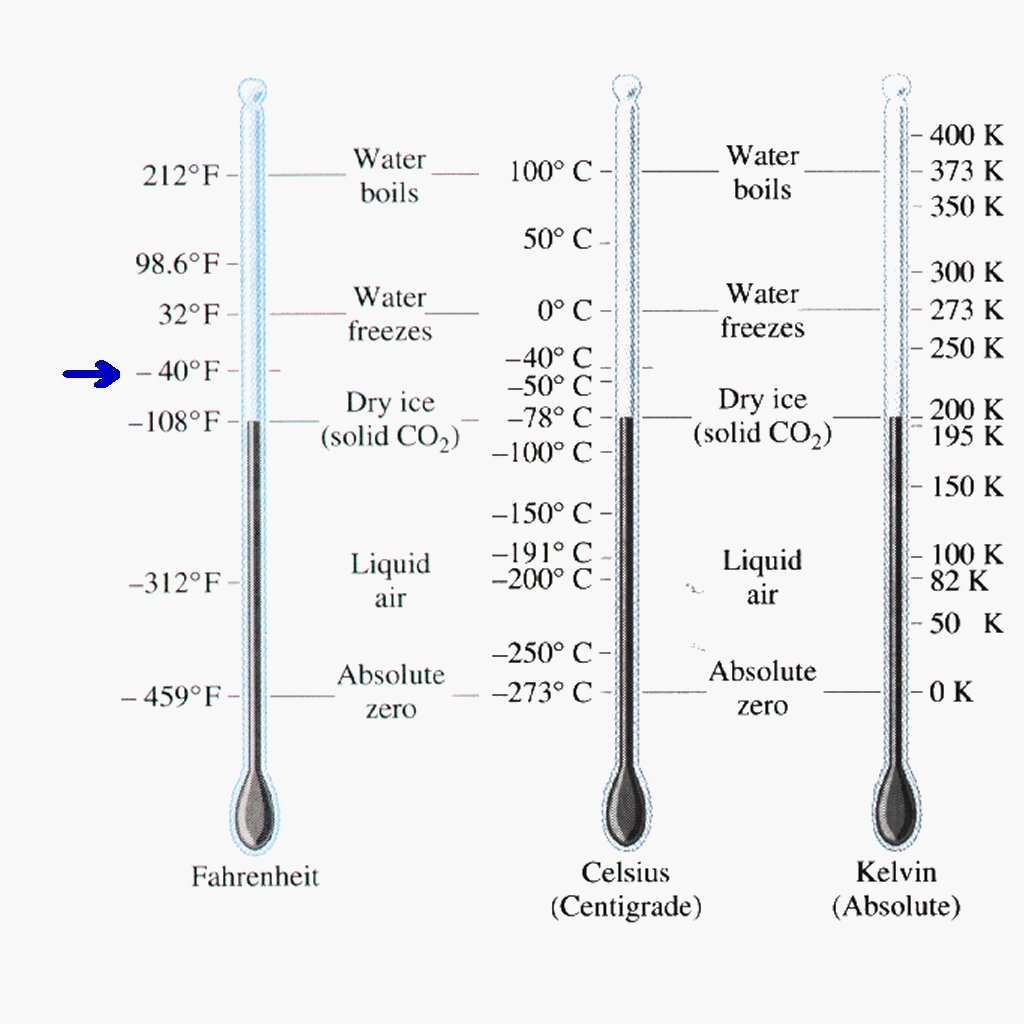
As a memory aid between U.S. preference for Fahrenheit and the rest of the world’s Celsius, I remember that 68-86 degrees F is 20–30 degrees C. (My favorite range of ambient temperatures.)
And, of course, -40º is where F and C agree.
Another Reversed Temperature Measure. Interesting Facts prompted me to research other temperature measures. And, don’t you know, there is at least another reversed one in the sense of hotter corresponding to a smaller reading.
Peter the Great’s Prompting. Wikipedia recounts, “In 1725, French astronomer Joseph-Nicolas Delisle was invited to St. Petersburg by Peter the Great, who was hot indeed on bringing Russia up to scientific standards of western Europe.

“In 1732,” Wikipedia says, “Delisle built a thermometer that used mercury as a working fluid. Delisle chose his scale using the temperature of boiling water as the fixed zero point and measured the contraction of the mercury (with lower temperatures) in hundred-thousandths. Delisle thermometers usually had 2400 or 2700 gradations, appropriate for the winter in St. Petersburg.”
Wikipedia notes, “The Delisle scale is notable as one of the few temperature scales that is inverted from the amount of thermal energy it measures; unlike most other temperature scales, higher measurements in degrees Delisle are colder, while lower measurements are warmer.
Peter the Great had died in 1726, the year after Delisle arrived. Delisle’s thermometer remained in use for almost 100 years in Russia. For other reasons (including gallivanting across Siberia), Delisle had fallen from court favor and left the country in 1747.
Now there’s a tale for more research. ds
© Dennis Simanaitis, SimanaitisSays.com, 2023
 Simanaitis Says
Fascinating post, Dennis. I learn something new from you every day!
Interesting that you remember the 68 – 86 degree F or 20 – 30 degree C range — in my case, I recall learning that if the indoor temperature was 20 – 25 degrees C (68 – 77 degrees F), save on energy and don’t bother turning on the heater or air conditioner.
An interesting transposed number equivalent, 28 degrees C or 82 degrees F, was the sea surface temperature (SST) we monitored for whether a tropical cyclone could gain or lose energy. It was also the SST that we became less worried about a victim in the open sea succumbing to exposure, then being attacked by a shark (species other than the Great White.)
One scale missing – Rankine (John Macquorn Rankine, 1859), the absolute scale for computations in Farenheit. Absolute zero = -459 °F, boiling point = 671 °R.
The most likely shark culprit in open sea attacks is probably the Oceanic Whitetip.
I like Newton’s. “Practical not theoretic.”
It has been a few years since I did thermodynamic calculations (2nd year University – 50 years ago, yikes!), but if you are doing thermodynamic calculations like PxV/T using imperial units and Fahrenheit temperatures, you need to use Rankine for your T value.