
Simanaitis Says
On cars, old, new and future; science & technology; vintage airplanes, computer flight simulation of them; Sherlockiana; our English language; travel; and other stuff
NORWAY—A BEV PARADISE PART 2
YESTERDAY IN PART 1, we learned what Ward, Lock & Co., c. 1930, had to say about Norway. Today, we discuss this Scandinavian country’s love affair with Battery Electric Vehicles.
It’s a case of “I warned you,” but I misjudged the value of subsidies.
Emissions Taxation, VAT, and Other Spiffs. As described in Norsk elbilforening (the Norwegian Electric Car Association), “The Norwegian success story is first and foremost due to a substantial package of incentives developed to promote zero-emission vehicles into the market. The incentives have been gradually introduced by different governments and broad coalitions of parties since the early 1990s to speed up the transition.”
I recognized this coming in “EVs—the Good, the Bad, the Indifferent,” and Norsk elbilforening gives details:
Polluter Pays Principle. “The purchase tax for all new cars with emissions is calculated by a combination of weight, CO2 and NOx emissions. The tax is progressive, making big cars with high emissions very expensive. For the last years, the purchase tax has been adjusted gradually to have more emphasis on emissions and less on weight.”
Like other European countries (France, for instance), a Value Added Tax is also involved. Car purchases in Norway had a flat 25-percent VAT. However, Norsk elbilforening notes, “For a long time EVs have had exemption from both VAT and Norway’s high purchase tax on new cars. As of January 1, the 25-percent VAT exemption on the purchase of new electric vehicles applies only to the first 500,000 Norwegian kroner of the price. From 2023 some purchase tax based on the electric cars’ weight is also introduced.”
Tolls, Ferry Fares, and Parking. The Norwegian Parliament ruled that “counties and municipalities can not charge more than 70% of the price for fossil-fuel cars on toll roads.” Also, ferry fares, municipal parking, and other automotive fees charged to BEVs are capped at half those applied to their fossil-fuel counterparts. Leasing and company-car taxation also had BEV benefits. (These and other EV costs used to be free up to 2017; gradually subsidies are being reduced.)
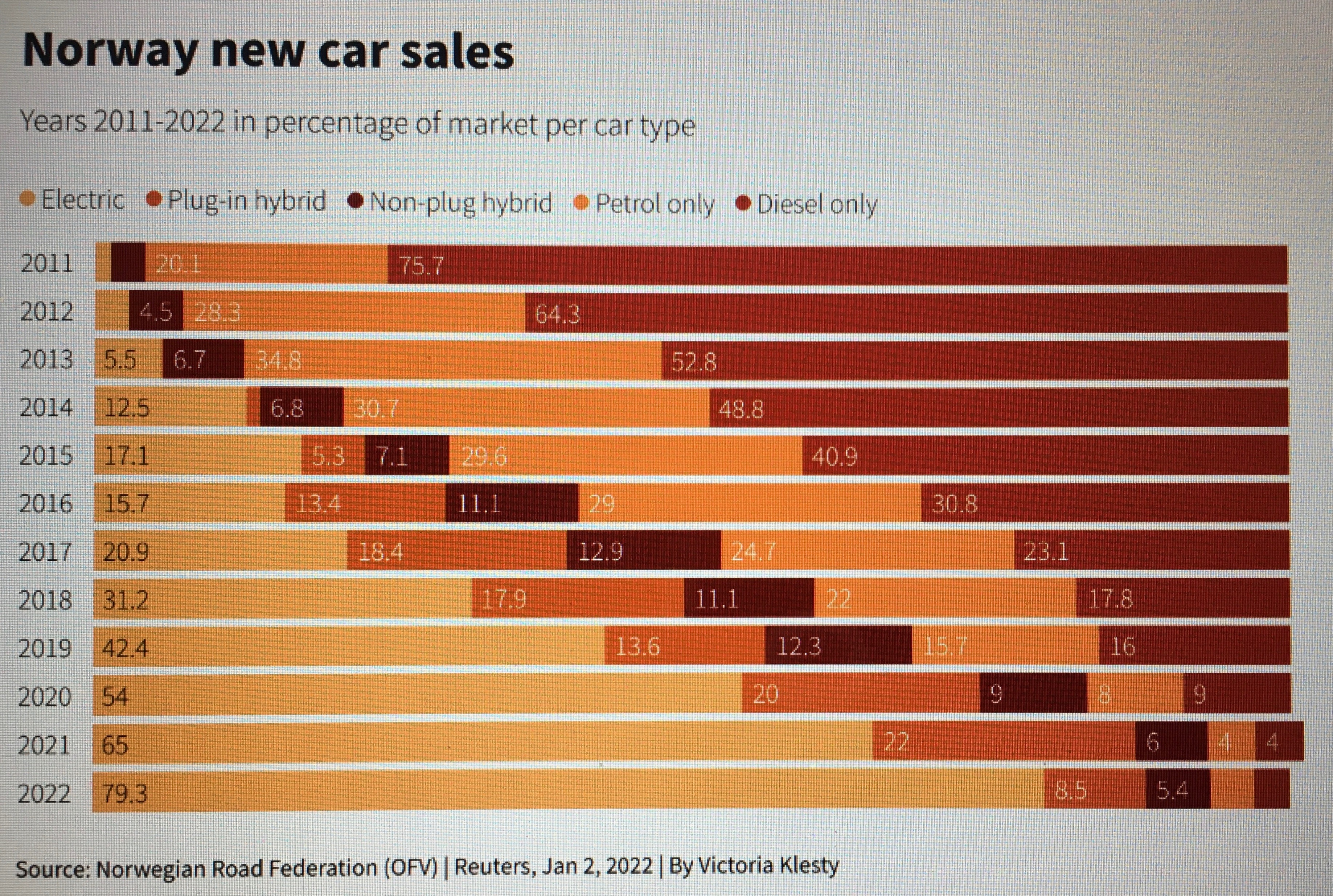
Subsidies Work, But.… Reuters, January 2, 2023, reports that some 79 percent of new car sales in Norway in 2022 were BEVs. However, “some in the industry say new taxes could thwart the country’s goal of becoming the first to end the sale of petrol and diesel automobiles by 2025.”
“While China is by far the biggest car market overall,” Reuters says, “Norway with its 5.5 million inhabitants has achieved the world’s highest proportion of electric vehicles with the help of generous subsidies, making it a proving ground for auto makers launching models.”

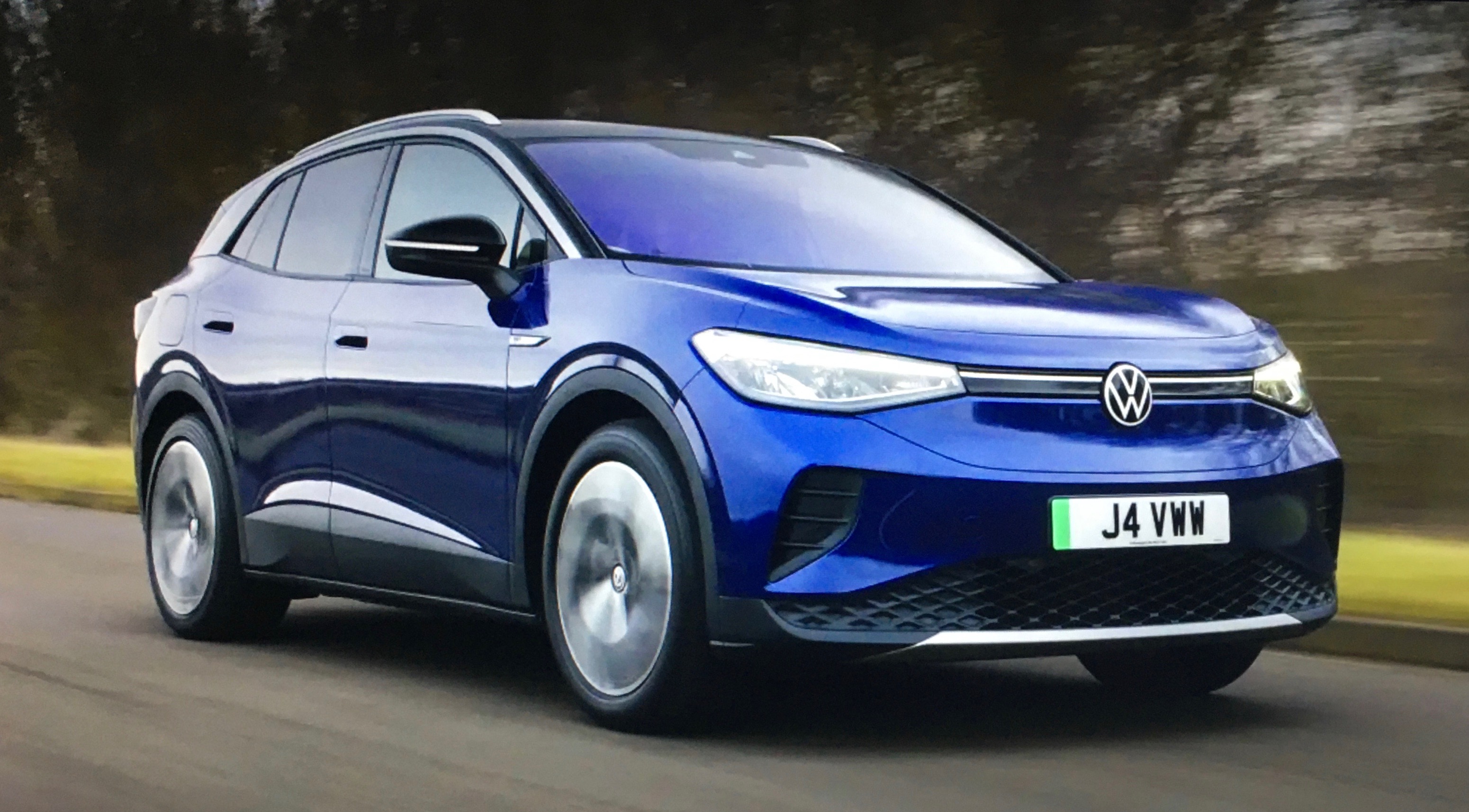
The year 2019 proved significant in new car sales in Norway. With BEVs continuing on the upsurge, Reuters observes, “The Tesla Model Y was the single most popular model of the year, ahead of Volkswagen’s electric ID.4 in second place, and Skoda Enyaq in third.”
The Tesla Model Y compact crossover is assembled in three countries, the U.S. (Fremont, California, and Austin, Texas), China (Shanghai), and Germany (Berlin-Brandenburg).

The VW ID.4, another compact crossover, also has international assembly: Zwickau, Germany; Chattanooga, Tennessee; and Anting and Foshan, China. The Skoda Enyaq is yet another compact crossover, like the ID.4 based on the VW Group’s MEB platform. It’s assembled in Mladá Boleslav, Czech Republic.
Norwegian BEV Tradeoffs. As another sign of internationalism (and of my mea culpa), The Japan Times, February 1, 2023, reports, “Norway’s Arctic Temperatures ‘No Sweat’ for Electric Cars.”

“With temperatures often falling below zero, rugged terrain and long stretches of remote roads,” Pierre-Henry Deshayes writes in The Japan Times, “Norway may not seem like the most ideal place to drive an electric car, with a battery that dies faster in cold weather.”
A point for U.S. readers: The rest of the world’s “below zero” (Celsius) is anything less than our 32 degrees Fahrenheit. Geez, I’ve known guys in Cleveland who play shirts-vs-skins at that balmy temperature.
Deshayes quotes a Finnish consultant Vesa Linja-aho: “But the following rules of thumb apply: a frost of around minus 10 C will reduce the operating range by around a third compared to summer weather, and a severe one (minus 20 C or more) by up to half.”
By the way, -10º C = 14º F; -20º C = -4º F, just below “our” zero. Extra credit: What’s special about -40º?
At any rate, Norway is a counterexample to my earlier fears about BEVs and extremes of temperature. So are Phoenix Teslas. Mea culpa. ds
© Dennis Simanaitis, SimanaitisSays.com, 2023
 Simanaitis Says
I live on Cape Cod and in Boston. I’m looking to buy a BEV around the end of 2024.
Heat pumps (instead of resistance-based heating) in BEVs reduce electrical consumption (by the occupants) in the vehicle (or so I’ve read — without benefit of a detailed analysis) but I suspect the battery-efficiency numbers quoted in your article today (on the BEV paradise in Norway) are related to the temperature of the vehicle’s batteries, not occupant comfort.
What about the impact of battery-powered battery heating? I thought I read something about its use but don’t know whose cars use that scheme and how effective it is (or isn’t) And battery insulation to retain battery heat when air temperatures outside the cars are quite low?
Cheers,
>
-40C = -40F = ******** COLD.
Range loss due to cold weather does bring new meaning to range anxiety out in the wilds though.
I asked a Tesla owner about his winter experience, and he said that he didn’t really have any problems, but cold weather can deplete battery life more than just the natural effects of cold weather as batteries may be engaged when the car is off to keep the batteries warm while parked.
All this talk about battery powered cars .
I had one in 1964, the two ‘D’ cell batteries went dead in a week and that was that, mom said no more batteries nor anything else powered by batteries .
Humph .
It’s raining here, I think I’ll take my 1959 VW Bug survivor for a drive ~ it’s manufacturing carbon foot print is long gone and it actually gets over 30MPG .
Few moderns cars get that no matter what the adverts say .
Yes, yes, I know it’s a death trap, so what ? I’m old and crippled I’ll keep my clean running (.02% C.o and under 400PPM HC) little ‘people’s car’ .
You can have my I.C.E.’s after you’ve pried my cold dead fingers off the steering wheel .
=8-) .
-Nate
Nate, you’re hardly the bad guy. Relax and enjoy your well-fettled old ride.
There are not enough raw materials for the world to swap all ICE (internal combustion) cars for EVs. EVs run on petroleum tires (producing most the dust in urban areas), and use six (6) times as many minerals as i.c. cars, including cobalt, lithium, nickel, copper, manganese, graphite, zinc, rare earths like neodymium, thallium, and dysprosium, the latters’ extraction requiring huge amounts of carcinogens like ammonia, hydrochloric acid, sulfates. Much of these minerals are imported from politically unstable regions. Thallium has been a common ingredient in rat poison. It’s tasteless, odorless, and nearly colorless. While those who tested positive hadn’t consumed poisonous levels of the metal, it was enough to cause fatigue, heart arrhythmia, nausea, digestive trouble, neurological problems, and hair loss. The scariest part is that even after patients completed detoxification regiments, thallium continued to show up in their systems.
“We now know that heavy metals are additive and synergistic,” says David Quid, the lead scientist at Doctors Data, PhD in nutritional biochemistry. “If you get a little thallium, and a little lead, and a little cadmium in your system, you’ve got one plus one plus one equals five or six, not just three.” In other words, these metals do more damage when they’re combined.”This stuff bioaccumulates,” he added. “Down the road, it’s going to kick you in the ass one way or another.”
Just another reason the world’s scientists agree, every poll, that overpopulation remains our by far biggest problem, their words, “bigger than climate.” According to UN and other studies, animals raised for meat and dairy produce more greenhouse gas than all the world’s cars, trucks, buses, trains, planes, ships combined.
Meanwhile, every study not overtly or covertly funded by meat, dairy, egg industry comes to the same conclusion: The single best way to stave heart disease, inflammation, hypertension, cardiovascular ills, high blood pressure, diabetes, cancer, macular degeneration, dementia (now called type 3 diabetes), Alzheimer’s is a plant based, vegan repast. Hasn’t slowed the world’s leading Formula One driver, Lewis Hamilton.
Thanx Mike ;
The real worry is : if there will still be filling stations ~ until the fake gas crisis of the 1970’s they were everywhere and kept prices down .
Now one has to go a ways to find their favorite filling station and $ave $ome $ ~ I usually fill up when near empty and .40 cents / gallon adds up fast .
-Nate