
Simanaitis Says
On cars, old, new and future; science & technology; vintage airplanes, computer flight simulation of them; Sherlockiana; our English language; travel; and other stuff
CROSSWORDS SANS FOREIGN WORDS
I AM a crossword puzzle fan. In moderation, mind; I don’t do them every day, nor in ink. But I enjoy working through the Sunday crosswords (and alternating acrostics) in The New York Times. Its February 7, 2016, issue added to the fun with an article “What Crossword History Says About the Language We Use,” by Charles Kurzman, professor of sociology at the University of North Carolina, Chapel Hill.

This and the following image from The New York Times, February 6, 2016.
Kurzman analyzed all of the NYT crosswords from February 1942, when the feature first ran, through the end of 2015. He devised an algorithm to search all 2,092,375 pairs of clues and answers for place names outside the U.S. and foreign words.
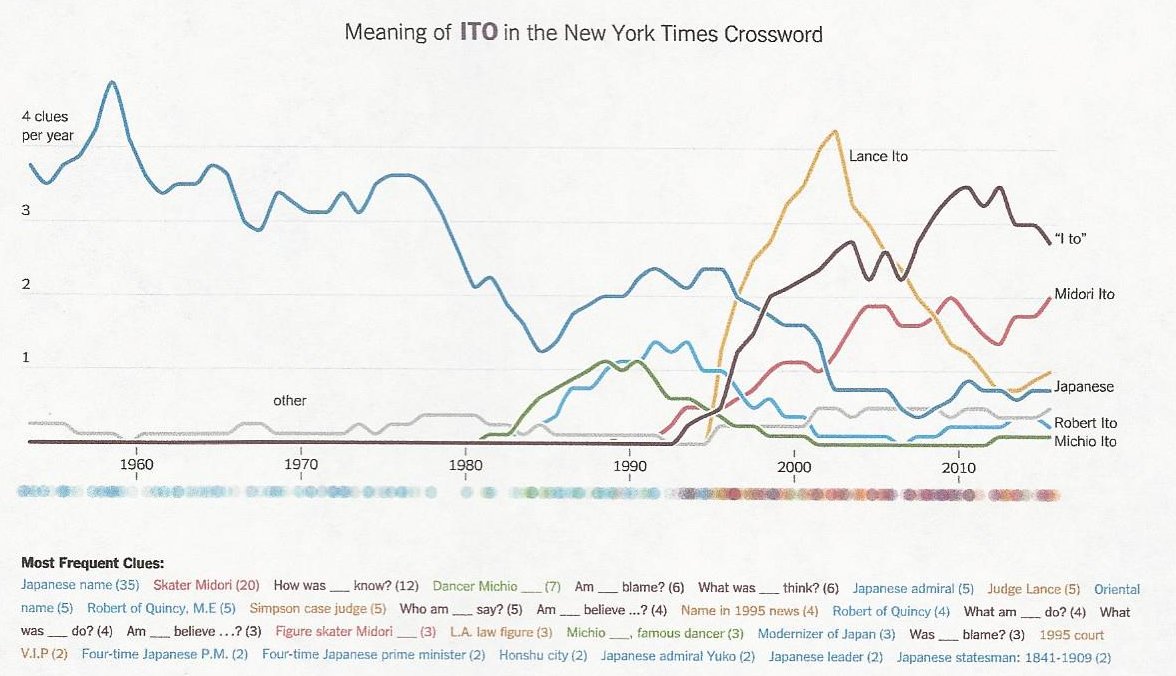
Briefly, Kurzman notes, “The puzzle today uses one-third fewer non-English clues and answers than it did at its peak in 1966, and makes two-thirds fewer international references than its peak in 1943.”
Are we getting less worldly or what?
On the other hand, ethnic foods are faring fine, thanks. Taco first appeared in the NYT crosswords in 1963; sushi, in 1982; dim sum, in 1985. Oddly, churros didn’t appear until 2011. Then again, I’m a Californian and the NYT isn’t.
Kurzman also identified words changing their clues: Hora has evolved from “Latin hour” to “Spanish hour” to “Israeli dance.” He notes as well the evolution of American ken of foreign tongues. French used to be the language of international diplomacy; German was the most common second language in the U.S.; and Latin was taught in schools. However, “Today, six times more Americans speak Spanish than French, and nine times more speak Spanish than German.” And, he claims, nobody knows Latin.
Has use of the vernacular for the Catholic mass done so much to pound the final nail in the coffin of this “dead language”? Don’t pre-law and pre-med curricula still require Latin? (Would “curriculums” be preferred?)
I looked up curriculum and learned it’s Latin for “the course of a race.” It comes from the Latin verb Currere, to run. The word didn’t get its academic meaning, in Latin, until the late 1500s. By 1633, it entered English.
This, in turn, got me thinking about foreign words in languages in general. Japanese is helpful in this regard, in using a distinct set of characters, Katakana, for foreign words. A similar idea is our using italics for foreign words or phrases in English. On the other hand, once English adopts the foreign word as its own, italics become unnecessary.
Wife Dottie is my editress at the website (although she disavows this whenever possible). Her, and usually my, primary authority is Merriam-Webster, specifically the online merriam-webster.com.

I like to think I’m something of a classicist, savoring the occasional italicized foreign word. It’s special fun if the word is in Greek or Cyrillic alphabet or in Japanese characters (thank you, Google Translate).
Some authors assume the reader’s erudition in this regard. For instance, in The Ox on the Roof, English author James Harding writes about 1920s Paris and feels confident that you parlez un peu français. He includes entire quotes of pithy remarks sans translation.
Indeed, as I’ve just done. The word sans is originally French, but has been adopted by no less an Englishman than William Shakespeare: In his Seven Ages of Man soliloquy in As You Like It, Act II, Scene 7, Jaques describes the seventh age as “sans teeth, sans eyes, sans taste, sans everything.”
On a less disheartening note, in Love’s Labour Lost, Act V, Scene 2, Biron romances Rosaline with “My love to thee is sound, sans crack or flaw.” She retorts, “Sans sans, I pray you.”

Biron romances Rosaline, Love’s Labour Lost, Royal Shakespeare Company, 1973. Image from The Annotated Shakespeare: The Comedies, Histories, Sonnets and Other Poems, Tragedies and Romances Complete (Three Volume Set in Slipcase).

Some folks say “sans” is used only rarely in modern English and pompous when it is. Just don’t come complaining to me when the crossword puzzle clue for a four-letter word is “lacking” or “___-culotte.” And, note, as I’m sure Wife Dottie will advise, Merriam-Webster has this latter term for a French Revolution republican radical sans hyphen. ds
© Dennis Simanaitis, SimanaitisSays.com, 2016
 Simanaitis Says
I do two crossword puzzles each weekend, love the foreign words. But I’d love them even if I did no puzzles.