
Simanaitis Says
On cars, old, new and future; science & technology; vintage airplanes, computer flight simulation of them; Sherlockiana; our English language; travel; and other stuff
RUTH LAW—NOT JUST A RECORD-SETTING AVIATRIX
WHEN PIONEER aviatrix Ruth Law Oliver sought to fly from Chicago to New York in 1916, she approached Glenn Curtiss to buy an aircraft capable of traveling such a distance. He is a hero of mine, particularly in his squabble with the Wright Brothers. However, Curtiss was also a man of his time—and apparently something of a male chauvinist. He told Ruth that the plane she wanted “was too much for a girl to handle.”
Harumph! Or whatever a young lady of good upbringing would say in 1916. Not to be dissuaded, Ruth set the record in her old Curtiss pusher, the equivalent of winning the Indy 500 in a Ford Model T.
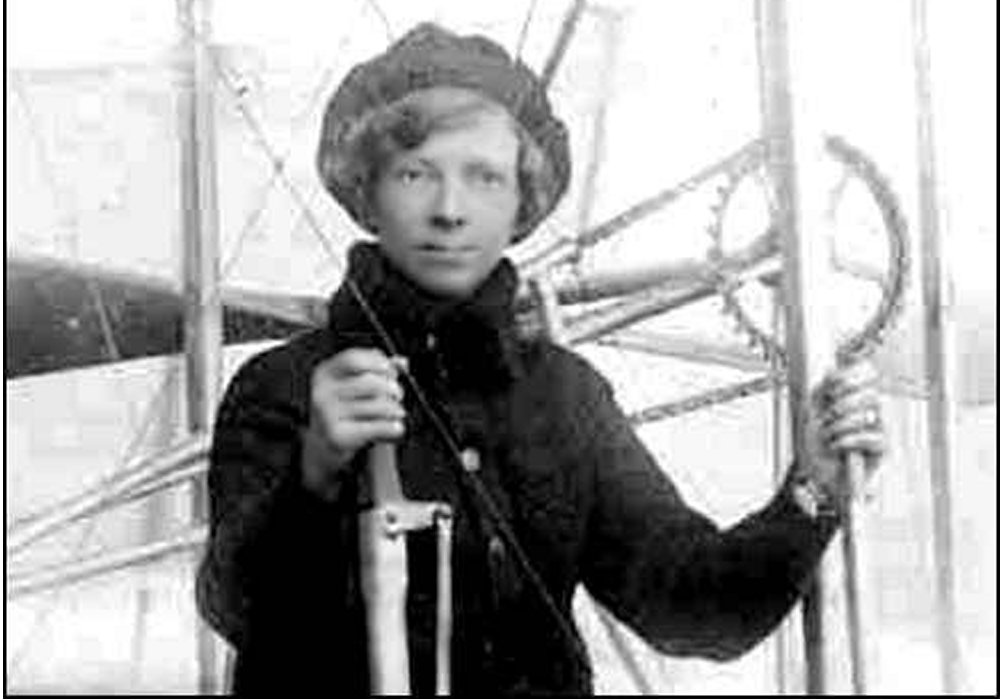
Ruth Law Oliver née Ruth Bancroft Law, 1887 – 1970, American pioneer aviatrix, feminist. Image from Early Aviators.
Ruth Law was that kind of woman. She bought her first aeroplane from no less than Orville Wright. By 1912, she earned Aero Club of America License No. 188. In 1915, Ruth demonstrated “loop the loops” and other aerobatics with her Wright Flyer over Daytona Beach. She also challenged men in contests of aircraft altitude.

Ruth Law and her Wright Flyer on the sands of Daytona Beach, 1915. Image from Florida Center for Instructional Technology.
Cal Rodgers and his Wright Vin Fiz had flown across the country in 1911, but it took him two months, with a number of crashes, to do this. The almost 900 miles from Chicago to New York City in a single 24-hour period seemed impossible, even with the aeronautical advances of five years.
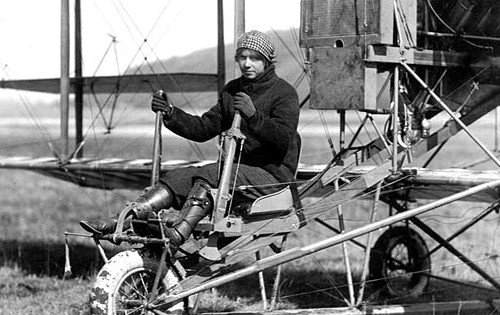
Ruth in her Curtiss pusher, 1915. Image from Area News Group Papers.
Ruth Law just about pulled it off. What’s more, her Curtiss wasn’t an “open cockpit” biplane; it had no cockpit at all. Its pilot sat, exposed to the elements, on a rudimentary seat ahead of the biplane wings.
It was November, but Ruth got used to the cold by sleeping in a tent atop Chicago’s Morrison Hotel. On the flight, she had a face mask, goggles, gauntlets and boots. She wore two woolen suits beneath two layers of leather. Plus, she brought along a skirt to wear over her flying suit in public; she stashed it behind her seat once ready to go.
The Curtiss pusher’s original fuel supply was only 16 gallons, but an extra tank brought the fuel load to 53 gallons, in theory enough for the 900-mile trip.
For directional notes, Ruth devised a scroll chart mounted on rollers, the case strapped to her belt. Thirty-nine years later, Denis Jenkinson used similar route guidance in his 1955 Mille Miglia-winning co-drive with Stirling Moss.
Law’s Chicago departure was delayed by a 55-mph gale. It was so cold the Curtiss engine refused to fire. Finally, on Sunday, November 19, 1916, Ruth rose from Chicago’s Grant Park at 7:25 a.m. local time, 8:25 a.m. at her New York destination. The aircraft’s initial fuel load kept it from exceeding 200 ft.
Ruth and the Curtiss flew non-stop for 590 miles, finally running out of fuel just outside Hornell, New York, south of Rochester in the west-central portion of the state. She glided toward a landing site and touched down at 2:10 p.m. after 5 hours and 45 minutes aloft. Ruth had averaged 103 mph on the trip and set a new American record for non-stop cross-country distance.
Law downed a quick meal, had her Curtiss replenished with fuel and oil. At 3:24 p.m., she left Hornell for New York City, almost 300 miles away. An hour later, Ruth ran out of light and set down in Binghamton, New York. She tied the Curtiss to a tree for the night.
The next morning, Law encountered thick fog and finally picked up the Susquehanna, Delaware and Hudson Rivers on her way to New York City.
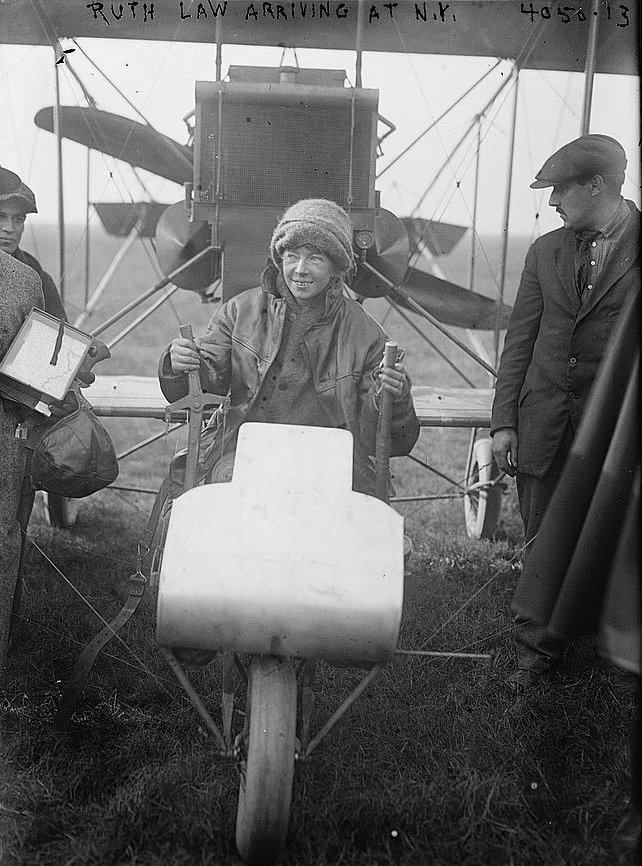
Ruth and her Curtiss in New York City, November 20, 1916.
The Curtiss low on fuel again, she glided and powered its way to the intended Governors Island destination, just south of Manhattan. Ruth set the Curtiss down at 9:37:35 a.m. on Monday, November 20, 1916. She was met by a crowd, including U.S. Army Captain Henry “Hap” Arnold. Her total flight time, in its three stints, for the 884 miles from Chicago to New York City was 8 hours, 55 minutes and 35 seconds.
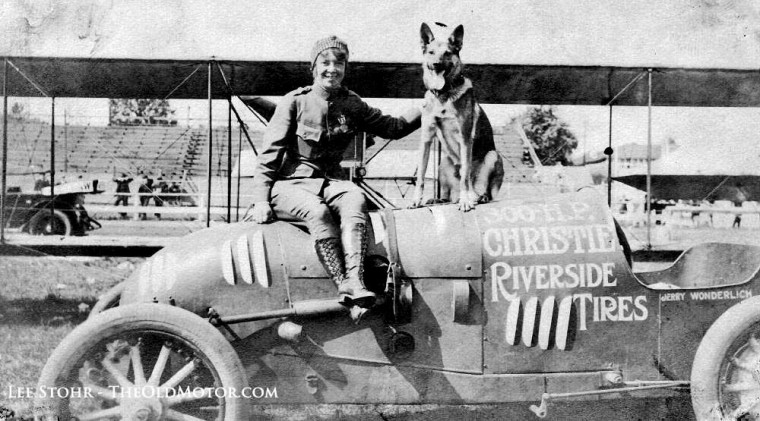
My favorite photo of Ruth Law: with a friend, her biplane and an ex-Oldfield Christie race car. Image from The Old Motor.
A reporter congratulated her, “You have made the longest flight a woman has ever made, haven’t you?”
Ruth replied, “I have made the longest flight an American ever made.” ds
© Dennis Simanaitis, SimanaitisSays.com, 2016
 Simanaitis Says
Always a good read. For this re-read, had to correct you. Ruth Law never called herself an “aviatrix or aviatrice.” She always insisted on being called “aviator” because in the air, all were equal. Check it out for ourself.
Mea culpa. I agree, she certainly seemed that sort of wonderful person.
I answered the comment about Glenn Curtiss in my almost finished bio on Ruth Law. Curtiss wasn’t any kind of a male chauvinist. I sent an inquiry asking if you would like a read. Offer still holds..