
Simanaitis Says
On cars, old, new and future; science & technology; vintage airplanes, computer flight simulation of them; Sherlockiana; our English language; travel; and other stuff
HYBRID VS. GASOLINE VS. DIESEL: TWO SNAFUS
THE RECENT Volkswagen diesel deceit reminded me of a 2010 SAE International presentation of mine that coordinated with an article in R&T. In retrospect, the presentation involved a pair of snafus, one claimed to be accidental at the time, the other only recently coming to light and admittedly duplicitous.
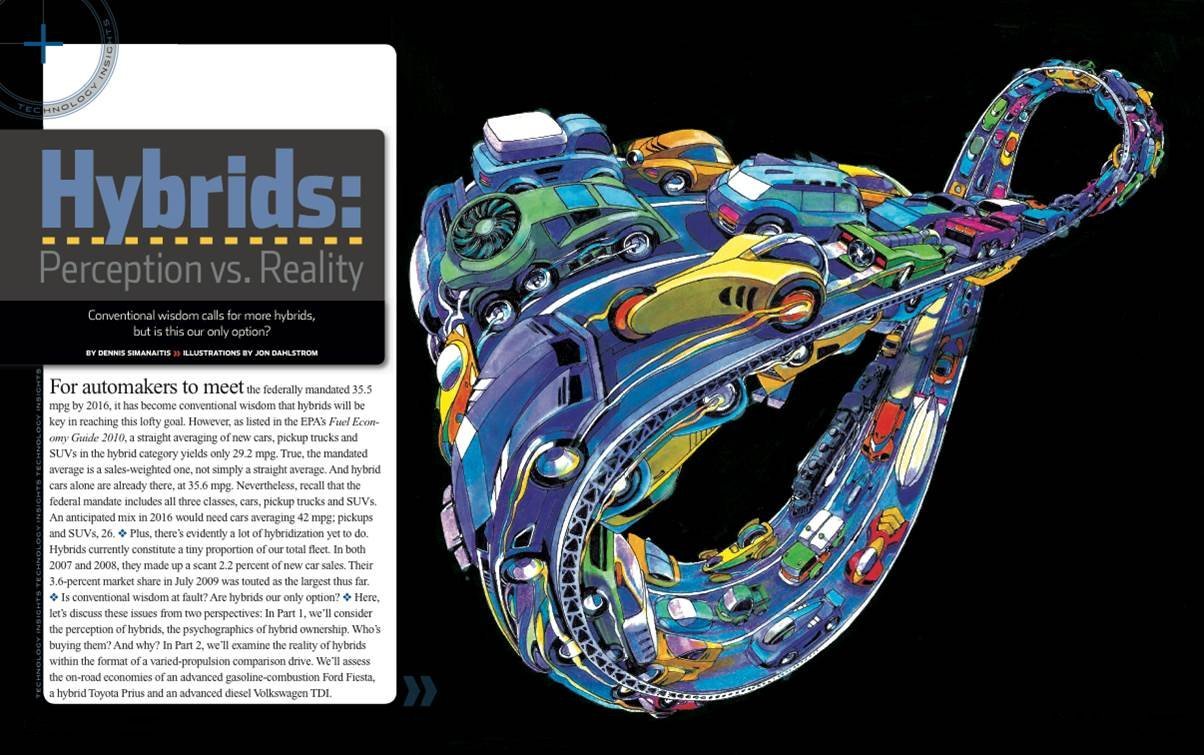
Hybrids: Perception vs. Reality. This and other images from “A Journalist’s Possibly Heretical Comments on Hybrids,” SAE International Hybrid Symposium, San Diego, California, February 2010.
In March 2010, R&T had a multi-part feature, “Hybrids: Perception vs. Reality.” I’ve already commented at this website on the perceptional aspects in “State of the (Hybrid/EV) Union.” There, I cited five groups attracted to alternative-power vehicles: the Firsties, Techies, Greens, Statement Makers and Pencil-Outers. I believe these five curiously disparate groups still exist.

Reality, as experienced in a variety of southern California modes.
As for reality, we took a trio of cars, a gasoline-powered Ford Fiesta, Toyota Prius hybrid and diesel Volkswagen Golf TDI, through eight decidedly different modes of driving.

Three propulsion choices, gasoline, hybrid and diesel, respectively.
There were three suburban stints, easy, sprawl and mixed; “free”ways; a dreaded commute; some canyon carving; the LA4 and back-to-back cruises assessing the influence of air conditioning. By amplification, the LA4 was a test route through downtown Los Angeles. This 7.5-mile figure-eight was designed back in the early 1970s.
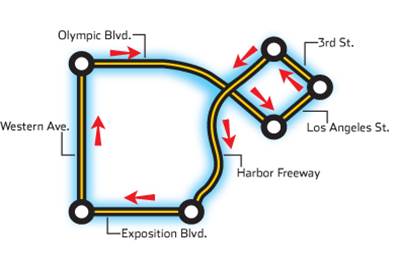
The LA4 through downtown Los Angeles is the granddad of the Environmental Protection Agency’s current City Cycle. A modern one-way street caused a trivial change in our 2010 route.
For measurements of fuel economy, we started with full tanks, had three top-offs during the various phases and used the cars’ on-board monitoring of mpg. A point on this last: Modern electronic Engine Control Units keep track of fuel usage with more accuracy than anything short of lab-calibrated beaker replenishments, so we understood this was the best approach.
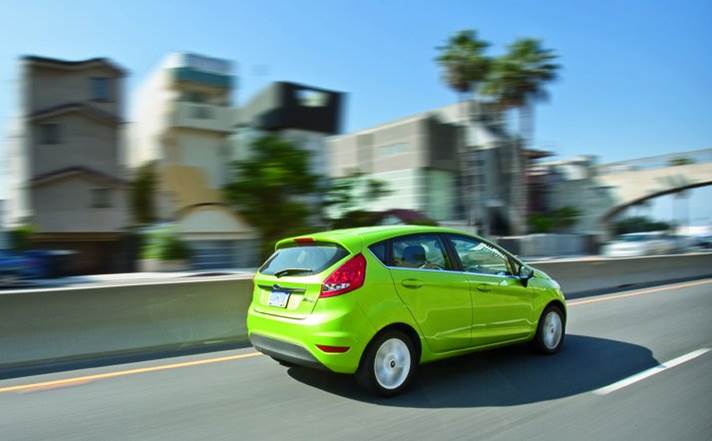
Our Fiesta’s trip computer gave us optimistic mpg readings….
We later discovered Snafu No. 1: Our Fiesta was an early 2011 model, borrowed from Ford as part of a nationwide Fiesta demonstration program. After the March 2010 R&T feature appeared, we were informed that the Fiesta’s trip computer and hence mpg readout were calibrated in Imperial gallons. That is, our initially published Fiesta mpgs were 20 percent better than U.S. mpg reality. By the time of my SAE presentation in February 2010 and in the April 2010 R&T Letters column, we corrected the Fiesta’s fuel economy.

Advanced gasoline vs. hybrid vs. advanced diesel, corrected data for the Ford Fiesta.
Snafu No. 2 concerns the VW Golf TDI. Being a 2010 model, it would have carried the recently acknowledged VW scam of its on/off NOX control, depending upon whether the car was being emissions tested or driven in the real world. To some extent—still unknown—the reality-driven VW was delivering better than “clean diesel” mpg and performance. ds
© Dennis Simanaitis, SimanaitisSays.com, 2015
 Simanaitis Says
Just a thought – would the TDI have been using test settings in your downtown tour, possibly recognizing it as something close to a dyno session? Could that be why its fuel economy was so bad (compared to the other segments) there? Given the Fiesta’s numbers, I would have expected the downtown mileage for the TDI to be a bit higher – maybe 34 or 35 mpg.
I do think you got a tweaked Prius, though. We have a 2007 (Gen 2), which in real world freeway driving (OK, keeping up with traffic not running in “road boulder” mode) gets 42-45, and 45-47 in suburban driving. Best ever was just barely 50 in some downtown stop and go with windows open and a/c off. So seeing 50 in downtown LA is possible, in economy-run mode, but well over 60 in the suburbs and high 50s on the freeway just doesn’t compute.
A true suburban “drive cycle” would have nearly every acceleration at full power from 0-50 or so, with a stop every 1/4-1/2 mile and 1-3 minutes of idle, plus some parking lot running and maybe a 10-mile freeway spurt. Where I live, the arterial speed limits are between 40-50, with hills, but average trip speeds during the day are around 15 mph; have fun designing the test cycle. Most cars in that situation, driven normally with a/c on, get at least 10% less than the city rating, including the Prius. Yes, I know, you had the newer model Prius, but it’s not THAT much better.
It’s my understanding that the VW defeat kicked in when it saw only the front wheels under load/turning, i.e., a dyno.
Easy way to test that would be to try the same VW on a standard dyno (pass?), then on a 4wd dyno with the drums/rollers linked, or one of those belt dynos (used for airflow testing under the car) – all wheels turning (no pass?).
Jalopnik (http://jalopnik.com/heres-how-much-horsepower-volkswagens-lose-from-their-d-1734341446) reports on exactly that sort of dyno test. Apparently, “dyno” mode with the rear wheels stationary produced more torque than spec; “normal” mode with all wheels spinning produced more power. Probably not definitive, but interesting.
Oops. I read the article then I watched the video. Torque AND power are lower with 2 wheels moving than in 4-wheel mode, especially in the low-mid speed range. Though in the video it threw so many warning lights that something else might be going on too, like a limp-home mode. Anybody else have one? Do all those lights come up in a standard test-only smog check?