
Simanaitis Says
On cars, old, new and future; science & technology; vintage airplanes, computer flight simulation of them; Sherlockiana; our English language; travel; and other stuff
RING, RING. PLEASE ANSWER THAT
FOR SOME unstated reason, wife Dottie and I have been known to answer phone calls from each other in manners other than a straightforward “hello.” I believe part of this comes from knowing friends around the world.
This got me researching just how people answer telephones, and it turns out there’s quite a history.

Pre Don Ameche, an actor portrays Alexander Graham Bell in a 1929 silent film. He’s holding a model of Bell’s first telephone transmitter.
Alexander Graham Bell proposed using the nautical “ahoy.” Thomas A. Edison, who perfected the carbon microphone producing a strong telephone signal, preferred “hello.” However, originally this word wasn’t a greeting as such. My 1971 Oxford English Dictionary cites it as a 19th-century “exclamation to call attention, also expressing some degree of surprise.”
I know exactly what the OED has in mind: The English sleuth says, “Hello, what have we here?”
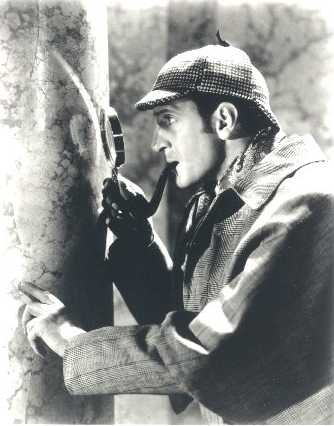
Basil Rathbone discovers a clue.
The word “hello” became common usage in many parts of the world, but not universally. Indeed, even in Britain it wasn’t the only response to a ringing telephone.
“Are you there?” used to offer less than full confidence that the connection was robust. And, even today, our friends in the English countryside tend to answer with their phone number, “Boxham 673,” as though it’s equally likely the wiring intended some other recipient for the call.
Here in the U.S., “hello” caught on so quickly that early telephone operators were known as “hello-girls.”

Several banks of hello-girls keep communications humming.
The various linguistic versions of “hello” are understood in many languages, among them, Albanian (alo), Czech (haló), France (allô), Lithuanian (alio) and Vietnamese, likely derived from the French, (a lô).
In the Arab world, a simple “hello” would be understood, but you’d be considered a real boor. Exchanges of effusive hospitality are the norm: “May your afternoon have a gentle breeze.” “May yours be full of shaded light,” might be a response. “Are you and your family well, I hope?” “Yes, Praise God, and yours as well.” Eventually, the point of the call would be reached. However, our “The reason I’m phoning is…” would be considered awfully brash.
Israelis avoid brashness in answering a phone, though with a single word: Shalom (peace).

Grandpa, what’s that funny black thing with the cord?
Germans and Scandinavians are known to answer the phone with their names: Schmidt hier. The Dutch say Hallo, met (their name), literally, “with Simanaitis…”
Italians express an enthusiastic readiness for the communication: Pronto! (Literally, “Ready!”) Spaniards have similar telephonic confidence: Diga! (“Speak!”)
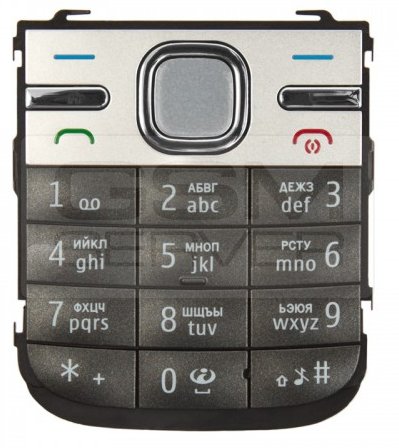
Russian keypad for a Nokia cellphone.
Russia has a rapidly developing mobile phone infrastructure, though for a long time, land-line telephones were not common in Russian residences. Apartment listings would include “telephone” in the same way other highly desirable amenities might be cited.
In a society as closed as the Soviet one back then, personal freedom of expression was not an assumed telephonic virtue. Perhaps Russian telephone culture reflects this. On answering a telephone, one response is Cлушаю вас, literally, “I am listening to you.” Another is simply pausing until the caller speaks first.
When I was a lad in Cleveland, I had a friend whose parents spoke only Russian. When phoning, I was taught to say, Zdravstvuyte, Leonid domoy?, “Hello, is Leonid home?”
Leonard’s father was always delighted to chat with a caller, at length, though I confess I might have been better off with “hello.” ds
© Dennis Simanaitis, SimanaitisSays.com, 2015
 Simanaitis Says
Perhaps a simple LABAS might simply be enough.
Yes, in at least one country I could think of. (And some neighborhoods of Chicago, Cleveland and ….)
When Caller ID shows an unfamiliar out-of-area call, probably a telemarketer or survey, I answer, “Yes?”, which conveys a guarded suspicion immediately.