
Simanaitis Says
On cars, old, new and future; science & technology; vintage airplanes, computer flight simulation of them; Sherlockiana; our English language; travel; and other stuff
FIASCOES, SHAMBLES, HAVOC AND HUBBUBS
I WAS reading recently about Chianti Classicos, Italian red wines. This evoked memories of romantic restaurants, red-and-white checkered tablecloths and candle wax dripping down onto straw-wrapped wine bottles.
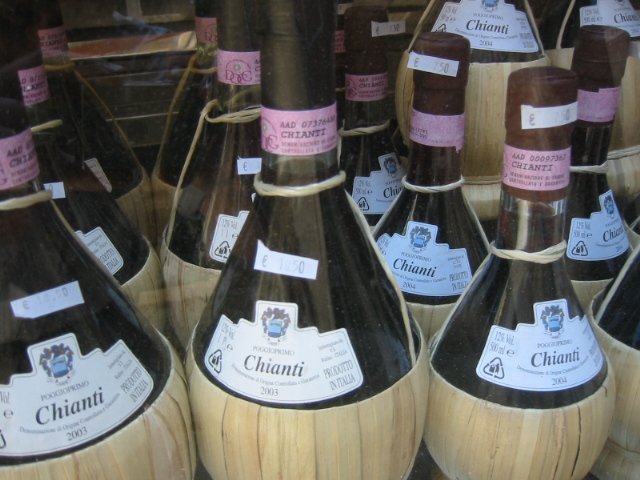
Straw-wrapped bottles of traditional Chianti.
Well, it turns out that such a traditional bottle is known as a fiasco, Italian for flask. It’s wrapped in straw to protect the contents in transit. The term is an old one; there’s mention of a fiasco holding red wine in Boccaccio’s Decameron, c. 1350.
But, wait. I know “fiasco” in a different context, meaning a complete failure in a ludicrous or humiliating manner. This deserves some research in our Oxford English Dictionary, 1971, a microprinted one with its own magnifying lens.

Googling is one approach to this research. Another is The Compact Edition of The Oxford English Dictionary, Complete Text Reproduced Micrographically (in slipcase with reading glass) (v. 1-20)
Sure enough, the OED has a container of wine as fiasco’s first meaning. Its second use is lurking in the Italian far fiasco, “make a bottle,” referring to “alleged incidents in Italian theatrical history.”
This second meaning of utter failure had entered English prior to 1855, by which time a politician was accused of “what the theatrical people call a ‘fiasco.’ ”
This research got me thinking of other words describing less than complete order. Shambles and hubbub initially came to mind.
The OED devotes more than a (micro)page to shamble/shambles. The word traces back to Old English and beyond, and originally meant a stool, table or counter of goods. By 1300, a shamble had come to describe a meat counter. Within three hundred years, its plural became synonymous with a slaughterhouse.
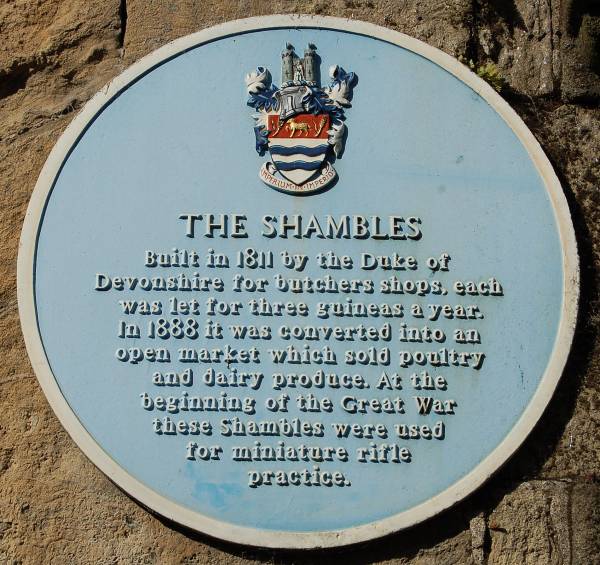
The Shambles, Wetherby, England.
By 1700, people were referring to any place of widespread carnage as a shambles. Today, its slaughterhouse meaning is considered archaic. The primary use of shambles is to describe a state of total disorder, a synonym of chaos or havoc.
Havoc. This is an interesting one.
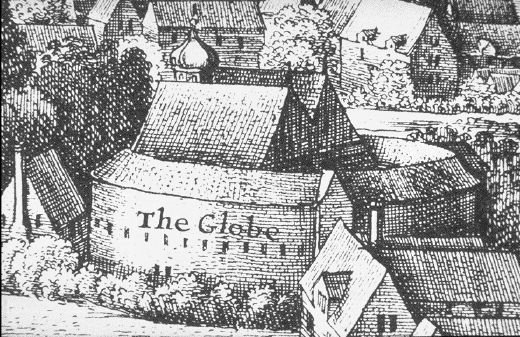
The Globe Theatre. Image by Wenceslas Hollar, 1647.
In Shakespeare’s Julius Caesar, Antony says Caesar’s vengeful spirit shall “cry ‘Havoc’ and let slip the dogs of war.” To his Elizabethan audience, the term “havoc” meant more than simply disorder.
“Havoc!” was a military order giving English troops the authorization to pillage the vanquished. The term dates from the 1300s, when “havoke” allowed “every man to take his part.” This was certainly a specialized form of disruption, and rather different from today’s “play havoc with.”
What a hubbub.
The OED says hubbub likely comes from the Gaelic “Ub! Ub! Ubub!,” a general outcry which probably sounded pretty fierce when shouted by a hairy axe-wielding Irishman.

I suspect Brian Boru, c. 941 – 1014, would have been adept at shouting “Ub! Ub! Ubub!”
By 1555, notes the OED, the term (if not the spelling) was familiar English: “Thei Ichthiolphagi of Afrike flocke together to go drinke, shouting as they go with an yrish who bub.”
Not exactly our crowd? No problem; according to the OED, Ichthiolphagi means nothing more threatening than “fish-eaters.” ds
© Dennis Simanaitis, SimanaitisSays.com, 2014
 Simanaitis Says
That photo of the Shambles is not of the Shambles in York but in Wetherby. The York Shambles is over 1,000 years old and many of the buildings date from the 1400’s.
Oops. Thanks for the correction, Jason.
Error corrected 2/13/15.