
Simanaitis Says
On cars, old, new and future; science & technology; vintage airplanes, computer flight simulation of them; Sherlockiana; our English language; travel; and other stuff
CHRYSLER FIVE-PACK
I CONFESS that this title sounds like Chrysler getting into the brewery business with a cost-cutting move. But, in fact, the Chrysler Five-Pack is one of World War II’s success stories. There are elements of modularity, some military history and even a good detective yarn.
The Sherman M4 was the Allies’ first-line medium tank. Though military historians say the German Panzer was a better fighting machine, the Sherman won by sheer numbers.
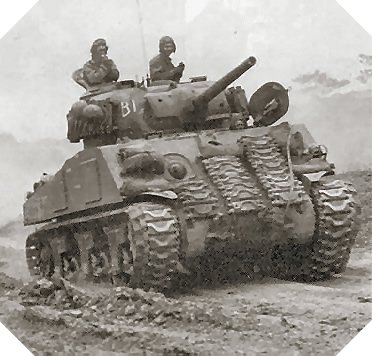
Sherman M4A4. Image from http://goo.gl/0nL2ki.
As tanks go, the Sherman was inexpensive, had straightforward maintenance and, especially critical, was easy to produce. By war’s end, almost 50,000 Shermans rolled out of ten different American manufacturers; among them, American Locomotive, Detroit Tank Arsenal, Fisher Tank Arsenal, Ford and Pullman-Standard Car Company.

The Chrysler Five-Pack powered the Sherman M4A4.
The Sherman M4’s powerplant varied from an air-cooled 9-cylinder Wright radial (the most common engine) to pairs of supercharged inline-6 GMC diesels to a huge (18.0 liters!) Ford V-8—to the Chrysler Five-Pack.
The Chrysler A57 Multibank Five-Pack benefited from existing tooling and modularity. It consisted of five Windsor inline-6s arranged in a cubical volume fitting the Sherman’s engine compartment.

Workers install a Five-Pack into the rear of a Sherman M4A4.
One bank of the Sherman M4A4’s Five-Pack was arranged vertically, two others were aligned at 45 degrees to either side (the pair forming a 90-degree V-12), with the remaining pair running almost but not quite opposed at the base.
Each cast-iron bank displaced 4.1 liters, with traditional long-stroke dimensions of 87.3-mm bore and 114.3-mm stroke, an L-head and a modest compression ratio of 6.1:1. Each had separate carburetor, ignition and a complex throttle linkage.
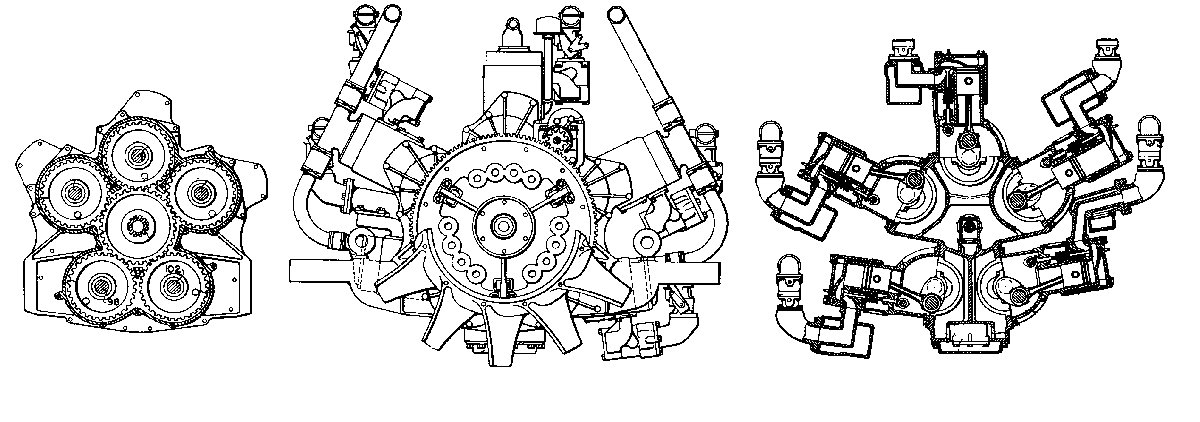
Five-Pack details: from the left, crankshaft gears drive a central output gear; complete view from flywheel end; cylinder alignment.
A central output shaft was gear-driven by the five individual crankshafts. Each bank yielded perhaps 94 hp at 2700 rpm, for a total output of around 470 hp. On the other hand, it was said the only time the five engines produced the same output was at idle.
Of the 49,234 Sherman tanks produced between 1941 and 1945, only relatively few, 7499, were Five-Pack-powered. Most of these ended up in Allied hands as part of Lend-Lease programs.
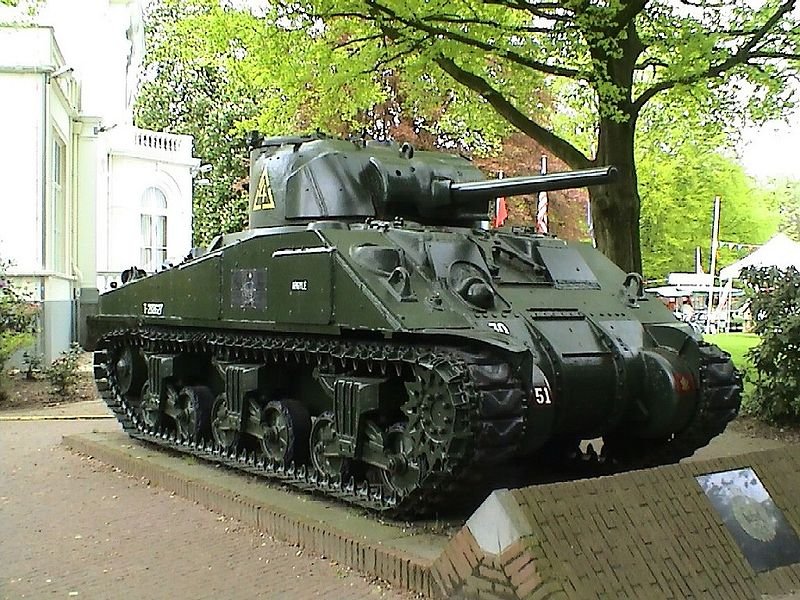
A Sherman M4A4 at the Airborne Museum Hotel Hartenstein, Oosterbeek, Gelderland, Netherlands. Image by W.wolny.
A good detective story accompanies Chrysler’s efforts to find a Five-Pack for display at its Walter P. Chrysler Museum in Auburn Hill, Michigan (closed since 2012 except for private rentals).
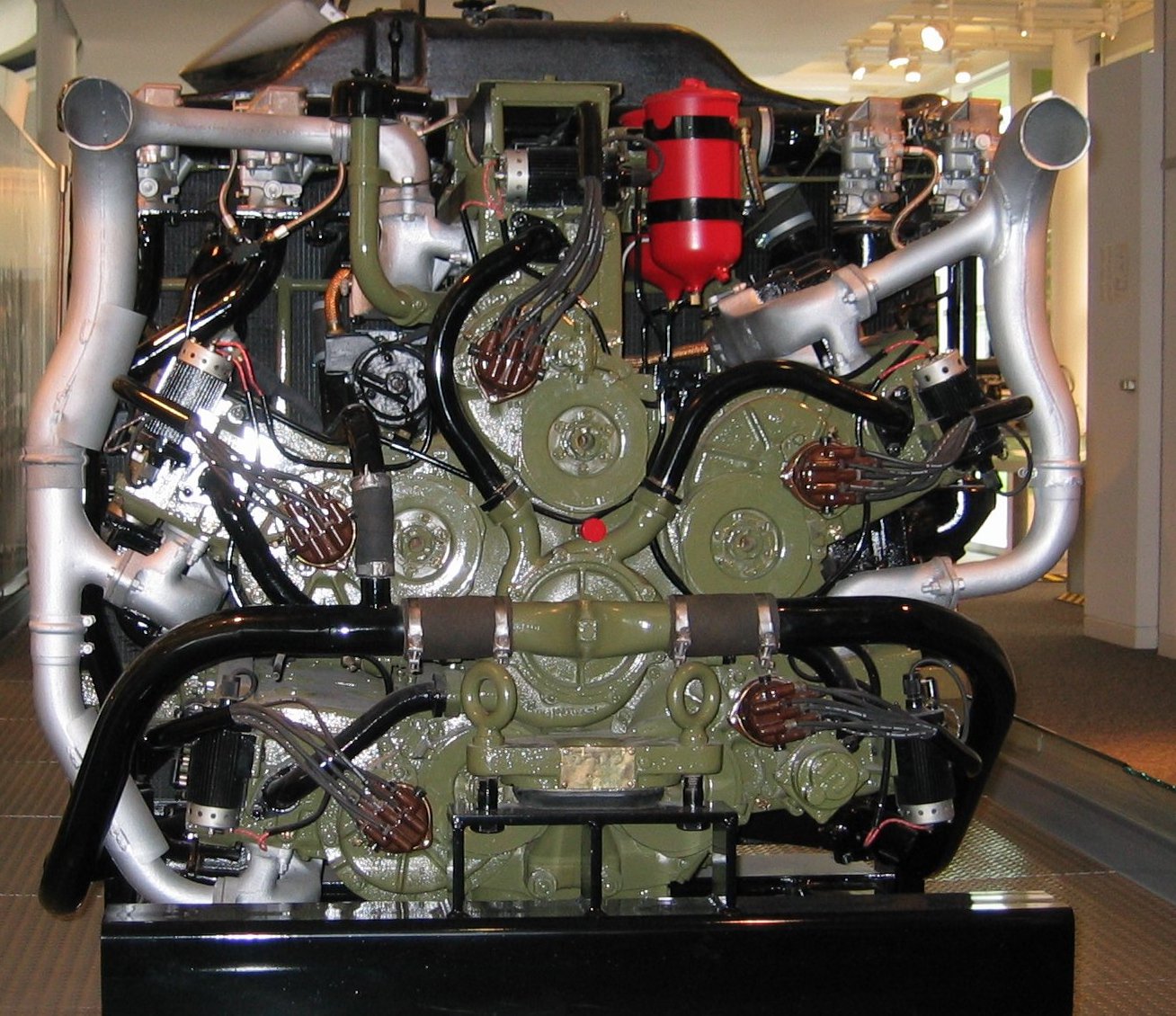
A Chrysler A57 Five-Pack, from the Walter P. Chrysler Museum collection, www.wpchryslermuseum.org.]
In searching out a Five-Pack, Chrysler found a guy in Minnesota, but understandably he wanted to sell the tank and all. Then maybe there was one in the Netherlands. Finally, a Five-Pack—still in its original crate—turned up in Argentina.
Twenty-six months of paperwork involved the Argentine Army, U.S. Customs, State Department and Department of Defense. (The Five-Pack was considered a “returning weapon of war.”) Matters were brought to a successful conclusion only after a phone call to Michigan Congressman John Dingell. ds
© Dennis Simanaitis, SimanaitisSays.com, 2014
 Simanaitis Says
(the pair forming a 90-degree V-8)?? I guess when you have 30 cylinders, what’s a few more or less?
Oops, make that a 90-deg V-6.
Correction made, with thanks.
Wouldn’t that be a 90-deg V-12?
(2 x 6)
Double mea cupla!
I must stop attempting these corrections at 6:00 a.m.
Flammable gas or merely combustible diesel, a difference that could rapidly get your attention inside those tanks. A reduced likelihood of fire was promoted by Junkers aircraft diesels in the thirties, especially during a forced landing. And adding to the quirky crank and cylinder arrangements, Junkers used six cylinders in-line, threw in an additional crankshaft, but made up for it by leaving out the heads.
‘Panzer’ simply means armoured vehicle. You need to specify which one of the many variants if you want to compare it with the medium tank M4.
Sorry, my source did not identify which.
I would say they are comparing with the Panzer MK IV (which I would say was on a par or slightly below the M4 depending on how you score the many factors involved), the MK V (which had serious mechanical and ergonomic problems) or even the MK VI (which is a heavy tank, not a medium).