
Simanaitis Says
On cars, old, new and future; science & technology; vintage airplanes, computer flight simulation of them; Sherlockiana; our English language; travel; and other stuff
THE CARS OF J MAYS
YOU REALIZE the passage of time when someone you remember as a promising kid now announces his retirement. And so it is with J Mays, 59, chief designer at Ford since 1997, who steps down at the end of this year. Not to sound positively geriatric—though perhaps I am—but I distinctly recall interviewing J at his first job with Audi in the early 1980s.

J Mays, Group Vice President of Global Design and Chief Creative Officer, Ford Motor Company. He retires the end of this year.
That personable young Oklahoman, sharing an initial with a grandfather known as SJ, had just graduated from Art Center College of Design in Pasadena, California. And there he was, living in Ingolstadt, Germany, with the neat gig of designing Audis.
It was clear J was on a fast track. He had a brief stint at BMW in 1983, then returned to Audi in 1984 as senior designer—at the age of 29.
Our paths would surely have crossed again in Tokyo in 1991.
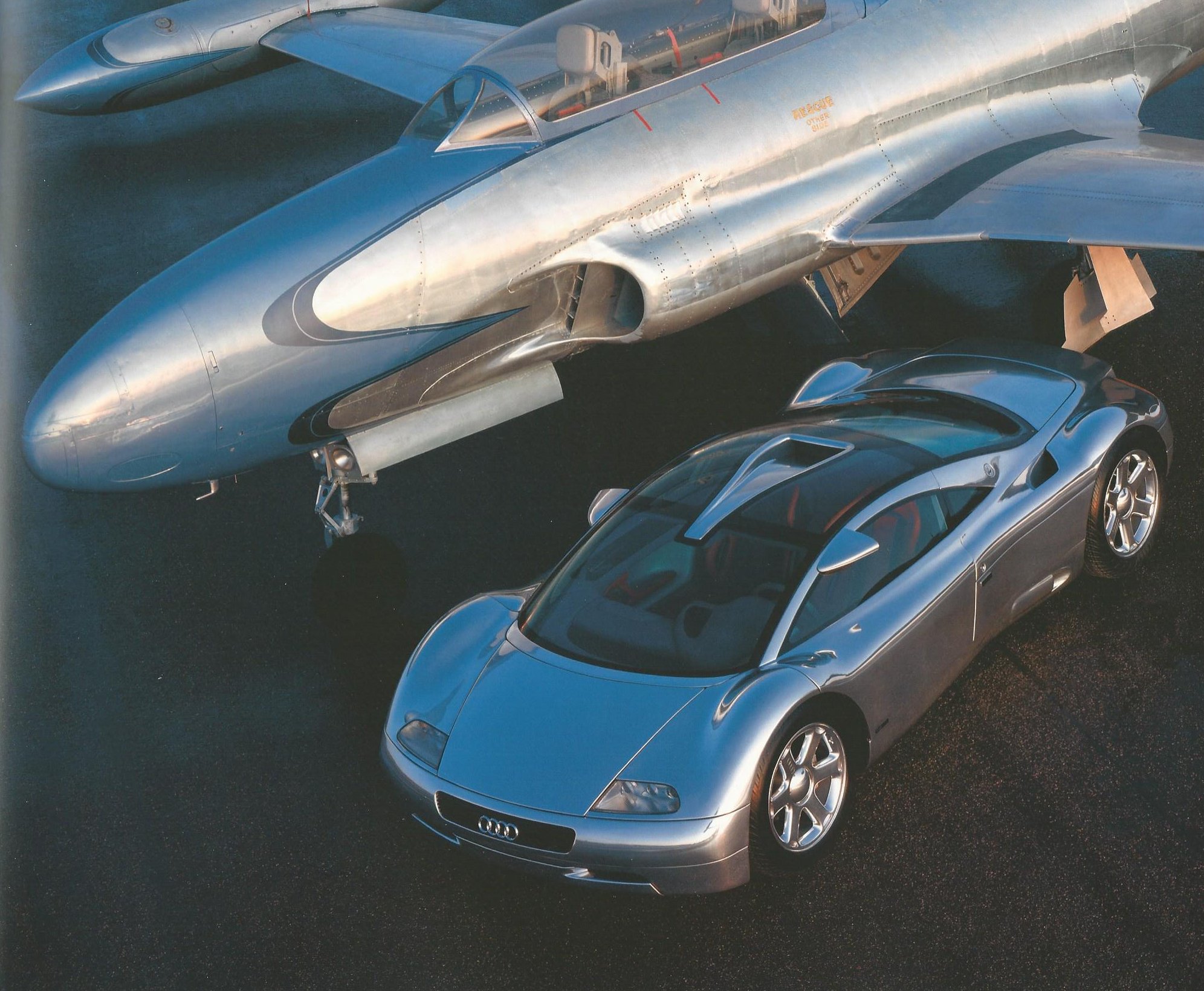
Audi Avus, as exhibited at the Tokyo Motor Show in 1991. Image from Retrofuturism. The tie pin below is from the press introduction.
The Audi Avus Quattro concept car was a Mays design and a star at Tokyo in 1991. The concept evolved into reality with introduction of the Audi TT series in 1998.
Mays returned to the U.S. in 1989 as chief designer at VW of America’s Design Center in Simi Valley, California. There, he and Freeman Thomas collaborated in shaping what became the New Beetle.
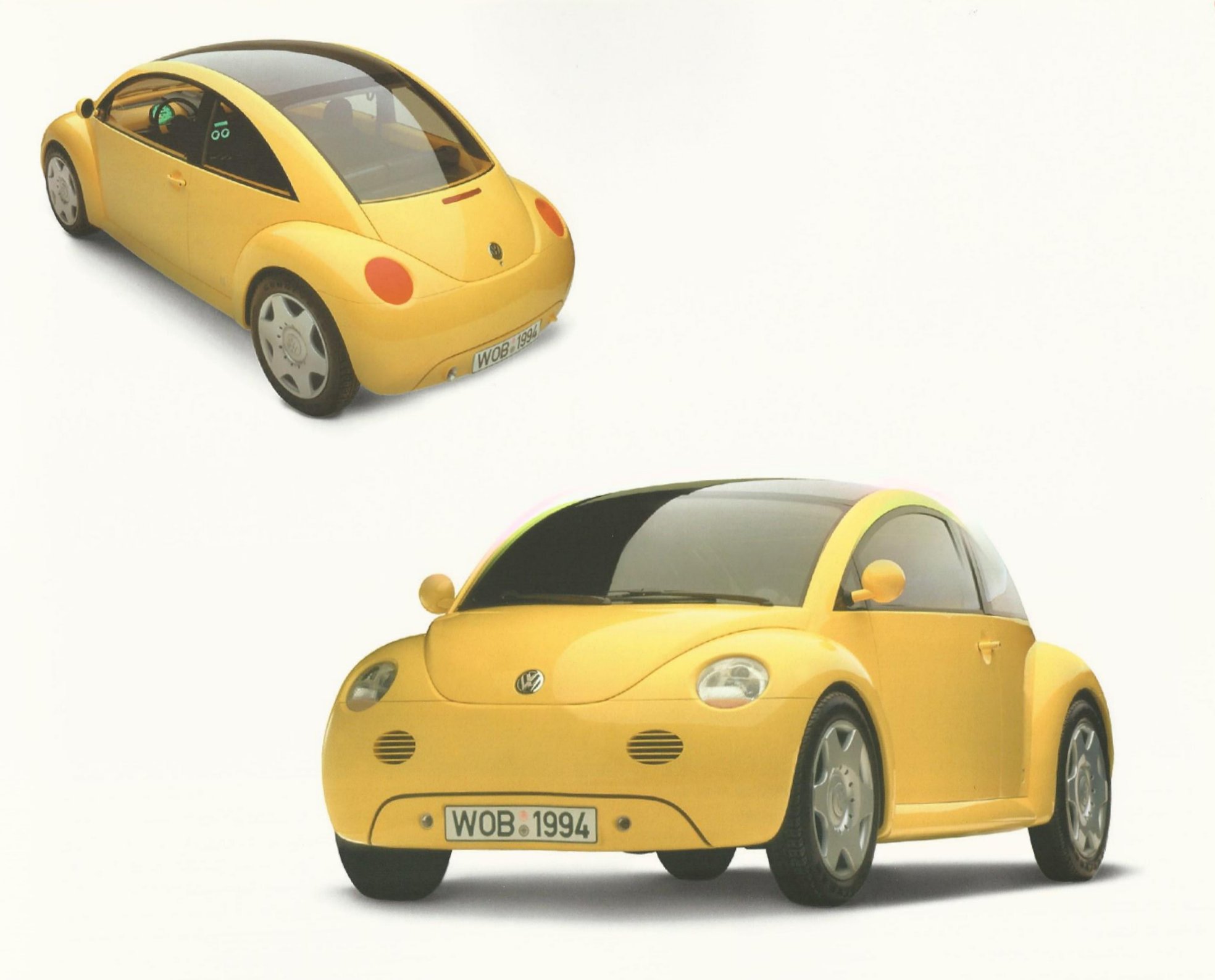
Volkswagen’s New Beetle is a styling coup of J Mays and colleague Freeman Thomas. Image from Retrofuturism.
In 1993, J moved back to Germany as Audi’s design director. Two years later, he became vice president of design development at SHR Perceptual Management, a consultancy with many automaker clients including Ford.
From 1997 on, J headed Ford’s design. His sense of style, “retrofuturism,” became evident in time at all eight of Ford’s brands, Ford, Lincoln, Mercury, Mazda, Volvo, Land Rover, Jaguar and Aston Martin.
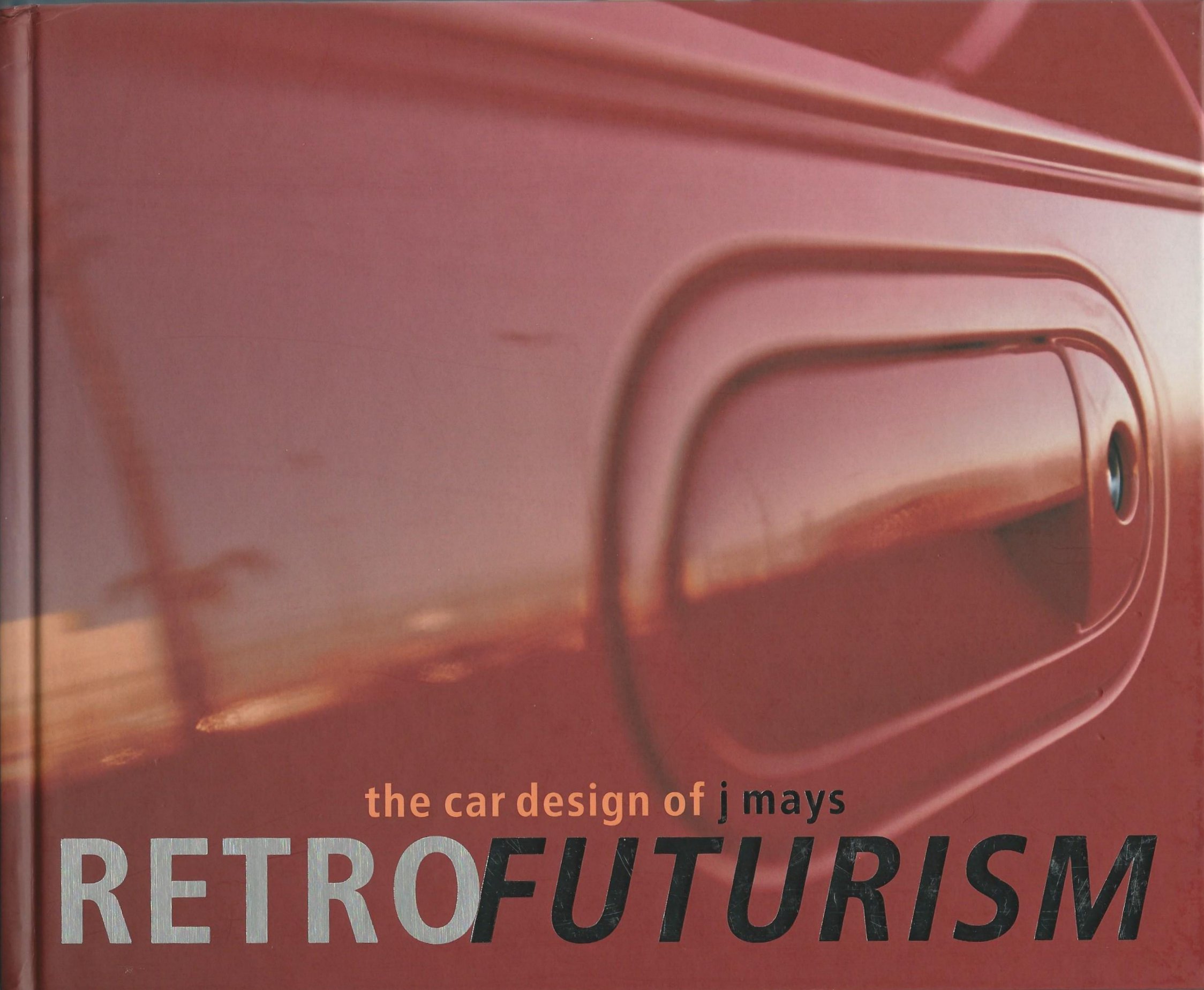
Retrofuturism—the Car Designs of J Mays, commentary by Brooke Hodge and C. Edison Armi, photography by Dennis Keeley, Universe Publishing, 2002.
The Museum of Contemporary Art, Los Angeles, set an exhibit of Retrofuturism in 2002 summing up J’s philosophy of car design. Its catalog includes extensive commentary on this topic.
Says J, “… all design is essentially based on modernism, which in my view is an assemblage of geometric shapes.”
Observes C. Edison Armi of the New Beetle design in the book Retrofuturism, J has “pure semicircular shapes expressed in its silhouette, cut lines, and graphics.” He goes on to say that tension and dynamism are present in extending these pure forms into three dimensions, something that “creates acceleration within the design.”
Mays’ career at Ford has set something of a record, in that he has worked under four regimes of CEOs, from Jacques Nasser to today’s Alan Mulally. Styling successes during Mays’ tenure have included the 2005 and 2010 Mustang, the current F-150 truck (perennial the best-selling vehicle in the U.S.), the 2011 Fiesta, 2012 Focus and 2013 Fusion (this last one sharing kinship of styling with Aston Martin).
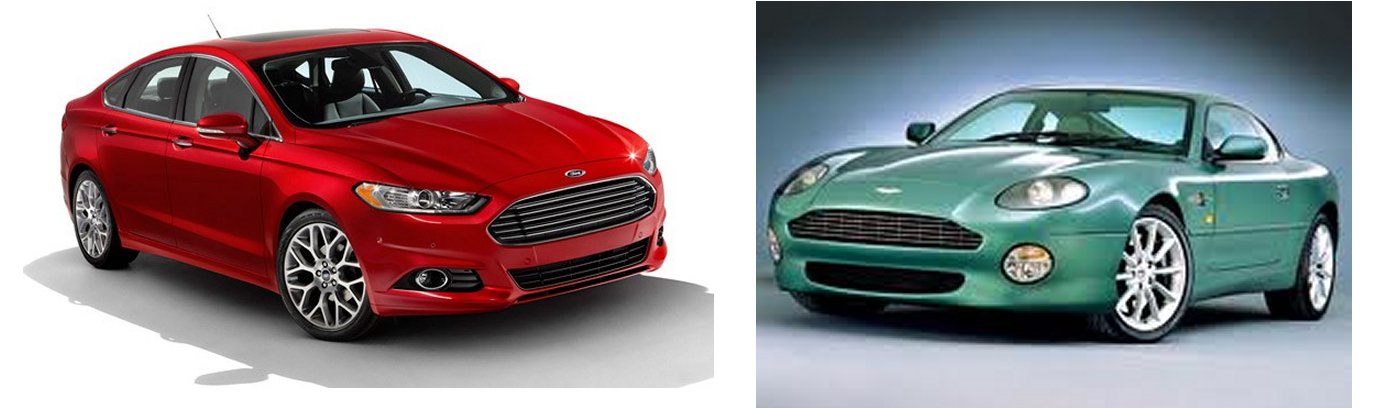
Ford Fusion, left; Aston Martin, right.
There have been some duds, including the 2002 Thunderbird (fine lines, but lacking headroom in my view), the 2005 Five Hundred sedan (can you say “blah”?) and the 2005 Freestyle (good looking, but ahead of the crossover curve).
J is quoted in Automotive News, November 11, 2013, as saying, “You don’t want people to justify a car based on logic; you want them to justify the purchase based on emotion. It’s a bit like falling in love with a spouse. You don’t fall in love for practical reasons.”
Come January 1, 2014, Moray Callum will succeed Mays as Ford’s global design chief. Moray, whom Mays brought to Ford, is the younger brother of Ian Callum, now Jaguar design chief and designer of the Aston Martin DB7.
What’s in J’s future? Between high school and Art Center, he studied commercial art at the University of Oklahoma before switching briefly to journalism.
I’d suggest he write the definitive history of automotive design. ds
© Dennis Simanaitis, SimanaitisSays.com, 2013
 Simanaitis Says