
Simanaitis Says
On cars, old, new and future; science & technology; vintage airplanes, computer flight simulation of them; Sherlockiana; our English language; travel; and other stuff
HOUDINI—PIONEER AVIATOR
HARRY HOUDINI performed death-defying feats during the early years of the 20th Century. Flying through the air—in the earliest of aeroplanes—was one of these feats, an achievement that got him into a first-rate hassle in Australia.
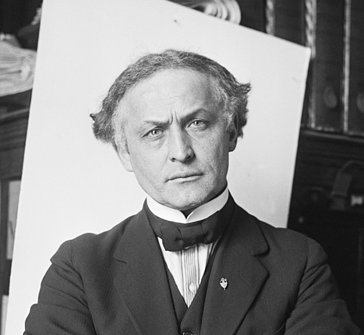
Erik Weisz, better known as Harry Houdini, 1874-1926, Hungarian-American magician, illusionist, stunt performer—and pioneer aviator.
Budapest-born Erik Weisz arrived in the U.S. at the age of four. The family name got changed to Weiss; Erik’s to Ehrich. He made his entertainment debut as a trapeze artist, Ehrich, the Prince of the Air, at age nine.
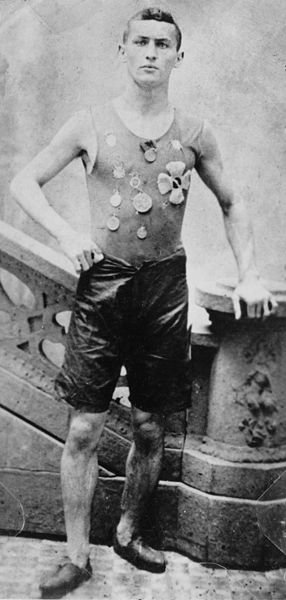
Harry, as he was known by then, with medals won as a member of the Pastime Athletic Club track meet in New York City, c. 1890.
Harry added magic to his repertoire and took the name Houdini in respect of his idol, French magician Robert Houdin. By the fin de siècle, Houdini was performing magic tricks throughout New York.
In 1909, less than six years after the Wrights’ first flights, Harry became interested in aviation. What’s more, by this time he had the wherewithal to exercise this whim.
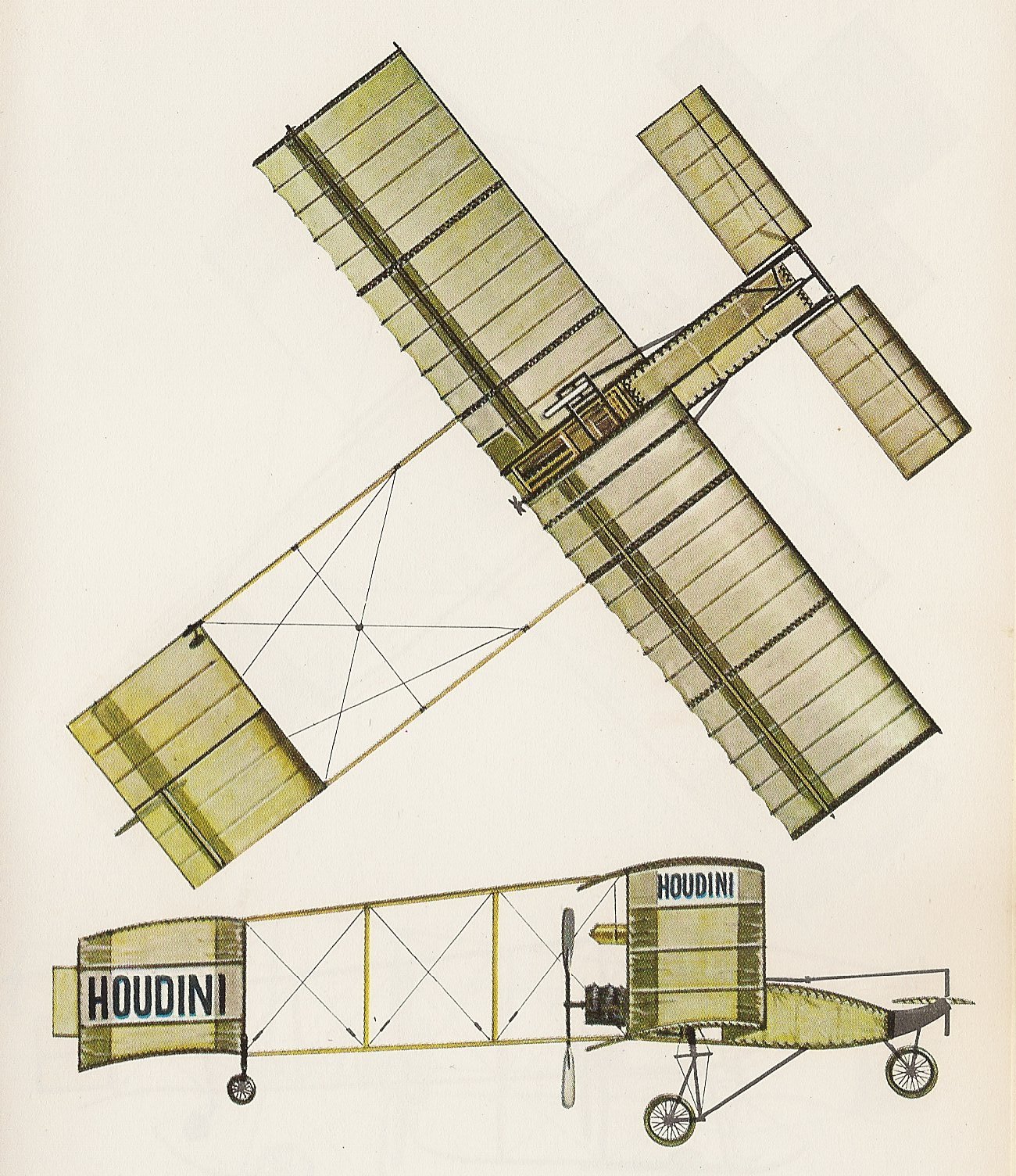
Harry Houdini’s 1909 Voisin biplane. Image from Pioneer Aircraft, 1903-1914, by Kenneth Munson, Macmillian, 1969. The book is listed at www.amazon.com and www.abebooks.com.
For $5000 (around $120,000 in today’s money), Harry bought a pusher biplane built by the French manufacturer Voisin. (See www.wp.me/p2ETap-B3 for tales of Gabriel Voisin.) Harry promptly crashed the aeroplane; eventually, his first successful flight came on November 26, 1909, in Hamburg, Germany.

Houdini and his Voisin, Australia, 1910. Image of his flight there from Flight: A Pictorial History of Aviation by the Editors of Year and News Front, foreword by Douglas W. Douglas, Year Inc., 1958. This book is listed at www.amazon.com and www.abebooks.com.
The Voisin was typical of the era, its spindly airframe fabricated of ash and steel tube; its covering a rubberized fabric. The Voisin’s pusher E.N.V. V-8 produced 60 hp. The craft had a top speed of perhaps 35 mph.
But it most definitely did fly, which is part of the Australian hassle.
Houdini made an Australian tour in 1910 and took his Voisin along with the intention of being the first person to fly there.
However, two other relevant achievements took place in Australia back then.
On December 9, 1909, at the Victoria Park Racecourse, Sydney, English aviator and race driver Colin Defries piloted his Wright Model A, The Stella, for a straight flight of about 100 yards at an altitude of maybe 15 ft.

Colin Defries and his Wright A, The Stella, c. 1909.
The Wright aeroplane was notoriously difficult to fly, and on Defries’ second attempt, he lost control (some say in trying to retrieve his cap) and crashed.
Charitably, Defries did not exhibit very much in the way of sustained controlled flight. What’s worse, some, including the Australian Aero League, questioned whether the flight had even occurred.

Fred Custance, on the wing, of the Blériot of F.H. Jones, at the tail. Image from Australian Aviation: An Illustrated History, by Brian Carroll, Cassell Australia, 1980.
Several months later, in the pre-dawn hours of March 17, 1910, Fred Custance may have piloted a Blériot monoplane in Bolivar, South Australia. The sole witness was the Blériot’s owner, F. H. Jones, who reported that Custance made three circuits of a field in 5 minutes 25 seconds—evidently with more sustainability and control than exhibited by Defries.

Harry Houdini and his Voisin, c. 1910. Image from Chronicle of Aviation, conceived and published by Jacques Legrand, editor-in-chief Bill Gunston, JL International, 1992. The book is listed at www.amazon.com and www.abebooks.com.
Meanwhile, precisely one day later, on March 18, 1910, at Diggers Rest, Victoria, Harry Houdini made three flights in his Voisin, one lasting 3 minutes 30 seconds with circling included. Being the showman that Harry was, he made sure these flights were photographed and filmed. See http://goo.gl/Hi9n23 for a brief video of this.
So who was first? Defries? Custance? Houdini?
The Defries claim is the shakiest, what with questions of sustained flight and control. The Custance claim looks good, until one learns that Blériot owner F.H. Jones later said the whole thing was made up. Later still, Jones said that it was he—and not Custance—who piloted the Blériot.
Australians have been arguing about it as recently as 2010. See http://goo.gl/0R9WLB. This all reminds me of the Curtiss/Wright squabble, also still worth a word or two (including mine: www.wp.me/p2ETap-zA). ds
© Dennis Simanaitis, SimanaitisSays.com, 2013
 Simanaitis Says
THOUHGT THIS MIGHT INTEREST YOU HIT ME UP MAGICKEYS1@YAHOO.COM
http://www.ebay.com/itm/harry-houdini-2-signatures-and-more-aero-manual-1909-/251583921517?pt=LH_DefaultDomain_0&hash=item3a9391fd6d