
Simanaitis Says
On cars, old, new and future; science & technology; vintage airplanes, computer flight simulation of them; Sherlockiana; our English language; travel; and other stuff
SUPREME COURT’S E15
RAISING THE ethanol percentage in gasoline from today’s E10 (10-percent ethanol) to E15 (hence a 50-percent larger dose) now has a U.S. Supreme Court ruling. See http://goo.gl/YKjND for details.

Not surprisingly, the court sided with the ethanol lobby and against gasoline producers, automakers, marine and other small-engine manufacturers, the food and grocery industries, AAA and even some environmentalists.
I’ve ranted on this subject before: www.wp.me/p2ETap-ET and, more recently, www.wp.me/p2ETap-14r. Here I offer the briefest of reviews and a straightforward recommendation.

Most cars appear to work fine on today’s E10. At the other extreme, Flex Fuel cars need to be specially built to run on E85. In between these two lies controversy. The U.S. Environmental Protection Agency says its research indicates cars built after 2001 have no problems with E15.
However, unlike EPA, automakers carry the warranty and liability aspects of this. Incompatible seals are one worry, leading to potential fuel leaks and resulting fires. Problems of driveability and adverse effects on mpg are also concerns.
Older cars will require a multiplicity of fuels being offered: maybe E85; of course diesel; and E15 in regular, maybe mid-grade, and high-test; and last, “legacy” E10 in two or three grades.
Consumer education is certainly called for. Otherwise, expect misunderstood pricing, misfueling and general confusion at the pumps.
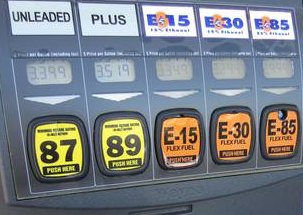
Let’s vote on this issue by punching the yellow buttons! Pass the word.
My recommendation is a straightforward one: Opt for E10. Let E15 proponents hang their pump nozzles high and dry. ds
© Dennis Simanaitis, SimanaitisSays.com, 2013
 Simanaitis Says
Dennis, Is there an economic model for any percentage of ethanol that shows it to be cost effective (after government subsidies)? How about the balance of energy consumed in the creation of ethanol?
Thanks!
There’s a lot of information. The challenge is finding balanced views on this complex matter.
I recommend two from Science, the magazine of the American Association for the Advancement of Science. An earlier summary is at http://goo.gl/h3thh. The summary lists lots of references along the lines of what you seek. A more recent article is “Battle for the Barrel,” Science, 22 March 2013.
My own views tend toward those of the automakers. They’re the ones with liability and warranty exposure.
I’m also old enough to recall the 1970s and 1980s, when government-induced emissions-control shortcomings of driveability and mpg affected all of our cars.
Actually Dennis, Current Flex Fuel cars aren’t much different from their siblings-the fuel systems were already hardened against ethanol a decade ago, the engine management systems are pretty much able to cope, the real major dfference is the need for a broad-band oxygen sensor in the exhaust stream so that the engine management system knows what is burning upstream.
Ultimately we are going to have to displace fossil fuels-right now are options are biofuels and electricity. Both have issues, but both will replace fuels that come from holes in the ground. How we go about it is, of course, the problematic issue…