
Simanaitis Says
On cars, old, new and future; science & technology; vintage airplanes, computer flight simulation of them; Sherlockiana; our English language; travel; and other stuff
WHEATIES CAR BADGES
DURING THE 1950s, General Mills cereal brand Wheaties—even then “The Breakfast of Champions”—had a neat program of offering car emblems as premiums. Thirty-one of these embossed and painted tin badges were distributed in boxes of Wheaties cereal and also available in three sets, each set for 25¢ (“No stamps please”) and a Wheaties boxtop.
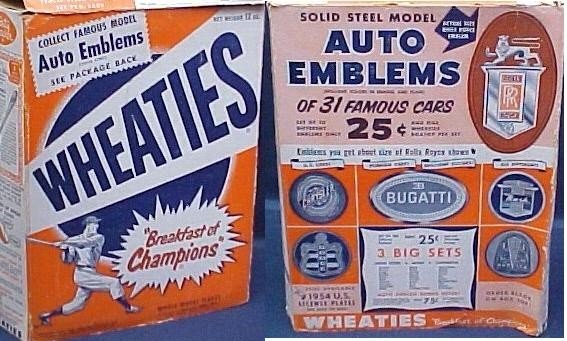
What a neat offer! Image from www.mrbreakfast.com.
Here is my collection of these badges, with commentary on the marques. Data come from The Complete Encyclopedia of Motorcars 1895 to the Present, edited by G.N. Georgano. Subsequent name changes, for example, DaimlerChrysler, Chrysler-Fiat, are ignored. Dates indicate the marque’s actual use, not trademark ownership.
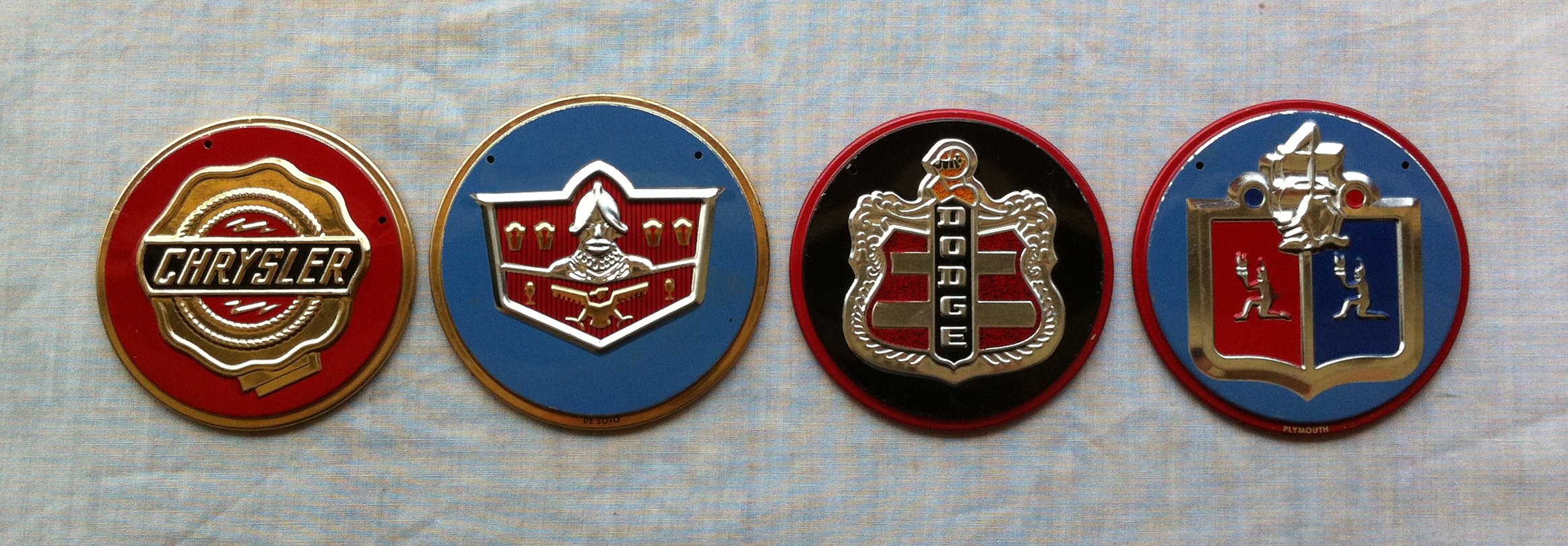
The Chrysler family: Chrysler (1923 to date), DeSoto (1928-1960), Dodge (1914 to date), Plymouth (1928-2001).
Back in the 1950s, Plymouth was the starter-car in the Chrysler lineup, then Dodge, DeSoto and Chrysler. Wife Dottie had a 1953 Plymouth Cranbrook Club Coupe in 1960. At the same time, friend Duane Polo owned a 1957 Chrysler 300 C convertible—lucky him!
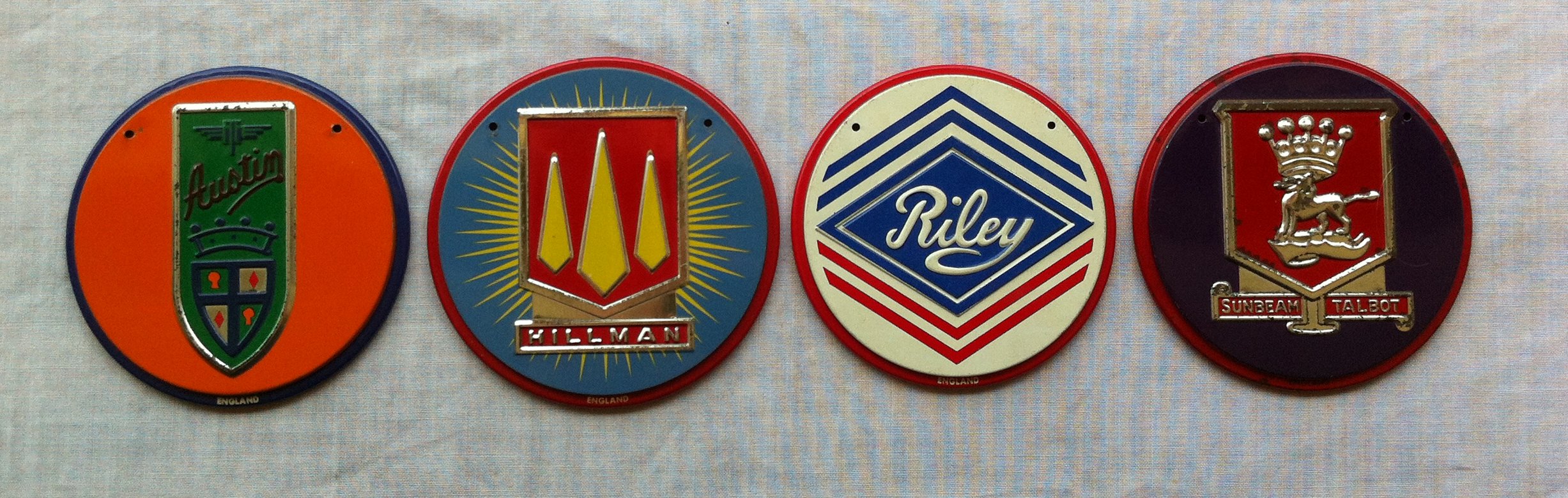
An English quartet: Austin (1906-1987), Hillman (1907-1976), Riley (1898-1969), Sunbeam Talbot (1938-1954).
Putting his countrymen on four wheels, Herbert Austin was England’s Henry Ford (www.wp.me/p2ETap-pq). I remember the Hillman Minx convertible as a sporty little car with an even sportier name. The “Austin” trademark is now owned by China’s Nanjing Automotive; Riley, by Germany’s BMW. As its name suggests, Sunbeam Talbot had ties with the French Talbot and English Sunbeam.
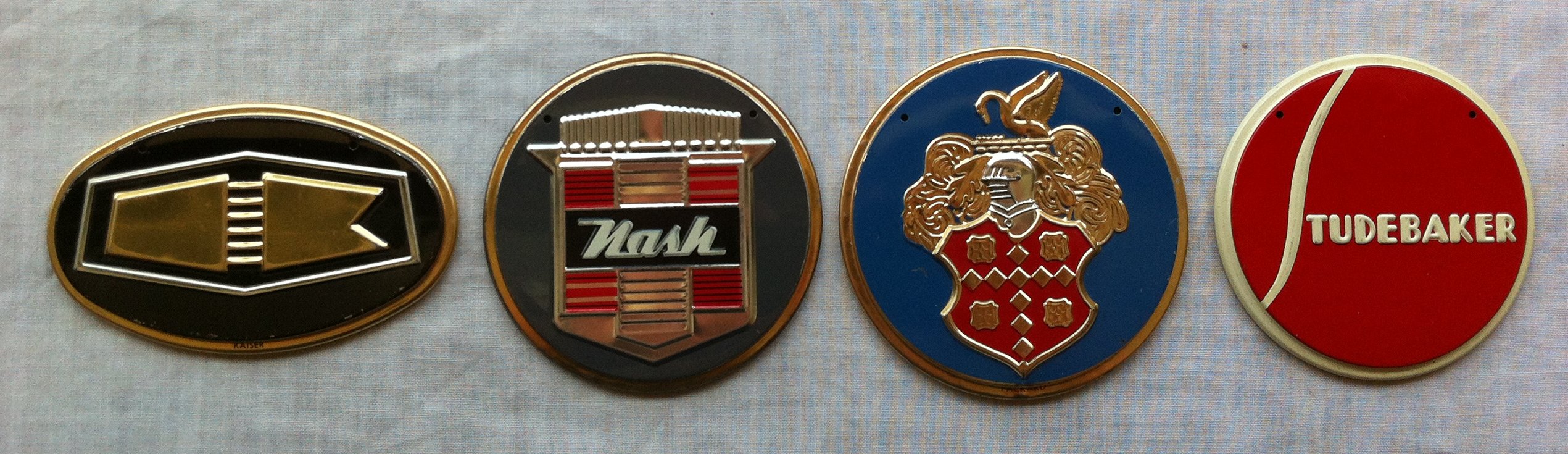
American entrepreneurs: Kaiser (1946-1955), Nash (1917-1957), Packard (1899-1964), Studebaker (1902-1966).
Henry J. (what a neat name for another car!) Kaiser was a millionaire U.S. shipbuilder during World War II. In fact, Vanport, Oregon, provided housing for workers at his Portland shipyard; the land is now Portland International Raceway, acquired by the city in 1960. Kaiser cars were always a bit closer to the truly bizarre than competitors of the era.
I thought highly of 1950s’ Nashes because their front seats reclined into beds. But as an enthusiast, I lusted after a Nash-Healey, a joint venture with Donald Healey. Among its competition successes at Le Mans were 4th overall in 1950, 6th in 1951, 3rd in 1952 and 11th in 1953. A Nash-Healey placed 7th overall in the 1952 Mille Miglia.
Packard is one of the Grand Marques; the Warren, Ohio, Packard Electric Co. concentrated on light bulbs before spinning off a car division in 1902.
Studebaker began making wagons in 1852. Its first cars in 1902 were electrics. A merger with Packard in 1954 bought it only ten more years; a Canadian deal, two more beyond that.
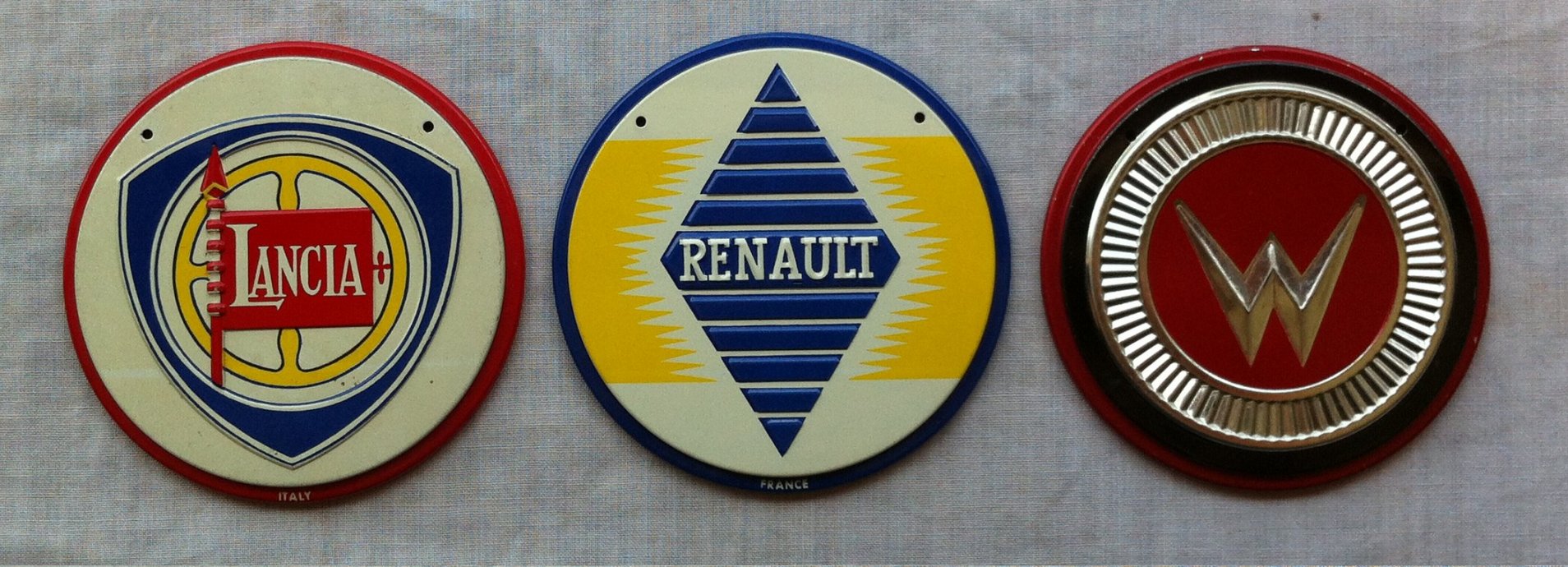
Three survivors; the last, in a complex way: Lancia (1906 to date), Renault (1898 to date), Willys (1903 to date).
Lancia built one of the first cars with a unitary chassis, the Lambda, in 1923. In the mid-1950s, the company’s Formula 1 effort competed with—and later folded into—Ferrari’s. Since 1969, Lancia has been part of the Fiat Group.
Renault is one of the world’s oldest automakers. Today, the Renault-Nissan Alliance is the fourth largest automaker in the world. I almost had a 1957 Renault 4CV as my first car; my dad’s wiser head prevailed.
Willys’ history stretches from the Standard Wheel Co., Terre Haute, Indiana, to today’s Jeep (a Registered Trademark of Chrysler Group LLC, a consolidated subsidiary of Fiat). During World War II, Willys-Overland and Ford built the small military vehicle originating as a 4 x 4 Bantam (Austin op. cit.) and forever revered as the Jeep®. ds
© Dennis Simanaitis, SimanaitisSays.com, 2013
 Simanaitis Says
I always thought that the last Packards were the 1958 models, with Packard flourishes tacked on to the Studebakers of the day.
Hello,
Right you are.
Packard’s demise was apparently a slow and complex one. Using Georgano as my source and honoring corporate entities as noted, Studebaker-Packard’s demise, under Georgano’s Studebaker listing, was 1964. Under the Packard entry, S-P’s demise is listed as 1958. For S-P consistency, I chose 1964 for both.
However, as you note, the last real Packards were 1958s. By 1959, S-P had stopped selling the nameplate; by 1961 it had removed Packard from the corporation’s name.
Gee, and I thought the Willys heritage was a complicated one….
Cheers mate! Glad to see someone loves them as much as me! Okay standard deviation is a measure of spread, and I used a graphics calculator on stats mode to figure them all out, but I will give you a website. I learnt in my maths class, but the website is just as good…
Does anyone know what a full set would sell for nowadays?
Hi, Valerie,
A quick look on eBay shows them asking $10-$20 apiece.
What looked rather less than all 31 was listed $80-$90.
Maybe someone will respond with more definitive info.
They vary a lot. I’ve seen people offering them for $3.50 to optimists asking $60.
Those were days frustrating to many of us. Mowing lawns for a month to get enough cash to send off for items on cereal box, bubble gum wrapper, or a comic book. My parents tossed about a year’s worth of “junk” every time we moved. The Rolls Royce badge is the rarest because you had to buy all 3 kits at once. 75 cents was a lot of money. United States: Plymouth, Dodge, Nash, Studebaker, De Soto, Packard, Hudson, Chrysler, Kaiser, Willys Aero. British: MG, Hillman, Jaguar, Austin, Sunbeam, Talbot, Riley, Bentley, Allard, Humber, Daimler. Continental: Volkswagen, Mercedes-Benz, Renault, Alfa Romeo, Opel, Citroen, Fiat, Ferrari, Lancia, Bugatti. Bonus: Rolls Royce. I used it as a game and “collected” the entire set, one photo at a time, from Ebay, in about 3 hours. The cereal box may the rarest item, being sold for around $85. Including the box, I figured nearly $400 for the set.
Thank you so much! This article really helped too! I have a full set but don’t want to part with them yet. Always thought I could make something cool out of them but always never enough time…
I remember collecting these as a kid and treasuring them, but for the life of me, I don’t know whatever happened to them. I just know I do not have them any longer. Thanks for the memory.
Of course Henry J. Kaiser is half the answer to the trivia question, “What two individuals have two different cars named after them?” I am certain you know the other.
And a fat lot of good his given name offered him.
Yes. As far as I know, no one ever paid it.
Hi Dennis, nice background as somebody just added the whole range to hobbyDB: https://www.hobbydb.com/subjects/13102. I have linked the Wheaties Auto Emblems article to your blog post here.
Loved collecting these back in the 1950s; think I still have a few left in the bottom of a storage box somewhere.
Just purchased an assorted lot of Wheaties car badges, plates & a reflector at auction but have no idea what they are worth. The only online assistance I’ve found is eBay & your post. Is there another site I can go to that would give me a better idea?
Hi, Shawna,
Maybe Googling “Wheaties Car Badges” might shake some sources out. In fact, I forgot how we accumulated ours. It was years ago.
Enjoy them as a bit of automotive/cereal history!
–Dennis
I’ve had a few of these over time. My main collecting focus is (was) horn buttons. I’ve got about 600 different buttons + a complete collection of postwar Studebaker buttons as well as a fair # of pre-war examples. I wrote a very comprehensive article about collecting the best examples I could find (many NOS). I’ve seen my work up on the net in several classic car reference sites.