
Simanaitis Says
On cars, old, new and future; science & technology; vintage airplanes, computer flight simulation of them; Sherlockiana; our English language; travel; and other stuff
CONNECTED CARS?
I SENSE that I may be preaching to the (car enthusiast) choir here, but haven’t we had enough with cars connected to social networks and the like? Automakers seem to think more and more connectivity will sell more cars. And, I fear, to a portion of the buying public, this might be true. Alas, these people are precisely the ones who are to be least trusted with this technology.
They’re the multi-taskers of this world. The ones who feel driving is less than a mind-occupying task.
Multi-tasking has its tradeoffs.
The tradeoffs of multi-tasking have already been well documented. See news of Stanford’s study on this at http://goo.gl/Usoz; for full details, see http://goo.gl/up1rH. Briefly, researchers found that those attempting several things at once don’t do any of them particularly well—but believe they’re doing them all just fine, thanks.
This category of mental overconfidence may be harmless when watching the telly, doing a crossword and tapping out a text to Sis. But it isn’t harmless when controlling a 4000-lb. mass that’s interacting with others of its kind—all at varying speeds and directions.
With this in mind, why ever should we, buyers, automakers or regulators promote additional connectivity?
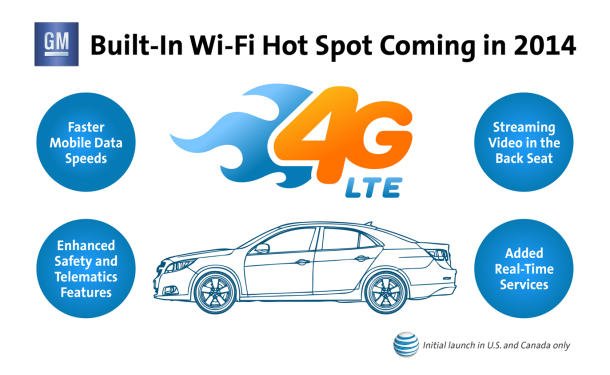
Some elements of connectivity make sense; others do not. See www.wp.me/p2ETap-RI.
Hands-free cell phones are the exception. The better car systems have automatic linkage, one-tap reception and all but touchless dialing.
Even here, though, common sense suggests that mobile phone chats diminish driving awareness. They’re best regarded as priority messaging, not just time-filling entertainment.
This is not akin to chatting with others in the car, because these people share the driving environment and are aware of the driver’s principal task.
For good or bad, there’s no back-seat driver on the other end of that phone connection.
And the thought of texting while driving—of taking one’s eyes off the road to operate tiny buttons—is ridiculous. In fact, a recent AAA study indicates that even the mental multi-task of hands-free texting degrades driving performance. See http://goo.gl/FesLB.
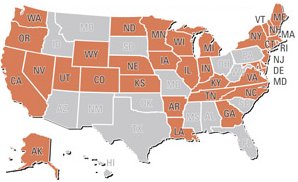
Conventional texting while driving is prohibited (in brown). Image from the Insurance Institute for Highway Safety and State Highway Safety Offices.
It astounds me to read the percentage of drivers, particularly young ones, who admit to this stupidity. (They’re inexperienced, yet overconfident—I know, because “been there, done that” when I didn’t have anything near this deadly temptation. Mine, mea cupla, was excess cornering speed, and dangerous enough at that.)
I have no problem with connectivity of rear-seat occupants. Give them the opportunity to websurf, text, stream movies and have other entertainment. But please keep the front cabin free of these distractions.
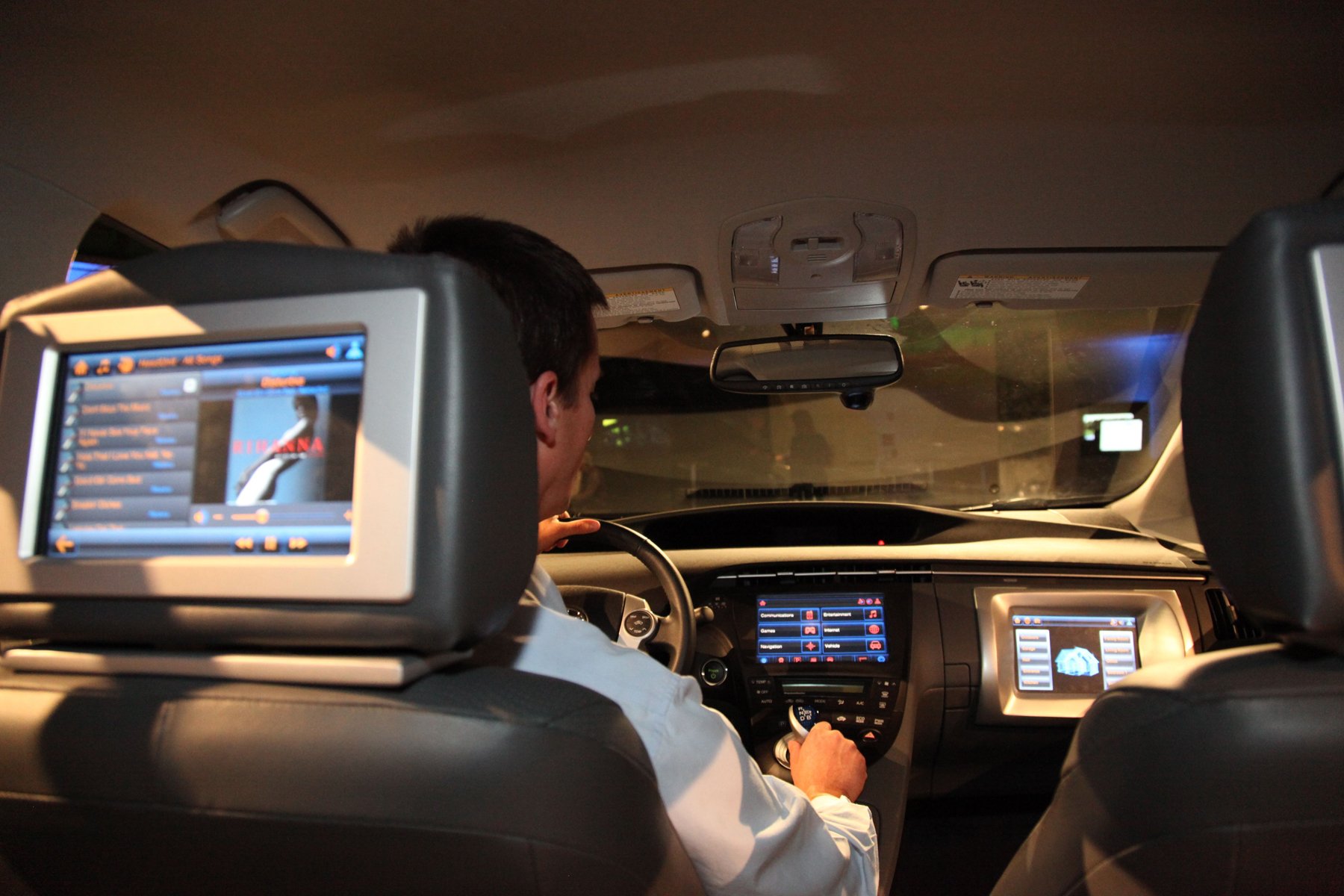
Part of this picture makes sense to me; part does not.
Last, my own jury is still out on autonomous cars (cars that drive themselves). Years ago, “helicoptering yourself to work” was just around the corner. It might have been technologically feasible, but not societally. And, for similar reasons, I’ve got to wonder about relinquishing control of what’s supposed to be “personal” mobility.
For those who prefer not to drive—and not to assume the responsibilities thereof—we already have an option: It’s called public transportation. ds
© Dennis Simanaitis, SimanaitisSays.com, 2013
 Simanaitis Says
Alberta introduced legislation against distracted driving, prohibiting hand held cell phones, texting, eating (i.e. a bowl of noodles – although a hand held snack, held in one hand is exempted), and other sundry stupid distractions, that should be obvious to anyone who understands anything about the dangers, and their responsibility when operating a two ton missile. Now many texters instead of holding the device on the edge of the steering wheel and texting with at least a modicum of peripheral vision possible now text with the device down in their lap and head faced down. I feel so much safer now. The law was totally unnecessary, as we already had laws covering driving without due care and attention.