
Simanaitis Says
On cars, old, new and future; science & technology; vintage airplanes, computer flight simulation of them; Sherlockiana; our English language; travel; and other stuff
U.S. DIALECTS
WE ARE a country rich in dialects, y’know? The dialects are partly based on geography, partly education, partly upbringing, partly age, but fun to learn about however they’re analyzed. A recent news item illustrated the regional aspects of this, artfully displayed by Joshua Katz, a graduate student in statistics at North Carolina State University (http://goo.gl/Pn7AO).
Katz used data from a linguistic survey done by another researcher, Bert Vaux, who is now a Reader (i.e., younger professor, Brit style) in Linguistics at the University of Cambridge. Vaux is highly regarded, even to having a linguistic proposition, Vaux’s Law, named after him. (I believe it has something to do with how we pronounce words like Bach.)

Bert Vaux, Reader in Linguistics, University of Cambridge, England.
Vaux’s regional survey, performed about a decade ago when he was teaching at Harvard, is well worth a look (http://goo.gl/rHIk5). He asked a sample of Americans, 30,788 of whom responded, a series of 122 questions about differences in American English usage.
Vaux’s responses by state show only a few anomalies. For example, Massachusetts is rather overrepresented with 4 percent of respondents (versus its 2 percent of the U.S. population). California is somewhat underrepresented with 9 percent of the survey contrasted with its 12 percent of the U.S. population. Generally, the density map of respondents agrees with U.S. data, albeit with a slight eastern tilt.

Vaux’s respondent distribution at left. Population density in 2000 at right; this image from www.learnnc.org.
Age distribution is another interesting aspect. Vaux’s respondents are somewhat heavy in the 20-29-year-old age group (College students? Recent college grads?) These made up 34 percent of the sample, whereas this age group accounts for less than 15 percent of the U.S. population.
The results are fascinating, even with these oddities of the sample. For instance, is your mom’s sister known as your ant or ahnt? (Survey: only a smattering of ahnts, except along the coast from New Jersey to southern Maine.)
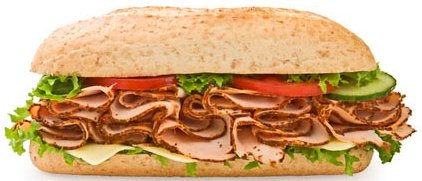
What is this delectable combination called? Image from www.tasty.sandwiches.com.
Another interesting finding of regional words is the name for a sandwich of cold cuts and other tasty stuff, typically served on a long roll. The big winner, a sub, scored 77 percent nationally with a uniform distribution. Geographical specialities included grinder, at 3 percent nationally, almost all in New England; hoagie, 7 percent nationally with heavy Pennsylvania scoring; hero, 5 percent, largely in the New York City area; and poor boy, 2 percent, along the Gulf Coast but also sprinkled elsewhere.

This map, from Katz’s work, identifies a sweetened carbonated drink, region by region. Soda, red. Pop, blue. Coke, green.
One of the more regionally distinctive splits is the name for a sweetened carbonated drink. Soda wins overall, at 53 percent. It’s also the strong regional choice in the northeast as well as common in California. Pop is second at 25 percent, predominately in the upper Midwest (and certainly matches my Cleveland upbringing).
The generic word “coke” scored 12 percent, the regional choice in the south through Texas—and, as shown by faint urban coastal blobs, in California, which wife Dottie confirms. “What sort of coke do you want?”
I remember “tonic” from my undergraduate days in Massachusetts; it scores only 0.67 percent nationally, but owns a tight little region in New England.
What about that grass strip between the sidewalk and the curb? Aha, I’ve addressed this one here (www.wp.me/p2ETap-8W). Vaux’s research identifies my Cleveland-bred name, the “treelawn” at 1.92 percent, as well as California-born wife Dottie’s choice, the “parking” at 1.75 percent.
Sure enough, northeast Ohio was heavily into treelawns. Curiously, the parking’s strongest regional showing was in Iowa. Nationally, berm scored 4.01 percent; curb strip scored 8.65 percent. The big winner, at 67.92 percent, was “I don’t have a name for this.”
Kids don’ know nothin’ these days. Of the 10,589 respondents on this one, not one of them mentioned “devil strip.”
It’s good fun to answer all of Vaux’s questions on your own. Let me know how things turn out. ds
© Dennis Simanaitis, SimanaitisSays.com, 2013
 Simanaitis Says
35 years ago, a term I learned from city zoning and inspection was “terrace,” denoting everything from the property line outward to the edge of the paved roadway. The inner edge of the sidewalk was generally on the property line. As to the strip in question here, I always called it “the grass strip between the sidewalk and the curb.” Grin.
In Iowa, many years ago, it was definitely the parking. Don’t ask me why, no one would dare to park there, even in the days before the assult rifle.! I could not figure out why they called it the treelawn in Cleveland. The trees that had been planted there were all elms, and they were all dying…