
Simanaitis Says
On cars, old, new and future; science & technology; vintage airplanes, computer flight simulation of them; Sherlockiana; our English language; travel; and other stuff
U OR NON-U, REDUX
IT USED be so simple. Beginning with October 14, 1066, one was either Norman or non-Norman. Up until recently (two days ago), it was U or non-U, the “U” standing for Upper Class.
But now, according to the BBC—an authority of things English, despite its recent kerfuffles—class structure is rather more complex. Here, let’s summarize Auntie Beeb’s assessments as well as previous attempts to keep the chavs in their place.
British linguist Alan S.C. Ross coined the terms “U” and “non-U” in 1954 in Neuphilologishe Mitteilungen, a Finnish journal.

Nancy Mitford—one of the fabled six Mitford sisters—followed up with an essay on the topic that same year and then with Noblesse Oblige, an expanded version in 1956 edited by her, Ross and others.
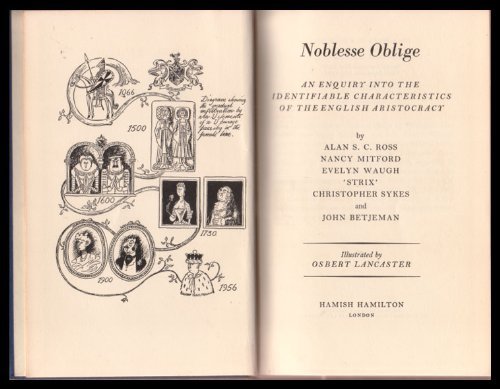
Noblesse Oblige: an Enquiry into the Identifiable Characteristics of the English Aristocracy, edited by Alan S.C. Ross, Nancy Mitford, Evelyn Waugh, “Strix,” Christopher Sykes and John Betjeman, illustrated by Osbert Lancaster, Hamish Hamilton, 1956. This particular title page is shown by a bookseller at www.amazon.com.
Curiously enough, and neither here nor there, “Noblesse Oblige” was also the motto of East High, my Cleveland high school.
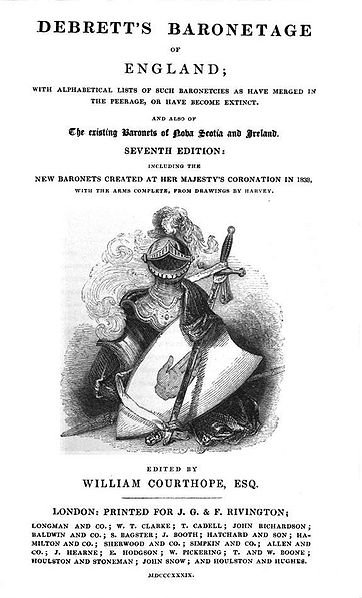
The title page from Debrett’s Baronetage of England, Seventh Edition, edited by William Courthope, Esq., printed for J.G. and F. Rivington et al., 1839. This is an example of the standard fare from Debrett’s, founded in 1769 to keep track of such things.
A followup to Mitford’s contribution, Debrett’s U & Non-U Revisited, received a bum rap by some, apparently thinking they were reviewing an updated Peerage & Baronetage. This latter work is currently in its 148th edition (published in 2010). By contrast, U & Non-U Revisted merely claimed to update linguistic matters to its 1978 publication date.
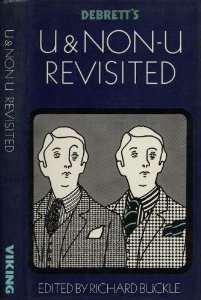
Debrett’s U & Non-U Revisited, edited by Richard Buckle, Debrett’s/Viking, 1978. Both www.amazon.com and www.abebooks.com list it. Later editions dropped the “Debrett’s” from the cover.
This brings us to the BBC and its recent collaboration with sociologists to characterize the modern British class system. More than 161,000 people took part in The Great British Class Survey launched in January 2011.
Researchers at the London School of Economics and the Universities of York and Manchester designed the survey and analyzed (or, as they would write, “analysed”) the data. See http://goo.gl/wQJVT for the Beeb article of April 3, 2013, as well as The Great British Class Calculator.
Briefly, this study is more than purely a linguistic determination. It replaced the familiar upper, middle and working classes with seven distinct groups: Elite, Established middle class, Technical middle class, New affluent workers, Traditional working class, Emergent service workers and Precariat.
You can use The Great British Class Calculator keyed to wealth, interests and social circle to determine your theoretical place in this new scheme of things. It identified me in the Technical middle class—with some accuracy but also some glaring errors. The Technical middle class is described as a “Small distinct group that aren’t so social but have money and are into emerging culture such as gaming, the internet and rock music.”
Rock music?? I checked Opera and Ballet! Or did the Calculator somehow find out about Rasputina?
Let me know how accurate it is in placing you. Whatever its conclusion, I am confident you say “loo” and not “toilet.” ds
© Dennis Simanaitis, SimanaitisSays.com, 2013
 Simanaitis Says
Reblogged this on niharikaagarwallse.