
Simanaitis Says
On cars, old, new and future; science & technology; vintage airplanes, computer flight simulation of them; Sherlockiana; our English language; travel; and other stuff
SOLAR HYDROGEN
THE PROMISE of a hydrogen highway populated by highly efficient fuel-cell vehicles depends on readily available—and inexpensive—H2. The electrolysis of water is one source of this hydrogen: Applying an electric current to H2O separates it into its constituent elements, hydrogen and oxygen. Hitherto, though, this has been an energy- and material-intensive process.
However, as reported in the October 2012 issue of Technology Review Published by MIT, one of the magazine’s “35 Revolutionary Innovators” is developing a means that may improve matters. William Chueh, now at Stanford University, is helping to lower the cost of electrolysis by replacing expensive catalysts such as platinum with a less costly material, cerium oxide. What’s more, the energy input comes directly from the sun.
A series of mirrors such as those already in use at solar facilities concentrates sunlight by a factor of 1500. This beam heats a small capsule of cerium oxide to a mind-boggling 1500 degrees Celsius (2732 degrees Fahrenheit), at which temperature some of the compound’s oxygen atoms are driven off.
Then, as it cools, the capsule is fed steam which readily gives up its own oxygen to this now oxygen-starved material. This, in turn, liberates the steam’s hydrogen, which is collected.
Last, the cerium oxide capsule is reheated to repeat the process. The key to all this is cerium oxide’s release of oxygen at elevated temperature, followed by its recapturing oxygen once cooled.
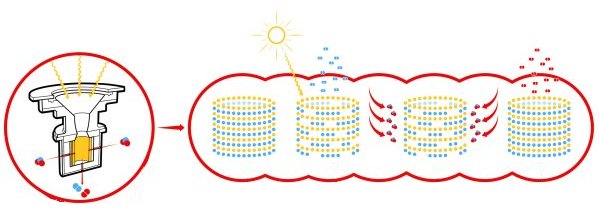
The sun superheats a cerium oxide capsule, driving off more and more oxygen. When steam is sprayed onto the oxygen-starved material, it grabs the oxygen, thus free up the hydrogen. Illustration by mckibillo, in Technology Review, October 2012.
The process can be teamed with solar generation of electricity; its iterative nature helps in this regard. Alas, its extreme temperature requires exotic containment that trades away the catalyst cost benefit. Chueh is developing a hybrid of cerium oxide and another material that will work at 500 degrees Celsius (932 degrees Fahrenheit), a temperature compatible with stainless-steel vessels.
Another challenge: Cerium is a rare earth, albeit the world’s most abundant of the category. It already has many applications in permanent magnets, automotive catalytic converters and even in polishing optical glass. Last, one of its primary sources is China.
There’s another fascinating aspect of Chueh’s research: The process can be used to make hydrocarbon fuels, though unconventional ones, from carbon dioxide. This is accomplished by transforming the CO2 into CO, carbon monoxide, which can then be combined with hydrogen, thus producing the hydrocarbon. According to Technology Review, for a given amount of input energy, the technique generates about 100 times more carbon monoxide than previous processes. ds
© Dennis Simanaitis, SimanaitisSays.com, 2012
 Simanaitis Says