
Simanaitis Says
On cars, old, new and future; science & technology; vintage airplanes, computer flight simulation of them; Sherlockiana; our English language; travel; and other stuff
PARIS TECH 2012
THERE WERE several cars of particular technical interest exhibited at 2012 Paris Mondial de l’Automobile. Here’s why I believe they’re significant.
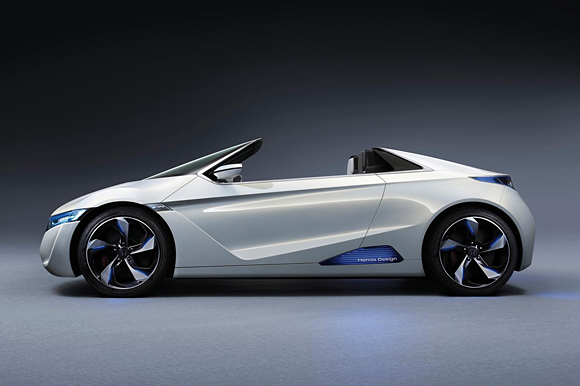
The Honda EV-Ster, said to be near production, fits the niche of urban entertainment.
Honda’s EV-Ster could be the kind of battery electric vehicle that makes sense. It’s a tidy two-seater that would be perfect for zipping around town. All the BEV worries of range and recharge time are irrelevant if this is the intended niche.
By the way, this Honda BEV coincides with rival Toyota’s announcement that it doesn’t believe BEVs make sense at this point. Toyota plans only minimal marketing of its electrified iQ. Instead, the company says it prefers to emphasize PHEVs (plug-in hybrids). Its Prius already dominates the HEV market.
As a front-wheel-drive car, the Concept Active Tourer indicates the direction BMW plans to take its 1 Series models. Currently these smallest of the Ultimate Driving Machines are—somewhat to their disadvantage—only scaled-down versions of other rear-drive Bavarian siblings. The Concept Active Tourer’s fwd improves interior space and packaging.
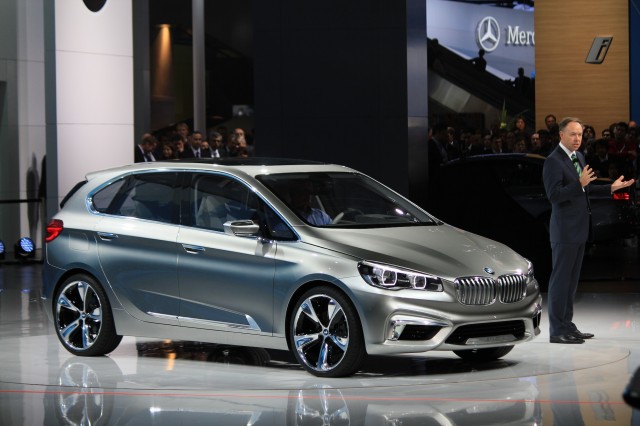
The Concept Active Tourer is significant in being a BMW front-drive plug-in hybrid.
It features PHEV technology of the series variety. That is, its 1.5-liter 3-cylinder engine is dedicated to spinning a generator which, in turn, feeds electricity to the propulsion motor. Whether three cylinders can be made sufficiently refined to support BMW heritage is a good question.
Hyundai plays at the top of the automotive fuel cell game, along with Honda, Mercedes-Benz and Toyota. Each of these has announced production plans for FCEVs by 2015 (and, of course, Honda has had a small fleet of its Clarity FCX model in a lease program for several years now).
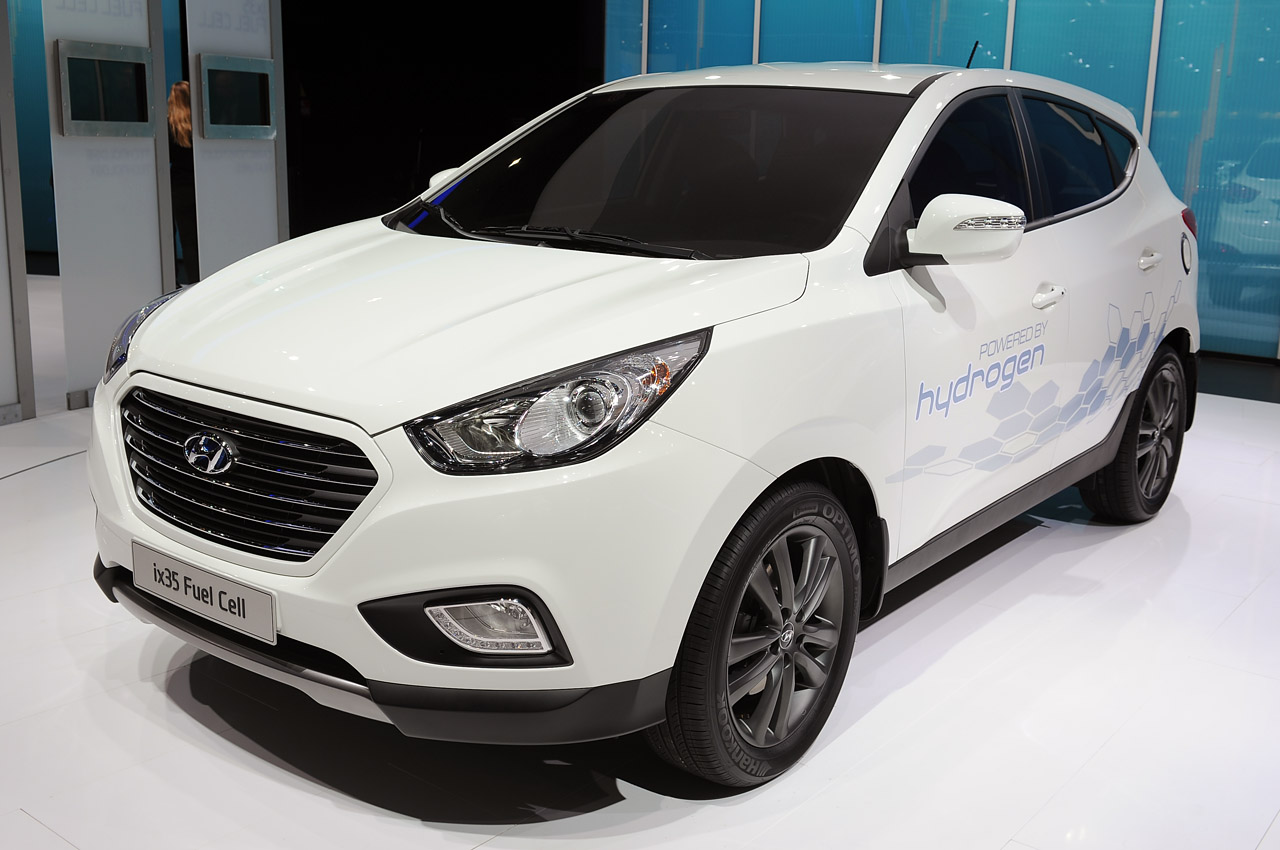
Hyundai’s ix3 might be the first full-production fuel cell car in your neighborhood.
Hyundai executives were even more specific in Paris: Full production of the ix3 will begin before the end of this year. The company plans to have as many as 1000 of the cars on the road by 2015.
Nissan’s Terra crossover indicates another potential trend: fuel cell conversion of a previously BEV powertrain. An FCEV, after all, is an electric vehicle that uses the fuel cell to make its own electricity. Hence, if you already have a well-executed BEV powertrain (think Leaf), then it may make sense to swap its battery pack—large, heavy and needing time-consuming recharges—for fuel cell stacks and a smaller buffer battery.
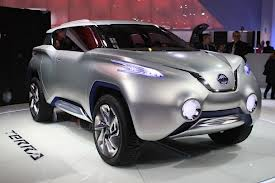
The Nissan Terra intends to take the FCEV concept off-road.
A downward trend of fuel cell cost is crucial here. Nissan notes that the cost of FCEV hardware has been cut by 83 percent, largely through a reduction in its precious metal content.
The Terra is tri-motored: A Leaf-derived motor up front drives the wheels at that end; separate smaller motors at each rear wheel give it full all-wheel drive.
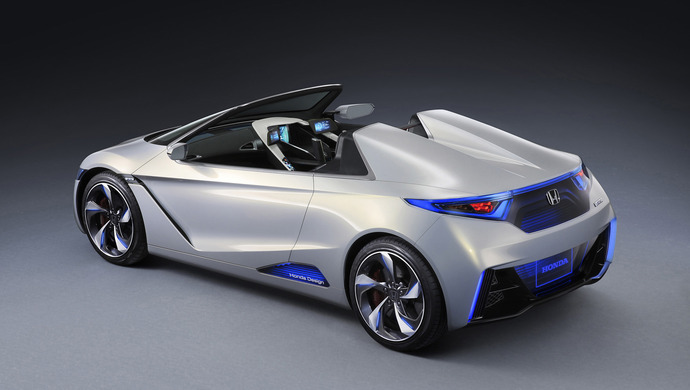
Here is another view of Honda’s neat EV-Ster, added because there are rumors it needn’t be only an EV. Also, don’t worry; any production version would have a real steering wheel, not the EV-Ster’s twin control levers.
Last, continuing this theme of powertrain concept swapping, wouldn’t Honda’s EV-Ster be neat powered by one of this company’s exemplary inte
© Dennis Simanaitis, SimanaitisSays.com, 2012
rnal combustion engines? As I keep claiming, I.C. isn’t dead yet. ds
 Simanaitis Says
An alternate title – “Paris Tech Tid-bits 2012” . . . interesting tid-bits as always. For older observers, the latest technology often reminds one of earlier efforts. The control levers in the EV-Ster remind me of a favorite story about Divco milk trucks. In the twenties their steering “tiller” came up through the middle of the floor, a handy apparatus for either left or right hand operation, and quick delivery to either side of the street. But it gets more interesting. The competition then was mostly horse drawn, and a Divco sales brochure touted another interesting advantage: no need to worry, when striding up to the porch, that your horse was eating the customers flowers! That was a simpler time. (Though Milton Friedman once said that if every car were a horse we’d have an entirely different, and very serious, emissions problem!)
Dennis, keep up the good work.