
Simanaitis Says
On cars, old, new and future; science & technology; vintage airplanes, computer flight simulation of them; Sherlockiana; our English language; travel; and other stuff
HE’S GOT A LOT OF BALTS
I WITNESSED history up close on a Saab Baltic Tour. It was May 15-18, 1990, a mere couple weeks after Estonia, Latvia and Lithuania declared their independence from a crumbling Soviet Union.

The Estonian border, immediately prior to May 1, 1990. Image, from Saab Baltic Tour route book.
These two photos tell the story succinctly. The one above, from Saab’s route book reconnoitered less than a month before, identifies Estonia as part of the Soviet Socialist Republic (Cyrillic CCP; Estonian NSV; our SSR). We took the photo below at the same location, by which time only the indications of a Republic remained.

Here’s our Saab at the border, but with historical changes.
Saab’s original plans were to start the drive in Lithuania. However, in a last-ditch effort of dominance, the Russians got shirty with Lithuania about energy and we began in Riga, Latvia. Alas, I missed out visiting my ancestral homeland.
The immediacy of Baltic freedom was evident everywhere we went. In Riga, the tour guide said there had been minor scuffles between home militia and military officials the day before. The one demonstration we encountered was peaceful enough.
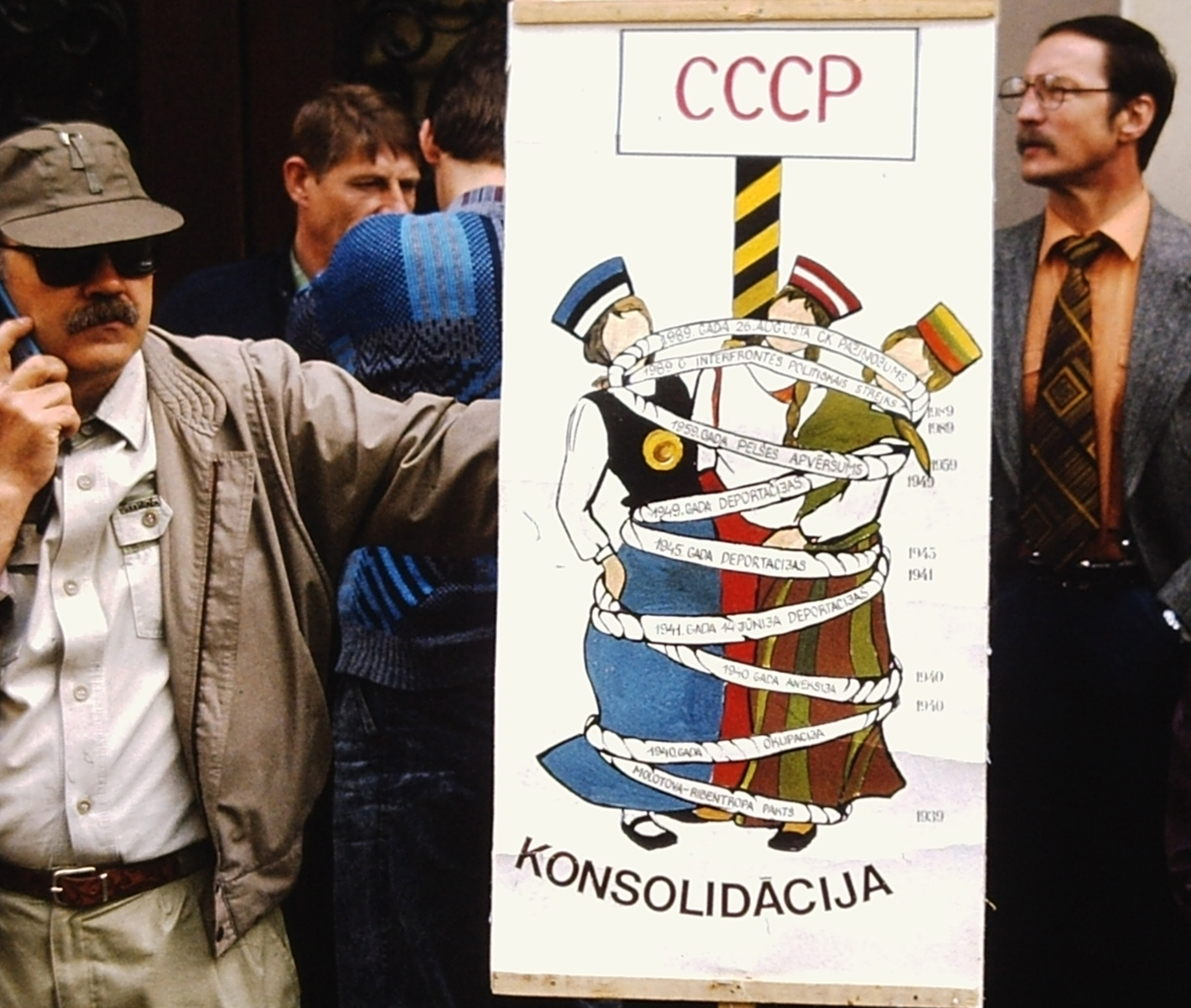
I recall being impressed by this fellow’s 1990 mobile phone.
“We’re now on Freedom St.,” our guide said. “Its name was changed two weeks ago. It had been Lenin St. and, before that, Hitlerstrasse…”
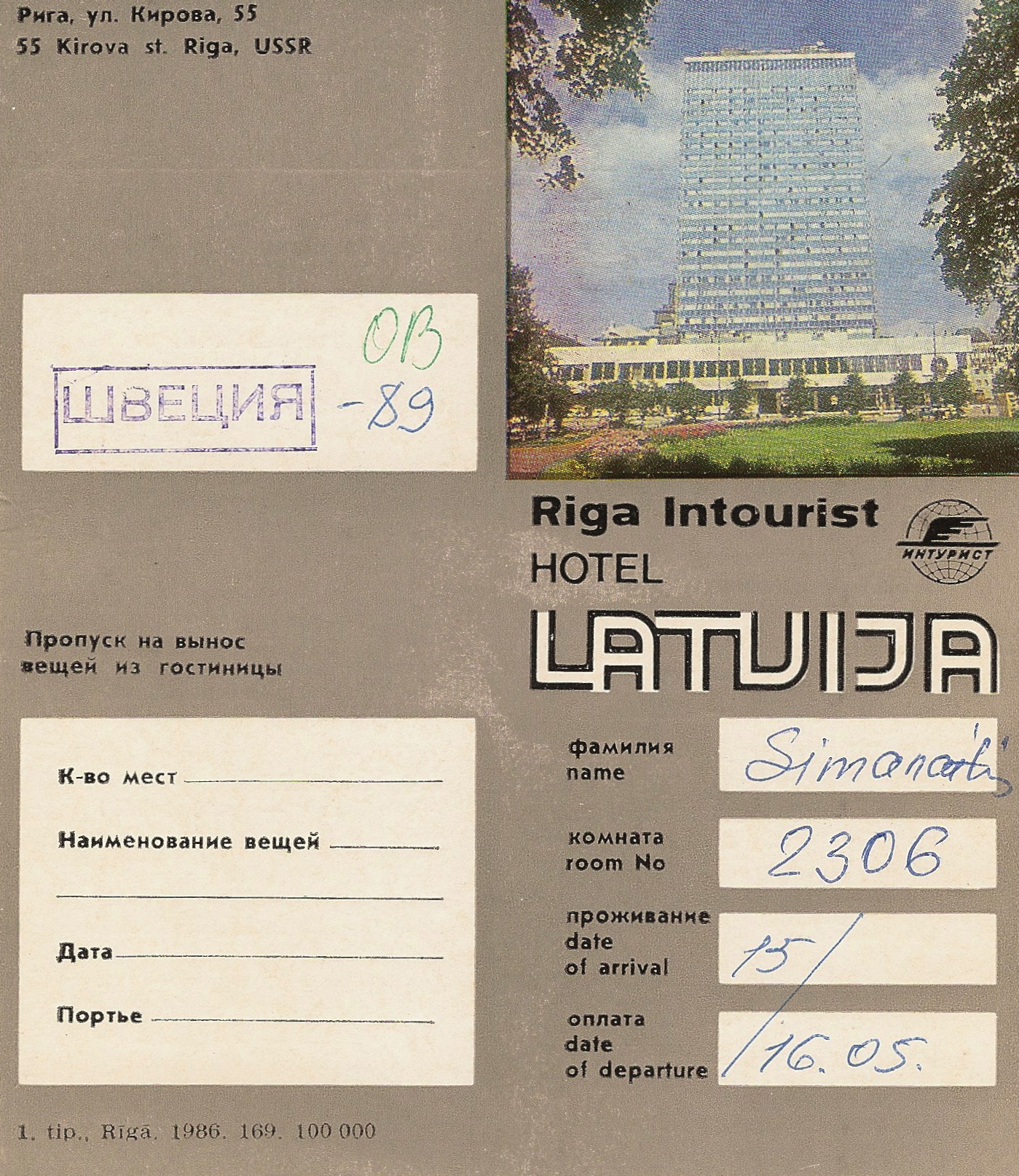
Our hotels were quite modern, generally built by Scandinavians.
Similar tales were related in Estonia. A Home Guard contingent of young men congregated in front of a radio-TV facility. The banner on a four-page English language newspaper was telling: May 9, 1990, No. 4, only one day after Estonia declared its independence.

It is not often that we sense history with such immediacy.
There were expressions of optimism, of relief and of joy. Walking around Tallin’s town square, we heard a woman’s voice practicing a Mozart aria. Our Saabs attracted people and seemed to encourage their optimism: Here were rolling examples of their enhanced involvement with the west.
Our drive ended in Russia. We were advised, “Expect to be stopped for speeding—regardless of what speed you’re driving. The very friendly policemen want only to sell you one of their speeding tickets. Price: 5-10 rubles (about $1-$2 U.S.).” Saab even gave each of us a 10-ruble note for this “fine souvenir.”
So there I was, driving briskly in a white Saab convertible with my pal Denise McCluggage. Sure enough, down at the bottom of a hill was a non-descript dark sedan, its policeman already at the roadside with his lollipop guiding me to a halt.
Great, I thought, here comes my souvenir.
“Passport,” he said.
He worked through its roman characters. “Simanaitis,” he said, with perfect pronunciation. “Litovski?,” he asked.
“Yes, my great-grandparents, I guess.”
Then he asked for Denise’s passport. “McCluggage” took him rather longer to decipher.
Then he looked at each of us. “Simanaitis…. McCluggage…” He smiled at both of us, winked to me, saluted and said, “Horosho! Do svidanya.”
Based on all this, my loose translation: “Good for you! Have a nice day.”

This is in lieu of my souvenir speeding ticket.
And that’s why I still have this 10-ruble note. ds
 Simanaitis Says
Interesting that several times over the years I’ve become good friends with, or correspondents of, people that turned out later to be of Lithuanian heritage. My father was Lithuanian. That helps explain – aside from the technical virtuosity – why I always looked first for the Simanaitis by-line on the R&T contents page . . .