
Simanaitis Says
On cars, old, new and future; science & technology; vintage airplanes, computer flight simulation of them; Sherlockiana; our English language; travel; and other stuff
LE MANS
WITH THE Le Mans Vingt-Quatre Heures de l’Endurance coming later this month, it’s appropriate to recall Le Mans tales, several entertaining, one horrific.
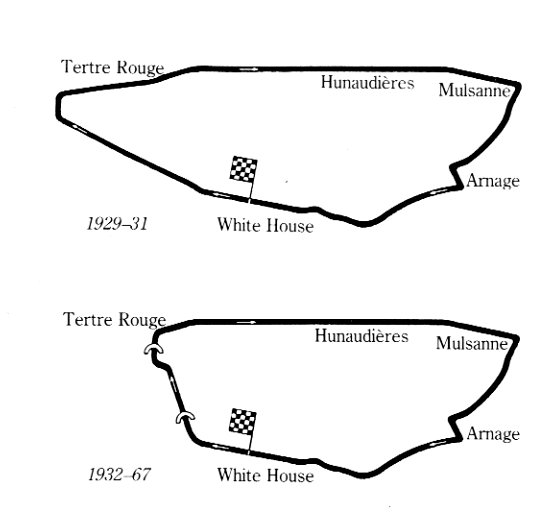
Le Mans, the early days until 1967. From the first race in 1923 to today, Le Mans has been held on public roads closed for the event.
Its Le Mans start is historical now, but this was a regular feature of racing at Le Mans and other circuits until the late 1960s. All the cars lined up angled in the direction of travel. Drivers stood opposite their cars across the track. The flag dropped, drivers ran to their cars, hopped in, fired up—and all hellacious competition broke loose.
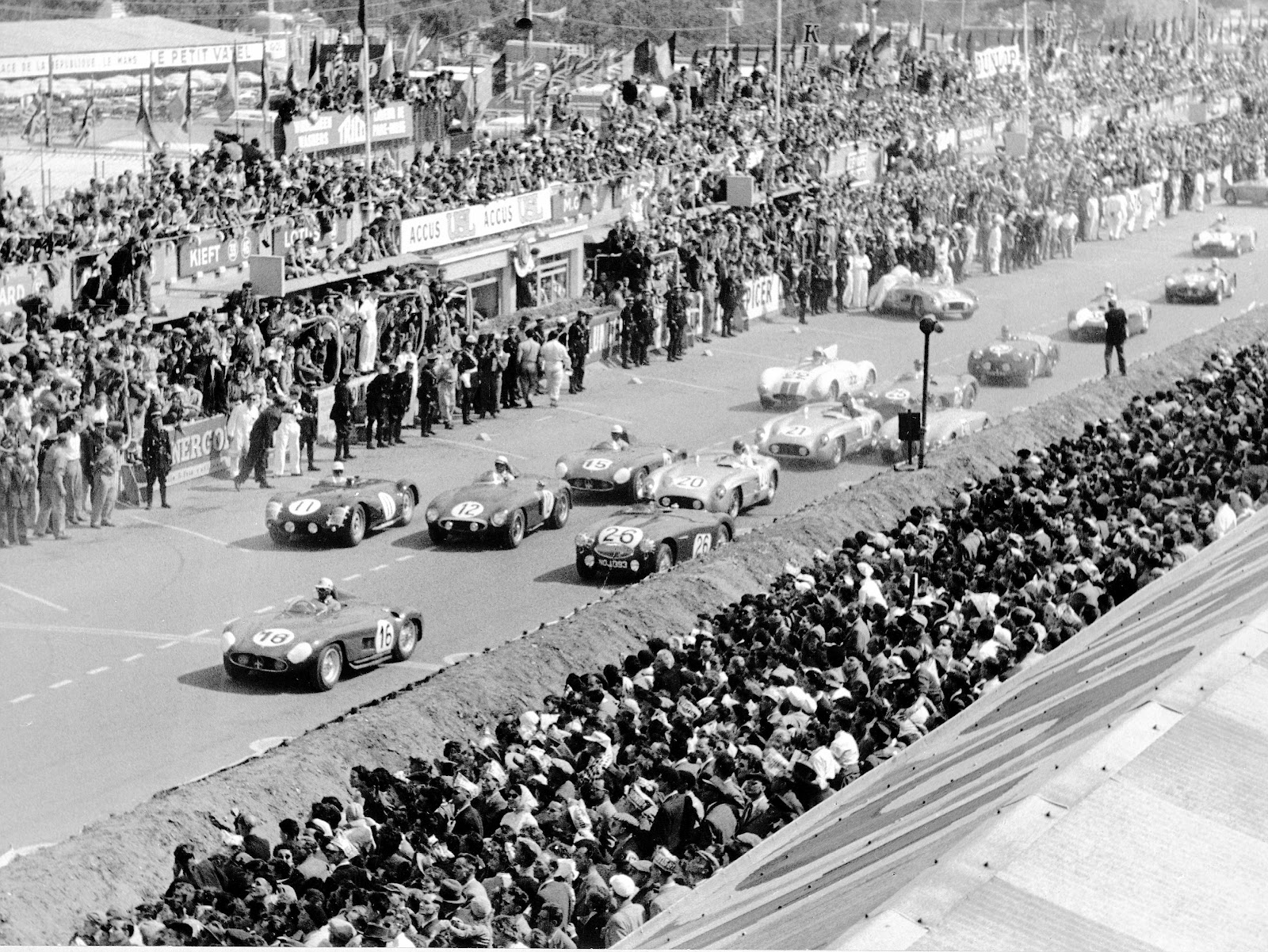
Le Mans, shortly after the foot race, 1955. Powerful Maseratis, Ferraris and Mercedes-Benzes mix with Austin-Healeys and Triumphs. Image from Daimler-Benz archives.
Cars were arranged by engine size, the largest in front. However, as shown in this photo, a quick-footed Lance Macklin put his Austin-Healey (#26) temporarily ahead of the Mercedes-Benz SLRs of Pierre Levegh (#20) and Karl Kling (#21). Tragically, Macklin, Levegh and Jaguar D-Type driver Mike Hawthorn were to interact 35 laps later in the worst accident of motor racing history.
Along the pit straight, Macklin swerved to avoid a late-pitting Hawthorn. Levegh’s Mercedes hit the Austin-Healey. The Mercedes went airborne and disintegrated into the crowd. Eighty-four people, included Levegh, perished.
Much has been written about the accident. A particularly moving first-hand account, not often cited, is in Paris in the Fifties, by Stanley Karnow, illustrations by Annette Karnow, Times Books, 1997.
The circuit, essentially unchanged from the early days, was widened after the 1955 carnage. Safety regulations were strengthened. However, traditional Le Mans starts remained through the 1969 race. Its winner, Jacky Ickx, purposely lagged back and buckled up before entering the fray.
In 1924-1928, drivers did more than run across the track: Those with open cars had to erect the soft top, and this structure had to survive 20 laps. In one race, a small sedan led—ever so briefly—because its driver had no top-fiddling to do. In 1927, one of the favored Bentleys had to stop after 100 yards when the top came loose.
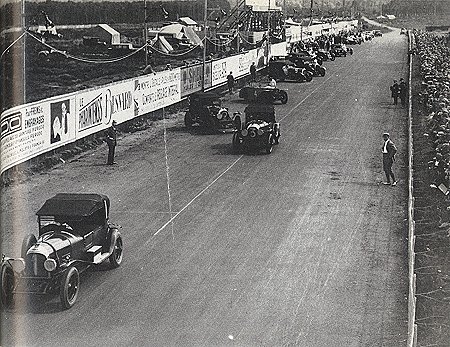
Bentley No. 1 gets its top up first; others to follow.
Even with this initial setback, the 1927 Le Mans remains a glorious legend among Bentley enthusiasts.
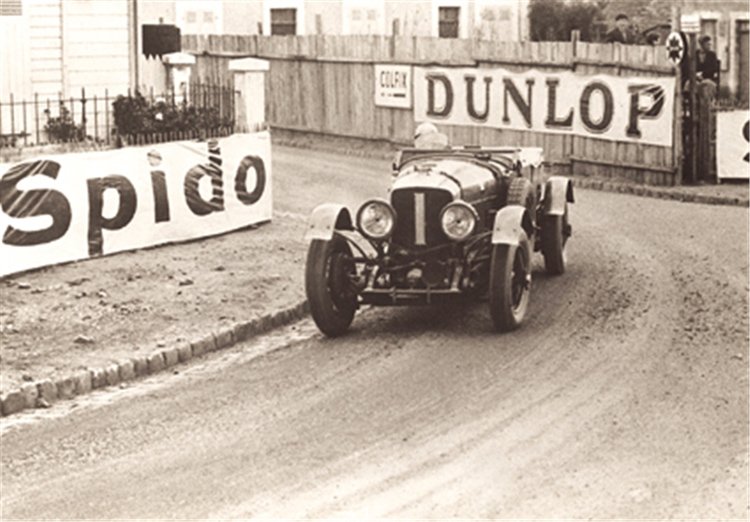
Top stowed after its regulatory 20 laps, No. 1 ran well with the other team Bentleys until twilight.
Around twilight, another spinning car collected the entire Bentley entry at White House Corner. Drivers were relatively unscathed, but their cars were hors de combat, with the exception of “Old No. 7,” carrying No. 3 in this race.
This Bentley soldiered on with a bent frame and front axle, its fenders and running boards crumpled—and a Smiths work lamp wired in place as a second headlight. And, amazingly, it won!
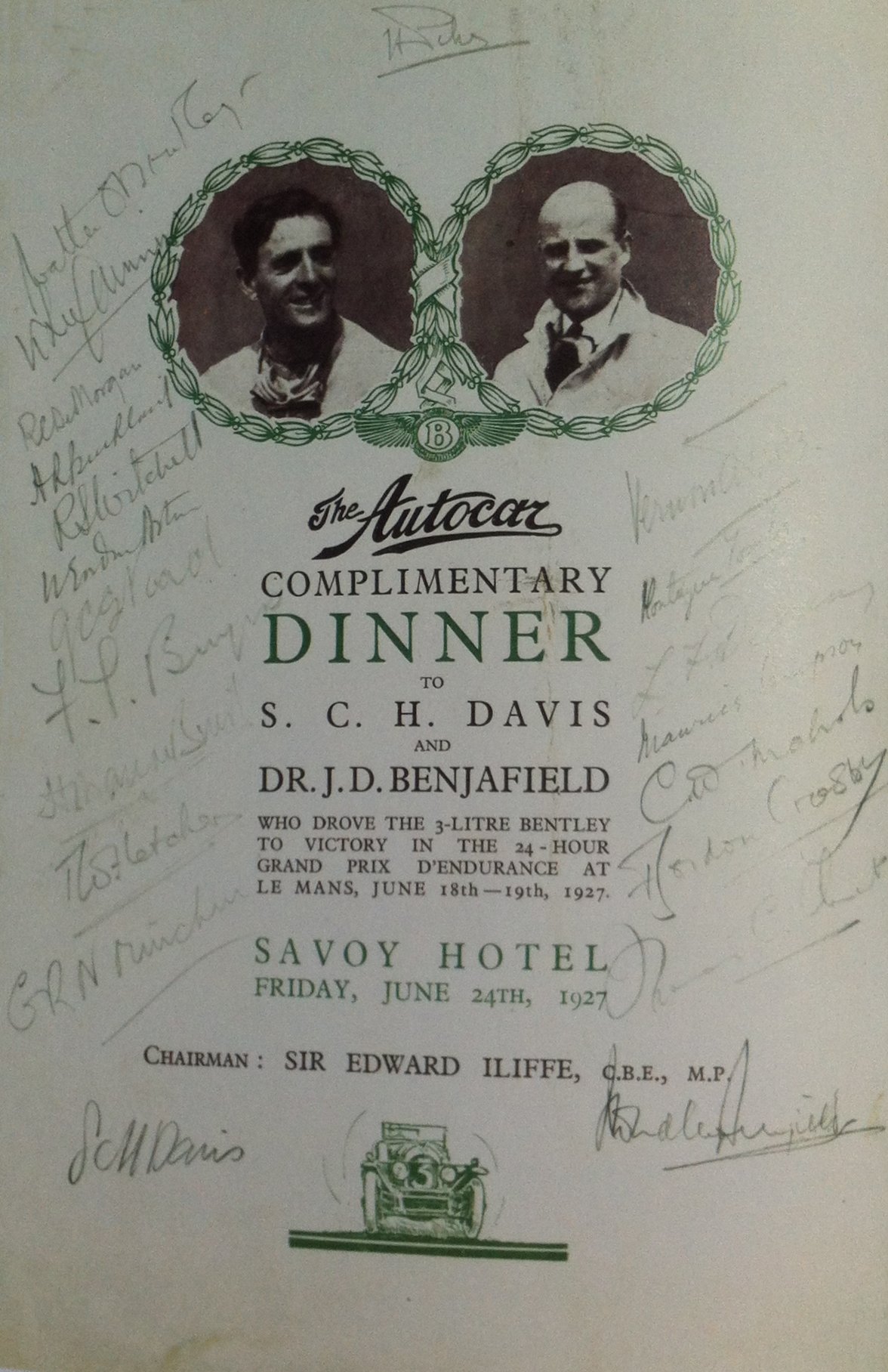
London’s Savoy Hotel had a special visitor, by invitation. These images from Bentley–The Story, by Andrew Frankel, Redwood Publishing, 2003.
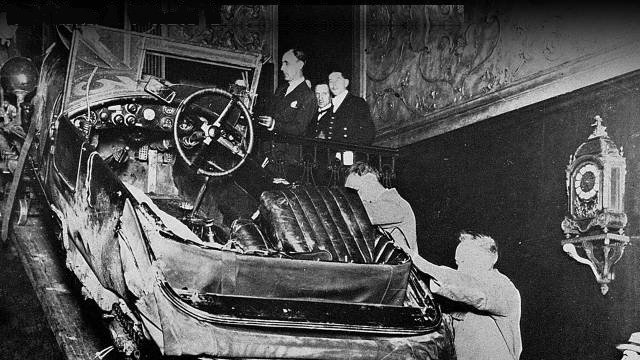
Celebrations continued later at London’s posh Savoy Hotel—where the Bentley Boys congregated.
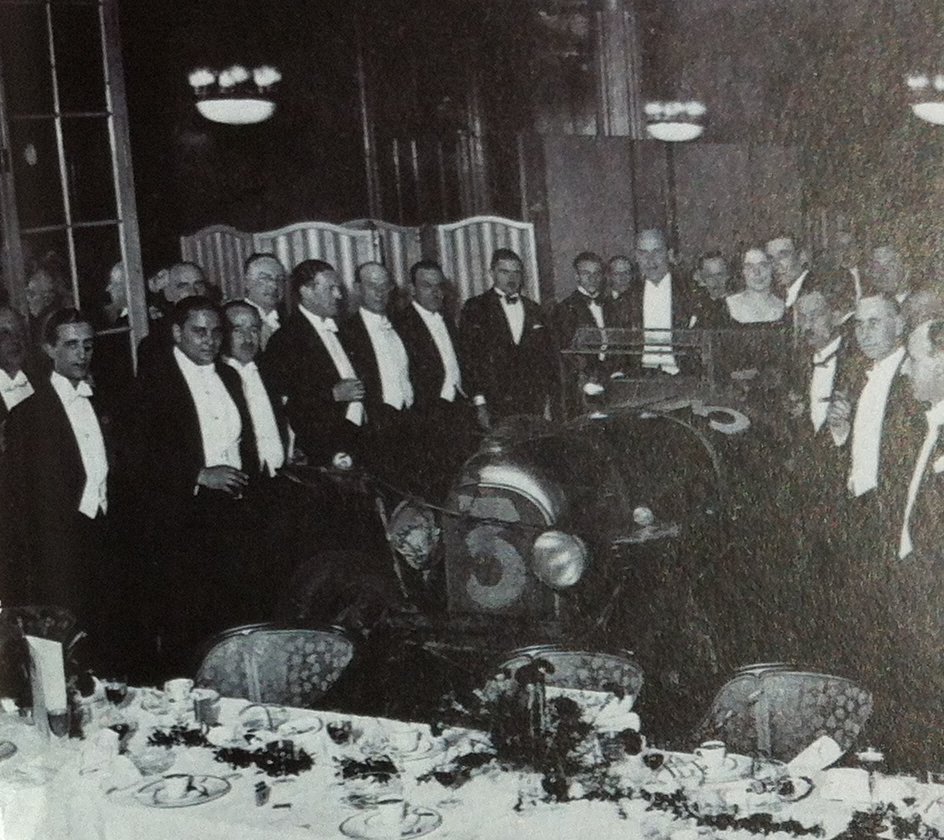
The Bentley Boys knew how to party.
The victorious Bentley No. 3 was brought into the dining room, its “single headlight ablaze and engine running.” ds
© Dennis Simanaitis, SimanaitisSays.com, 2013
 Simanaitis Says
Excellent, Dennis!
Pingback: Hooniverse Asks: ’50s Edition- What’s the Greatest Race Car of the Nineteen Fifties? | Hooniverse