
Simanaitis Says
On cars, old, new and future; science & technology; vintage airplanes, computer flight simulation of them; Sherlockiana; our English language; travel; and other stuff
I REALLY LIKE THAT SONG TOO, FROGGIE
HERE’S A TANTALIZING TITLE FOR A TECHNICAL PAPER: “Humans Share Acoustic Preferences With Other Animals,” by Logan S. James et al., AAAS Science, March 19, 2026. Science editor Sacha Vignieri offers a summary: “Humans have well-known affinities for pleasant sights and sounds such as flowers and music. Other animals also display such preferences, notably when choosing a mate.”

Vignieri continues, “Humans and other animals’ shared histories and preferences for certain stimuli suggest that these preferences may be conserved, a phenomenon Darwin called a shared ‘taste for the beautiful.’ James et al. tested for the presence of such shared preferences for sounds and found that human participants preferred sounds that the nonhuman animal receivers preferred and with the same strength. This was true across multiple different taxa, including birds, frogs, and amphibians.”
Here are other tidbits gleaned from this research.

Creds. Researchers Logan S. James, Sarah C. Wooley, and Jon T. Sakata are at Montreal’s McGill University Centre for Research on Brain, Language, and Music; Courtney B. Hilton and Samuel A. Mehr are at Yale University’s Child Study Center; and Michael J. Ryan is at the Department of Integrative Biology, University of Texas at Austin. Their other academic affiliations include the Smithsonian Tropical Research Institute in Gamboa, Panama; Australia’s Melbourne School of Psychological Sciences, University of Melbourne; New Zealand’s School of Psychology, University of Auckland; and the International Laboratory for Brain, Music, and Sound Research, Department of Psychology, Université de Montréal. Quite the international array of institutions.
Adorned, Ancestral, and of Lower Frequency. In their Abstract, researchers James et al. note, “In this study, we show that humans share acoustic preferences with a range of animals, that the strength of human preferences correlates with that in other animals, and that humans respond faster when in agreement with animals. Furthermore, we found greatest agreement in preference for adorned, ancestral, and lower-frequency sounds.”
The researchers cite, “Darwin suggested that some animals ‘have nearly the same taste for the beautiful as we have.’ Here, we report a citizen-science experiment testing this hypothesis.”
Methodology. The researchers describe, “We gathered 110 pairs of sounds produced by 16 nonhuman animal species (hereafter, animals), which were recorded in prior research, and played them to humans recruited globally online [4196 participants] in a gamified experiment: Participants rated which of the two sounds in a pair they ‘liked more’ ”
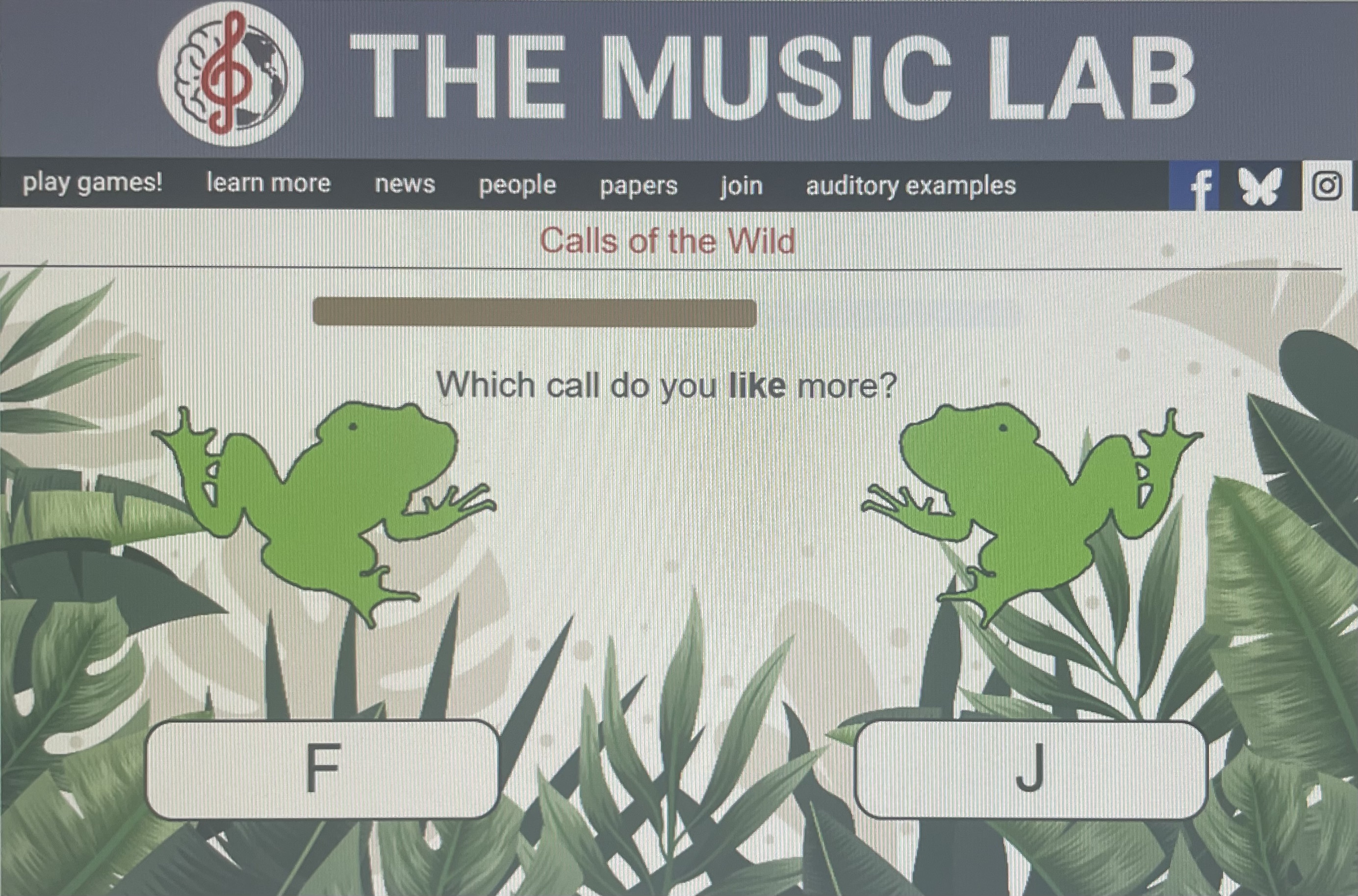
This and following image from James et al.
Animals’ Choices. “For each stimulus pair,” the researchers describe, “the animals from which the sounds originated are known to display a preference for one of the two sounds (hereafter, the more attractive sound). For example, male túngara frogs can produce a simple call or a complex one that includes an acoustic adornment; female frogs choose a complex call over a simple call ~84% of the time, a 5:1 preference. The strength of animals’ preferences varied [55 to 93%], enabling tests of the degree to which human preferences were similar to those of other species.”
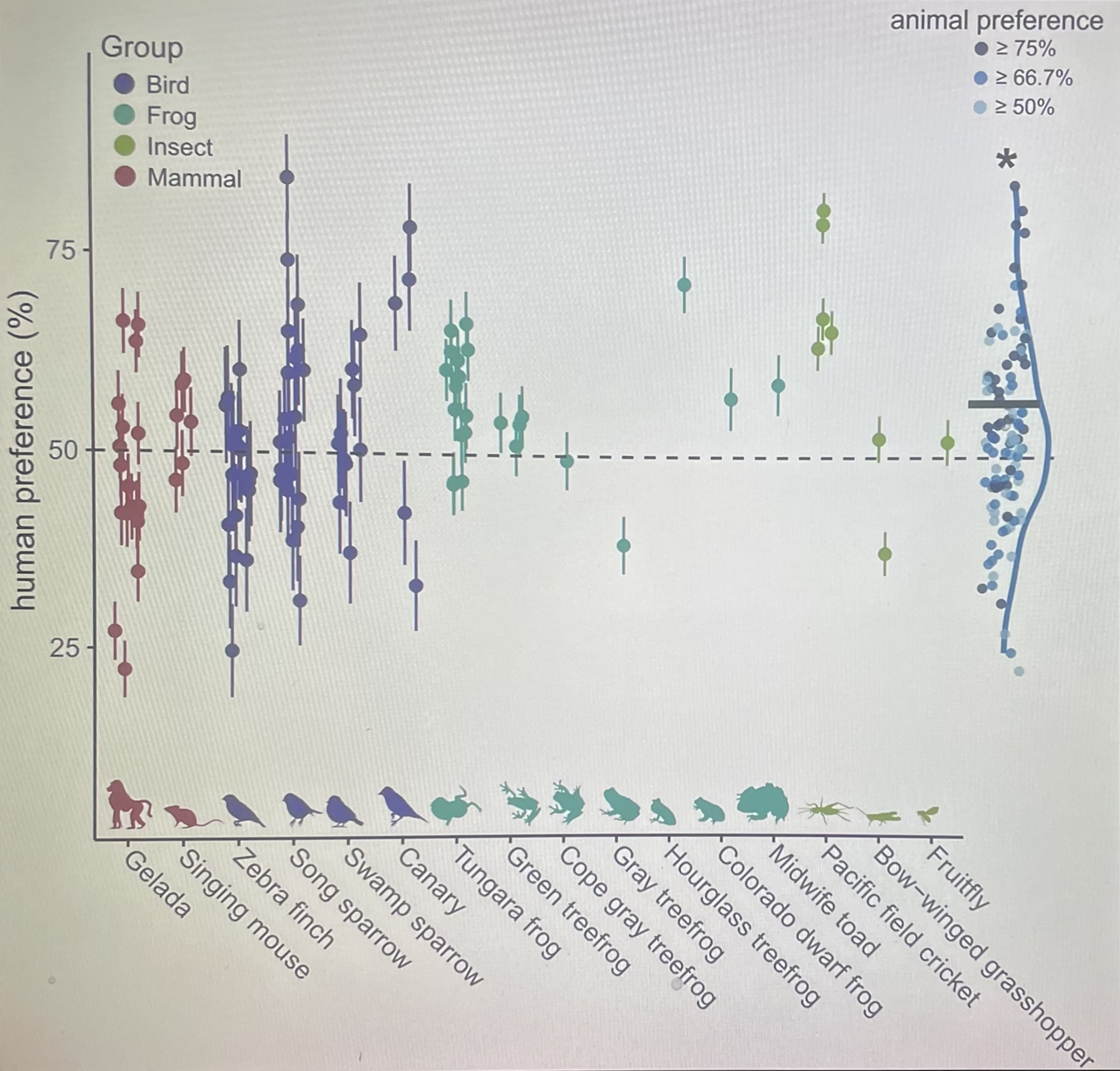
The researchers recount, “Humans chose the more attractive sound above chance. In the main plot, the dots each depict the percent of humans who preferred the more attractive sound from a given species; the vertical lines represent 95% CIs, and the horizontal dotted line represents chance (50%).”
“To the right,” researchers continue, “each dot represents the mean level of human preferences for a stimulus pair, with color indicating the strength of preference in animals. The solid blue line represents a kernel density estimation, and the horizontal bar denotes the mean across stimulus pairs with at least a 2:1 preference in animals.”
Human Choices. The researchers cite, “There were three principal findings. First, human preferences for animal sounds correlated with the preferences of the animals themselves. The percent of humans that selected the more attractive sound correlated positively with the animal’s strength of preference.”
“Second,” the researchers cite, “agreement between human and animal preferences was higher when the animals’ preferences were more robust. When animals exhibited moderately strong preferences (at least 2:1 odds, or 67%), humans were significantly more likely than chance to choose the more attractive sound.… Moreover, we found no significant differences in agreement across the large clades of animals present in the study (birds, mammals, frogs, or insects).”
Humans Reaction Times. “Third,” the researchers relate, “shared preferences across humans and animals were supported by two additional measures. Humans answered 51 ms faster, on average, when choosing the more attractive sound than the less attractive one…. Their responses were also internally reliable: In a subset of trials, we played participants the same stimulus pair twice and found that their preference was maintained across both presentations at a rate higher than chance (63% were the same choice, on average).
Are Human Musicians More Sensitive? “Lastly,” researchers relate, “we tested whether characteristics of the participants were predictive of their agreement with animals. We predicted that prior experience with animal sounds and musical expertise would predict human preferences given that experience can shape auditory perception and preferences.”
Nope: The researchers report, “Humans with experience identifying animals by their sounds, such as birders (“animal experts”; n = 3730, ~90% of participants) and expert musicians (n = 730, ~19% of participants), exhibited similar degrees of agreement as nonexperts…. The only significant predictor of agreement was time listening to music, with those reporting more time listening to music per day agreeing with animals more.”
As noted in my title, it’s music listeners who say, “I really like your song too, Froggie.” ds
© Dennis Simanaitis, SimanaitisSays.com, 2026
 Simanaitis Says