
Simanaitis Says
On cars, old, new and future; science & technology; vintage airplanes, computer flight simulation of them; Sherlockiana; our English language; travel; and other stuff
KIT MARLOWE—AN ELIZABETHAN JOHN LE CARRÉ PART 1
GREAT WRITERS THINK ALIKE. And also, moderate hacks occasionally parallel the thoughts of competent authors. I’m thinking of two examples: Christopher Marlowe and John le Carré. And me and London Review of Books contributor Michael Dobson.

Michael Dobson writes of “Flash and Thunder,” London Review of Books, March 5, 2026, a review of Stephen Greenblatt’s Dark Renaissance: The Dangerous Times and Fatal Genius of Shakespeare’s Greatest Rival. The latter, of course, being Christopher Marlowe.
And I am the hack having offered “Elizabethan Noir,” SimanaitisSays, December 4, 2021, in which I admit my favorite Elizabethan noir playwright is Christopher Marlowe, whom Dobson likens to “David Cromwell né John le Carré.”
Following here are tidbits gleaned from Dobson’s LRB piece, together with my usual Internet sleuthing (hacks included).
Plays About Marlowe, Not By Him. Dobson notes that Kit hasn’t been modern-day SRO: “That isn’t to say that Marlowe isn’t good box office any more: It’s just that the RSC [Royal Shakespeare Company] finds it easier to sell seats for plays about Marlowe than plays by Marlowe. Soon after he had finished playing the title role in Edward II at the Swan, Daniel Evans directed a revival of Liz Duffy Adams’s Born with Teeth at Wyndham’s in the West End, with Ncuti Gatwa as Marlowe. First produced in Houston in 2022, Born with Teeth positions its Marlowe as the bad angel to a less worldly Shakespeare.”
Being a dedicated Marlovian, I find this premise an interesting one.
Image from The Marlowe Society.
Joe Orton and a Dash of Espionage. “Like other recent fictionalised Marlowes,” Dobson relates, “this one, though proud of his humble origins, displays an aristocratic contempt for the credulous and the uncreative, with an admixture of Joe Orton and a dash of espionage. In Adams’s script the two playwrights complicate the mutual attraction developed while co-writing Henry VI by flirting with the possibility of betraying and/or killing each other, for reasons never satisfactorily explained by some clunky passages of political exposition. While their imagined relationship owes something to that between Mephistopheles and Faustus, the play’s intimate prose could hardly be further from Marlowe’s hyperbolic flash and thunder.”
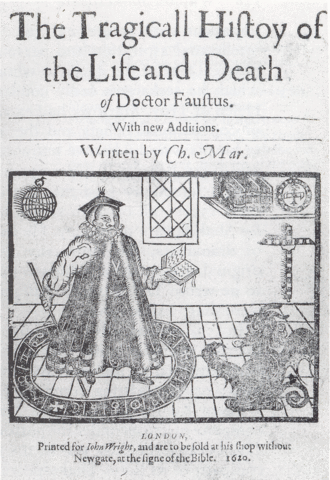
Frontispiece to a 1620 printing of Doctor Faustus showing Faustus conjuring Mephistophilis. The spelling “Histoy” is agreed to be a typographical error. Image from Wikipedia.
Mention of Faustus reminds me of “the wonderful tale that, in one Elizabethan production, an even dozen actor-devils were to drag Faustus to hell, but thirteen devils were on stage.”
Pause here for a shiver.
Tomorrow in Part 2, we’ll continue enjoying Dobson’s crafty writing and Marlowe’s complex personality. ds
© Dennis Simanaitis, SimanaitisSays.com, 2026
 Simanaitis Says