
Simanaitis Says
On cars, old, new and future; science & technology; vintage airplanes, computer flight simulation of them; Sherlockiana; our English language; travel; and other stuff
A RUBE GOLDBERG-SORTA TALE
THE MARCH 2, 2026, AAAS SCIENCE HAS REVIEWS of fourteen books selected from two lists prepared annually by the National Science Teaching Association and the Children’s Book Council—the “Best STEM Books K-12″ list and the “Outstanding Science Trade Books for Students K-12” list. One of the books particularly caught my eye because of “On the Smoot,” SimanaitisSays, October 7, 2021. Another, from which tidbits are gleaned here, is a cultural/scientific analysis of Rube Goldberg. As is my custom, I accompany this with Internet sleuthing.

An Introduction. Marc S. Lavine, a Senior Editor at Science, recounts, “Most people’s names do not get turned into an adjective, much less one immersed in popular culture. However, Rube Goldberg’s name will always be connected to the idea of adding complication and complexity to an otherwise simple process. This is a notion he pioneered through his long career as a cartoonist, but it has found new life through the emergence of the internet and video-sharing platforms where ‘Rube Goldberg’ ways of doing things find widespread popularity.”
I respect Rube Goldberg’s achievements, at least in part because my own research techniques have been known to devolve into analogous intellectual machinations.
Rube Goldberg, the Polymath. As Wikipedia notes, though Rube Goldberg won a Pulitzer Prize for political cartooning in 1948, he was more than an artist of this genre.
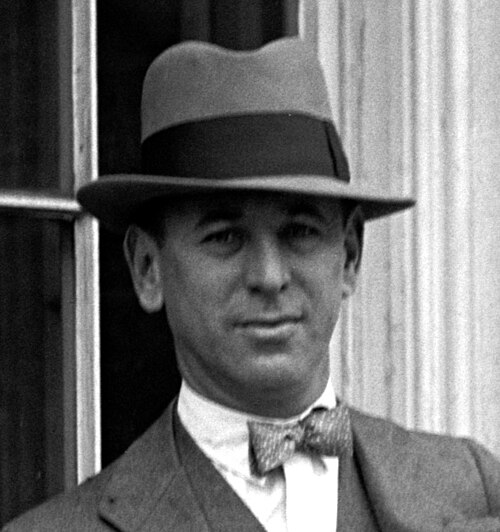
Reuben Garrett Lucius Goldberg, 1883–1970, American cartoonist, sculptor, author, engineer, and inventor. Image, 1929, by the National Photo Company via Wikipedia, available from the U.S. Library of Congress Prints and Photographs.
Having earned an engineering degree from the University of California, Berkeley, Goldberg worked as a city engineer for six months before he became a sports cartoonist for the San Francisco Chronicle. Another San Francisco newspaper job followed a year later, then in 1907 Goldberg moved to New York City as a sports cartoonist with the New York Evening Mail.
Wikipedia recounts, “Goldberg’s first public hit was a comic strip called Foolish Questions, beginning in 1908. The invention cartoons began in 1912. The New York Evening Mail was syndicated to the first newspaper syndicate, the McClure Newspaper Syndicate, giving Goldberg’s cartoons a wider distribution, and by 1915 he was earning $25,000 per year and being billed by the paper as America’s most popular cartoonist.”
Gee. $25,000/year in 1915 was real cash.
Wikipedia continues, “The cartoon series that brought him lasting fame was ‘The Inventions of Professor Lucifer Gorgonzola Butts, A.K.,’ which ran in Collier’s Weekly from January 26, 1929, to December 26, 1931. In that series, Goldberg drew labeled schematics in the form of patent applications of the comically intricate ‘inventions’ that would later bear his name.”
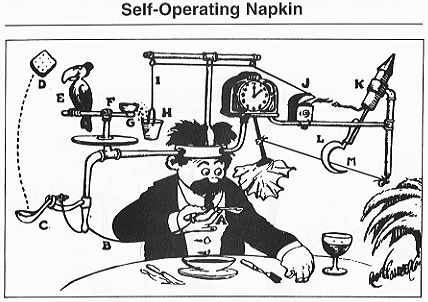
Professor Butts and the Self-Operating Napkin. Image via Wikipedia originally in Colliers, September 26, 1931.
It took awhile, but in 1966 the Random House Dictionary of the English Language included the term “Rube Goldberg” meaning “having a fantastically complicated improvised appearance”, or “deviously complex and impractical.”
Goldberg, 87, died in 1970. He is the inspiration for international competitions known as Rube Goldberg Machine Contests, which challenge participants to create a complicated machine to perform a simple task.
Smash, Crash, Topple, Roll! A Book Review. Marc S. Lavine recounts, “From the creative minds of author Catherine Thimmesh and illustrator Shanda McCloskey comes Smash, Crash, Topple, Roll!—intended for readers aged 8 to 12—with three interspersed and intertwined themes, in the true spirit of Goldberg’s way of viewing the world. The first is an accounting of Goldberg’s life and accomplishments. The second is a breakdown of a typical Rube Goldberg machine, including detailed instructions on how to plan and build your own. And the third is an explanation of the physics behind six simple machines, such as a lever and an inclined plane, as these frequently appear in Rube Goldberg constructs.”
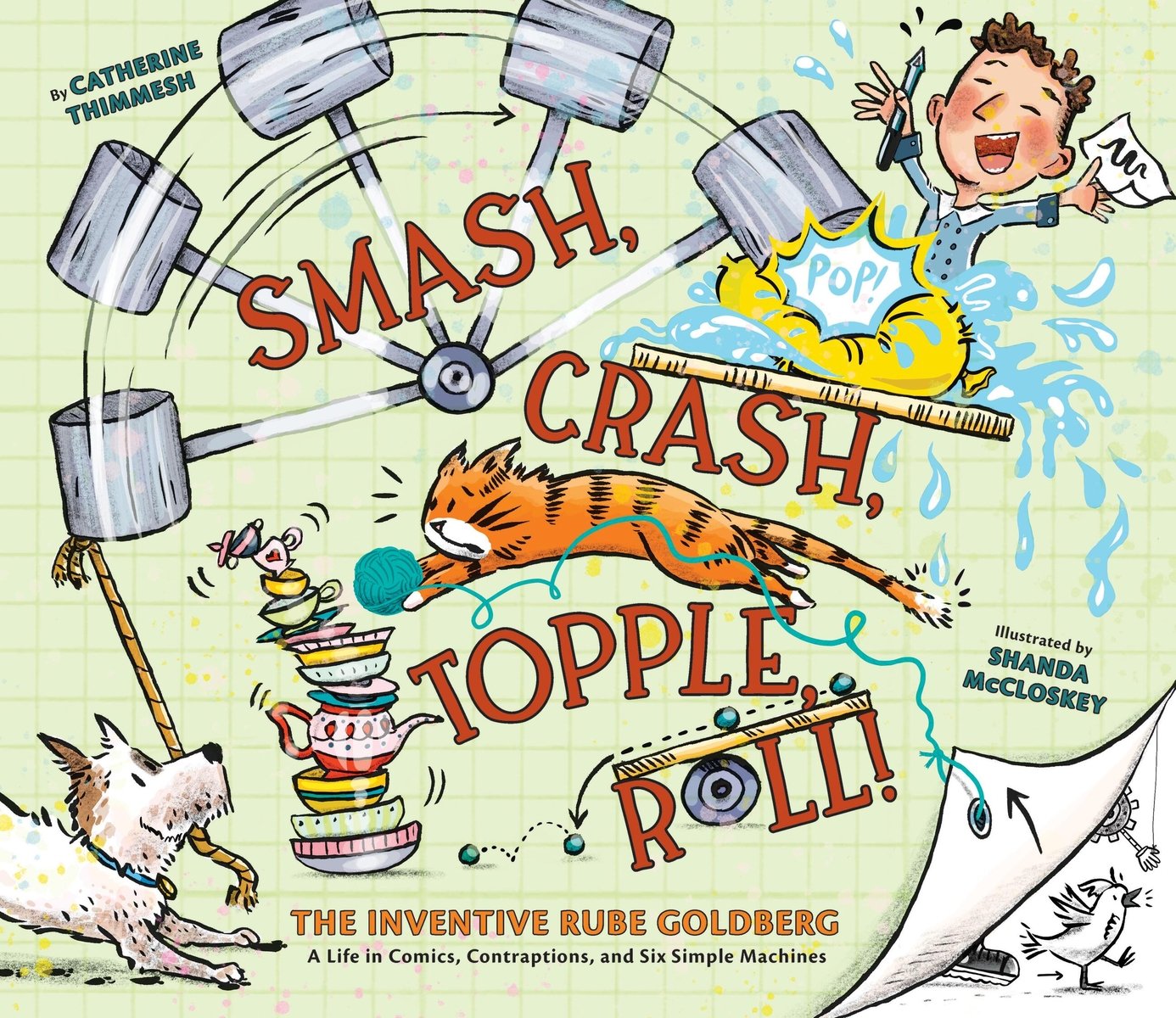
Smash, Crash, Topple, Roll!, The Inventive Rube Goldberg—A Life in Comics Contraptions, and Six Simple Machines, by Catherine Thimmesh, author, and Shanda McClosky, illustrator; Chronicle Books, 2025.
Lavine’s review continues, “Born in 1883, Goldberg grew up at a time of rapid technological and industrial development. His passion for drawing and cartooning emerged at a young age, but it was his training as a mining engineer—a career path his father tried to force—that led him to envision unnecessary complexity as a source of humor. A key second ingredient to his thinking was that it was the chain reaction of steps, and not the final accomplished task, that entertained the readers. In that vein, one could argue that Thimmesh and McCloskey have either crafted a biography that teaches physics, or a physics book that encourages creativity, or a book about trial and error to tell readers about Rube Goldberg’s life. No matter how you view it, you are likely to find it enjoyable, educational, and entertaining.”
And not only if you’re 8 to 12. Smash, Crash, Topple, and Roll! sounds like good fun. ds
© Dennis Simanaitis, SimanaitisSays.com, 2026
 Simanaitis Says