
Simanaitis Says
On cars, old, new and future; science & technology; vintage airplanes, computer flight simulation of them; Sherlockiana; our English language; travel; and other stuff
A SELF-SUPPORTING NOBLE COMPOSER—AND A WOMAN AS WELL PART 1
THERE’S A LONG HISTORY OF COMPOSERS depending upon nobility for their livelihood: Vivaldi and Emperor Charles VI, Bach and Prince Leopold of Anhalf-Cöthen, Handel and the British royalty, Haydn and the Esterházy family, Mozart and Emperor Joseph II, Beethoven and Archduke Rudolph among others, Wagner and King Ludvig II of Bavaria, to name several. But here’s a countess who, in her lamentably short life, all but established her country’s musical tradition yet did so independently.
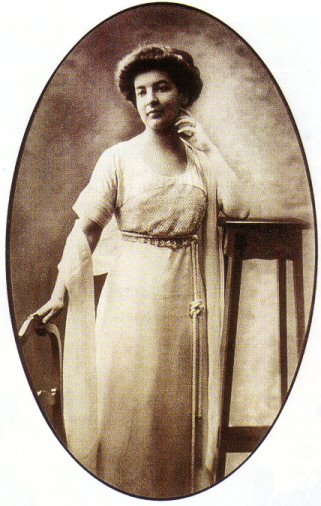
Countess Maria Theodora Paulina “Dora” Pejačević, 1885–1923, Croatian composer, pianist, violinist, something of a socialist despite her class. Image from Wikipedia.
Principal Sources. My primary source about Dora Pejačević is Pamela Blevins’ “An Introduction to Croatian Composer Dora Pejačević.” Wikipedia also provided tidbits which follow here in Parts 1 and 2 today and tomorrow.
Introductions Are In Order. Indeed, Pamela Blevins’ introduction to Dora Pejačević was as serendipitous as mine: I came upon Pejačević’s Symphony in F-sharp minor, midstream, on SiriusXM’s “Symphony Hall.” Its lyricism mixed with complexity caught my ear.
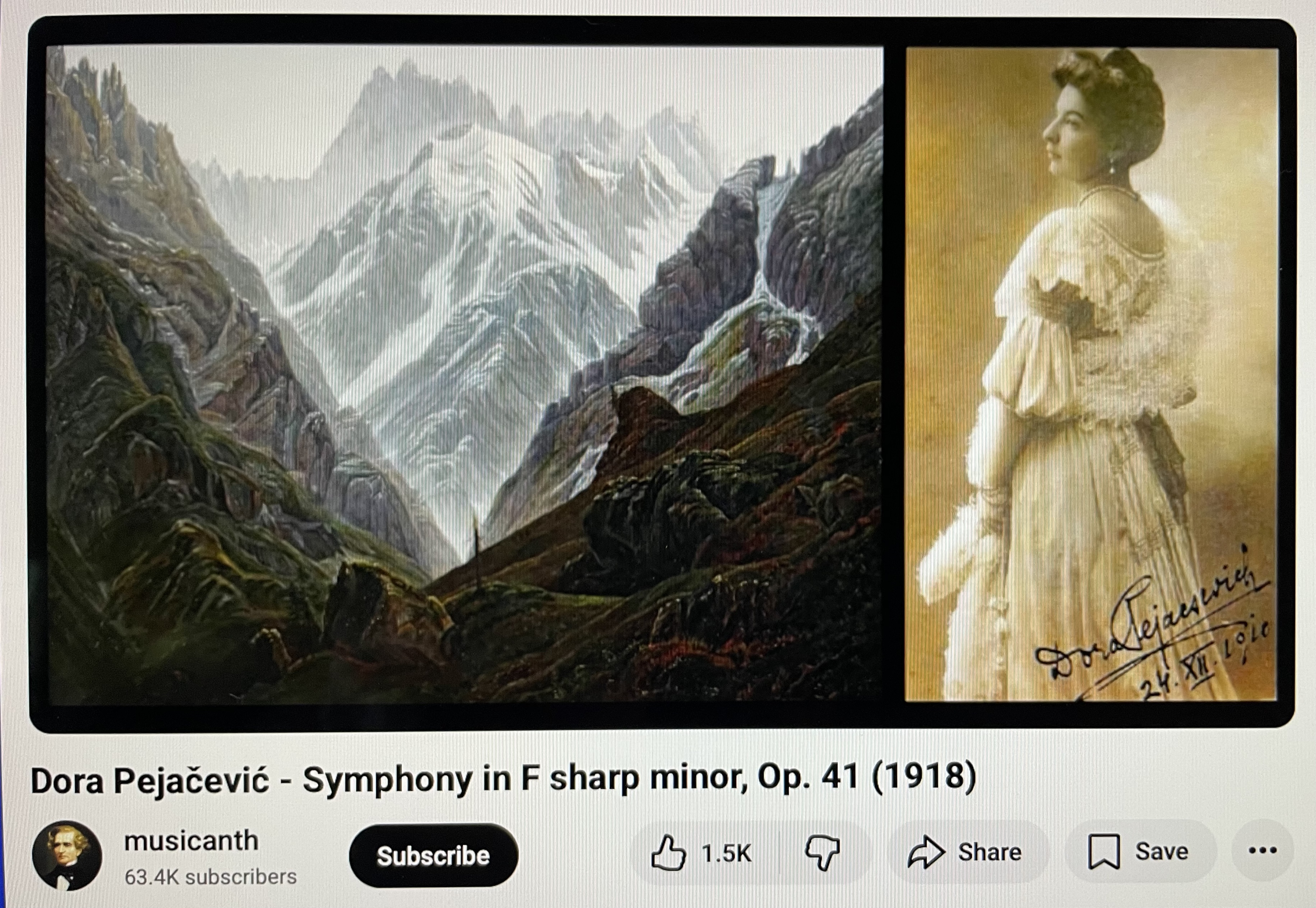
Here is the piece in its entirety from YouTube. (It makes wonderful listening as you read on.)
Colleen Wheelahan, the charming morning commentator on “Symphony Hall” related just enough of the composer’s background to identify Dora Pejačević as a woman worthy of admiration.
And Pamela Blevins’ article begins with thoughts similar to mine: “I must admit that I had never heard of Dora Pejačević until I came home one afternoon several years ago and found her on my doorstep. She had arrived in a very large, somewhat travel-worn package from Croatia — the Croatian Music Information Center to be exact. What a treasure trove I found when I opened it — the newly published score of her first symphony, an illustrated, dual-language biography with a sampler CD as well as two other non-commercial CDs of her larger works — the symphony and piano concerto. These were sent to me because I edited Signature, our online magazine about women in classical music.”
A Croatian/Hungarian Heritage. Blevins continues, “Maria Theodora Paulina Pejačević (Dora) was born on 10 September 1885 in Budapest, a new addition to a noble Croatian family that had long played a significant role in the political life of that nation. Her mother was an Hungarian countess, a woman of great beauty who was a trained singer, played the piano and was a fine amateur painter. She was also an authoritarian force who was often at odds with her strong-willed, intellectual daughter whose curiosity led her to rebel against the constraints of the aristocratic life into which she had been born.”
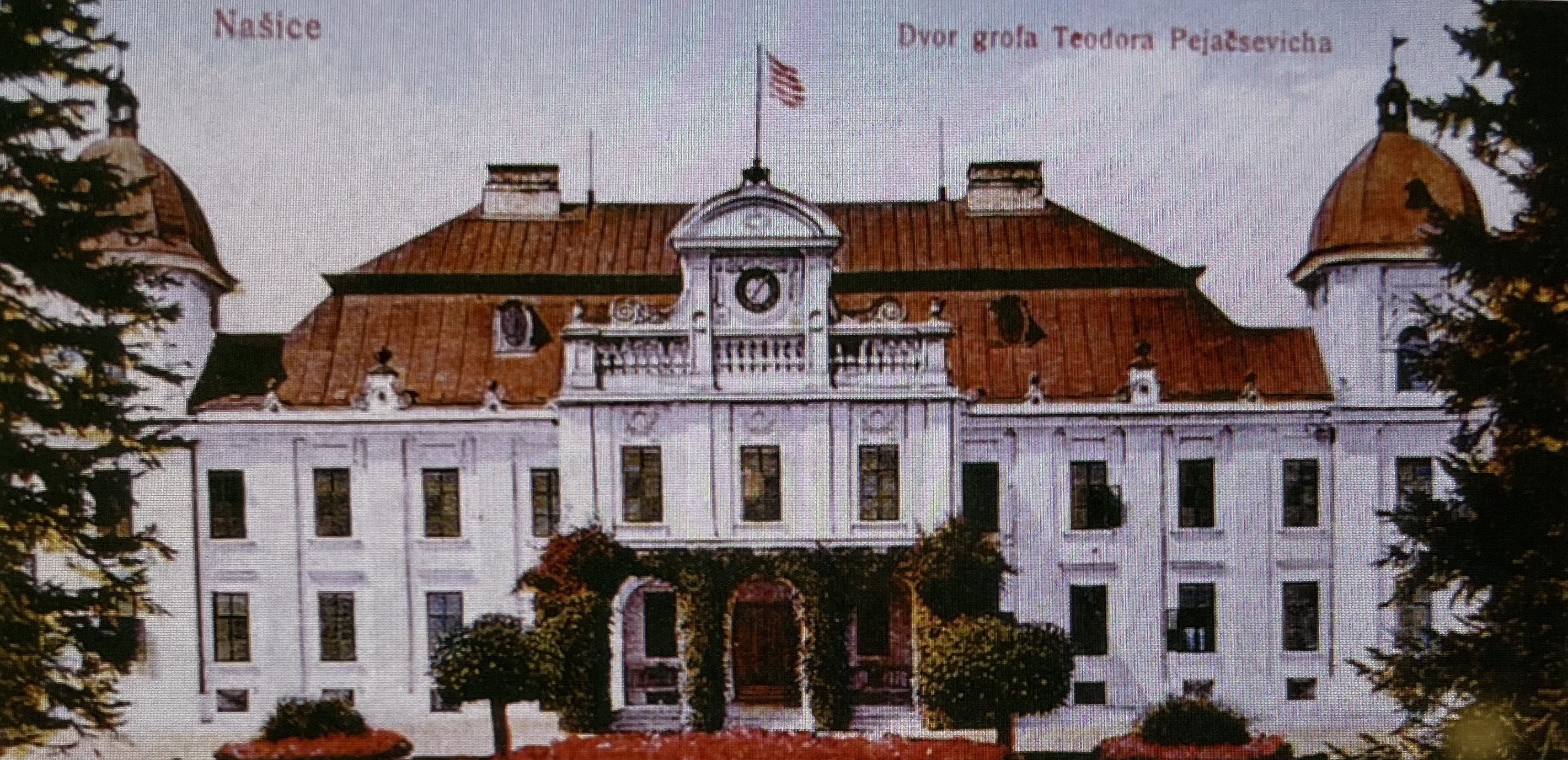
The family’s palatial home in Našice. This and the following from Pamela Blevins’ article.
Wikipedia recounts that Dora’s father, Teodor Pejačević of Virovitica, was a Croatian count with mostly magyar ancestors…. Pejačević and her family resided in their family castle in Našice, but they also spent much of her time in Vienna, Budapest, Prague, and Munich.”
Curiosity Widens Dora’s Aristocratic Life. “Tutored privately at home by an English governess,” Blevins relates, “Dora was fluent in several languages, including English, and easily shifted among them in her voracious reading. Curiosity was the driving force in her life. She was interested in politics; she knew how to talk to the men and women in the street and understood them. Her views led her to be labeled ‘Socialist.’ ”
Tomorrow in Part 2, we’ll learn about Dora’s musical transition from 19th-century Romantic to 20th-century Modern.
© Dennis Simanaitis, SimanaitisSays.com, 2026
 Simanaitis Says