
Simanaitis Says
On cars, old, new and future; science & technology; vintage airplanes, computer flight simulation of them; Sherlockiana; our English language; travel; and other stuff
THE PALIMPSEST OF ARCHIMEDES PART 2
YESTERDAY, WE BEGAN SHARING CLAIRE HALL’S LRB REVIEW “Maths is Second Best” of Nicholas Nicastro’s Archimedes: Fulcrum of Science. Today, we pick up with her analysis of the Hellenistic world before Archimedes.

Pre-Archimedes: “In the Hellenistic world of Archimedes’ birth,” Hall contrasts, “intellectuals weren’t meant to be practical. Stories of their childlike innocence were common. Some of the earliest concerned Thales, an astronomer in the sixth century bce who fell down a well while looking at the stars.”
“The prejudice,” she says, “was partly just ordinary people poking fun at the pointy-heads: they might have brains, but we have common sense. But elite men in the classical Greek world distrusted technical knowledge, which they associated with slavery and femininity.”
“Greek myths about craftsmen,” Hall observes, “tend to be cautionary. Hephaestus, the god of bronzeworkers, is lame and mocked for it; the titan Prometheus is punished for teaching technical skills to men; and the canniest craftsman of all, Daedalus, loses his son Icarus through his hubristic invention of artificial wings.”
The “Eureka” Tale. Hall recounts, “But Archimedes was a new type, a scientist who combined theory with practical know-how. The most famous story about him displays this combination. The ruler of Syracuse, a popular tyrant called Hieron II (the grandfather of the ruler who incurred Rome’s wrath), suspected he was being duped about the purity of a gold crown he had ordered as a religious offering. But he wasn’t certain – the crown did seem to weigh the right amount. Perplexed, he called in Archimedes.”
Hall describes, “The rest is legend: Archimedes ran naked from his bath crying ‘eureka’, ‘I’ve found it’ (the Roman architect Vitruvius, who tells us this story, takes care to mention that he shouted in Greek). Archimedes’ realisation, based on the water that spilled out of the bath when he got in, was that he could measure the water displaced by the crown and compare it to the amount displaced by a piece of gold of equal weight. Since gold is very dense, if the crown displaced more water than the equivalent piece of pure gold, it must have been adulterated with some lighter metal.”
Another Homespun Hagiography? “This might seem at first glance,” Hall says, “like another homespun hagiography. But as Nicastro points out, something about it rings true. We see exactly the same principles Archimedes outlines in Method of Mechanical Theorems: the close relationship between reality and mathematics, and the use of an experiment to solve a geometrical problem – in this case, the volume of an irregular solid.”
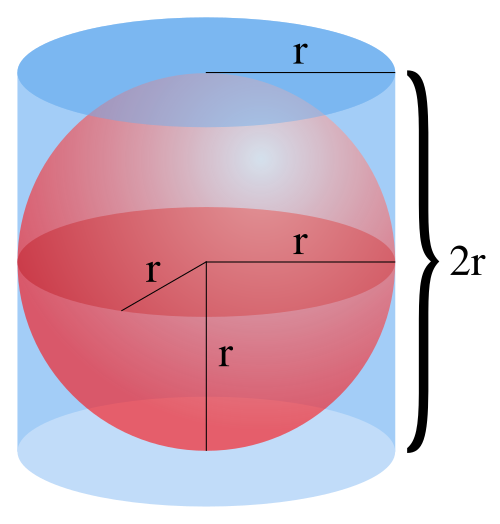
Another Archimedean observation (of which it is claimed he was most proud): A sphere has 2/3 the volume and surface area of its circumscribed cylinder including its bases. Image by Andertxuman Vector version: CheCheDaWaff from Wikipedia.
Mutually Reinforcing Worlds. To Archimedes, Hall observes, “the mathematical and physical worlds were as real as each other and mutually reinforcing. To know something about the physical world, you could use maths to model it. But more radically, you could also use the physical world to open up and model mathematical ideas: balances, levers and floating objects could be treated as geometrical proofs.”
An oft-cited bit of Archimedes wisdom: “Give me a lever long enough and a fulcrum on which to place it, and I shall move the world.”
I wonder what Archimedes would have thought of A.I.? ds
© Dennis Simanaitis, SimanaitisSays.com, 2026
 Simanaitis Says
Saw an article the other day that triggered memories of Simulated Integrated Modular Prose (look it up; there are both manual and automated tools for it available online) for generating nonsense but authentic-looking corporatespeak. Then realized that modern AI as exemplified by LLMs might just be SIMP on massive steriods. Hmmm?
As for Archimedes, he seems like the prototype of the modern engineer: part scientist, part dreamer, part practical.