
Simanaitis Says
On cars, old, new and future; science & technology; vintage airplanes, computer flight simulation of them; Sherlockiana; our English language; travel; and other stuff
THE PALIMPSEST OF ARCHIMEDES PART 1
THE WORD “PALIMPSEST” MAY JOG THE MEMORY of longtime readers of this website: “Medieval DNA Sleuthing,” SimanaitisSays, August 7, 2017, described “A palimpsest is a piece of writing material, parchment, for example, given further use by scraping off its previous writing.” And “From Tablet to Scroll to Codex to Book,” October 8, 2019, gave information on this transition of preserving human thought.
Indeed, I thought I had also mentioned Gore Vidal’s memoir Palimpsest either here at SimanaitisSays or at R&T, but neither the bright A.I. lads of Google nor Bing can find it. Nor can I. Perhaps I’m A.I.-like hallucinating?
No matter, because the term meant the same thing to Vidal as it does here: a recycling of a manuscript. And this time, it’s a 10th-century manuscript of Archimedes’ Method of Mechanical Theorems lurking beneath a 13th-century Greek liturgical book. Details are offered in Claire Hall’s “Maths is Second Best,” a review of Nicholas Nicastro’s Archimedes: Fulcrum of Science in London Review of Books, February 19, 2026.

Here, in Parts 1 and 2 today and tomorrow, are tidbits gleaned from Hall’s review, together with my usual Internet sleuthing.
The Original, c. 230 B.C.. The original Method of Mechanical Theorems, Hall recounts, “is a letter from Archimedes to Eratosthenes, the head of the library of Alexandria and a renowned philosopher in his own right. Most of it is devoted to proving relationships between the centres of mass of different shapes. Archimedes starts with the familiar – parabolas, triangles, spheres – but quickly moves beyond them.”
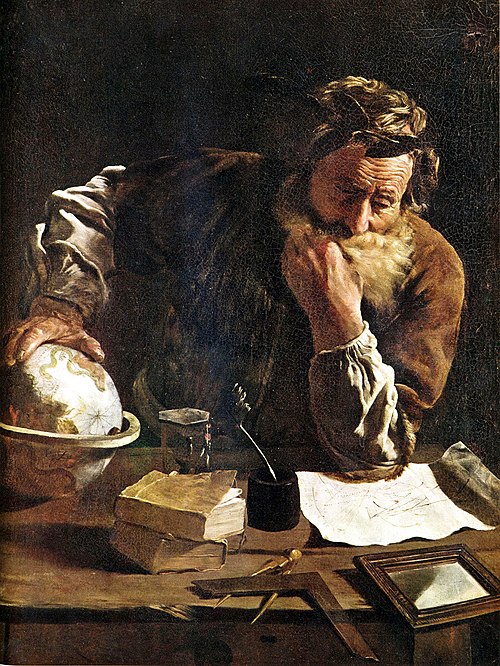
Archimedes of Syracuse, c. 287 B.C. – c. 212 B.C., Greek mathematician, physicist, engineer, astronomer, inventor, was a leading scientist of classical antiquity. Image Archimedes Thoughtful, by Domenico Fetti (1620) from Wikipedia.
A Playful Confession. “But in Method of Mechanical Theorems,” Hall relates, “Archimedes makes a playful confession. He has been using a ‘mechanical’ method of his own devising to formulate new mathematical problems. Once he has found a problem to work on, the mechanical method can also help him solve it. He encourages Eratosthenes to try it, speculating that others may find exciting new mathematics with it.”
That is, Hall observes, “…. some of his abstruse theories, particularly those about centres of mass, may have been scoped out using physical models made of wood and metal. Rather than relaying complex geometrical relationships from his mind’s eye onto the page, Archimedes had been patiently constructing, adjusting and balancing his models, and then doing the geometry to shore up his discoveries.”
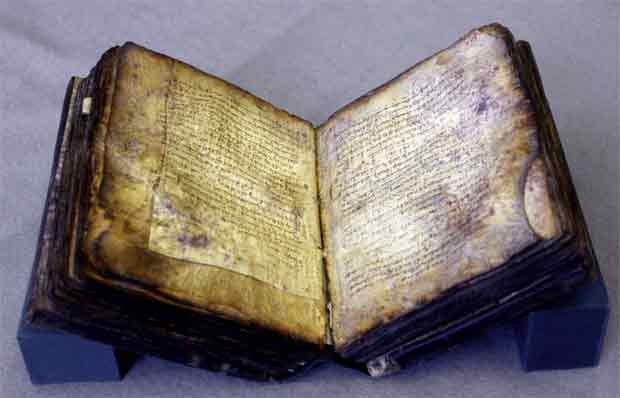
The Archimedes Palimpsest. Image from The Archimedes Palimpsest. Also see this website for details of palimpsest technology and deciphering.
“The mechanical method,” Hall notes, “exposed a way of thinking that set him apart from an earlier generation of philosopher-mathematicians: he trusted that the intellectual world of mathematics corresponded to material reality.”
Tomorrow in Part 2, we’ll continue Hall’s analyses of Archimedean achievements as displayed palimpsestically. ds
© Dennis Simanaitis, SimanaitisSays.com, 2026
 Simanaitis Says