
Simanaitis Says
On cars, old, new and future; science & technology; vintage airplanes, computer flight simulation of them; Sherlockiana; our English language; travel; and other stuff
A PAIR OF WIND WAGONS PART 2
YESTERDAY WE SHARED Bill Milliken’s adventure with his Aero-Triple-Cycle. Today in Part 2, Sam Posey tells us about his Crazy Uncle Teddy’s Wind Wagon. The primary source of this is R&T, April 2004 (that issue’s April Fool road test). All quoted passages are Sam’s.
The Wind Wagon’s Origin, 1929. “The Wind Wagon was the creation of my uncle Teddy. At the age of 16, infatuated with the idea of becoming a pilot, he had desperately wanted to buy, or build, a plane. His parents said no.… Permission was granted, however, to construct a motorized land vehicle, so my uncle set out to create a device as close to a plane as he could get. He painted it silver, like Charles Lindbergh’s Spirit of St. Louis, which had made its famous flight just two years before.”
“The starting procedure mimicke aviation practice of the time: Your mechanic spun the propeller, by hand. The engine (an air-cooled V-twin Harley-Davidson) sounded like a plane’s, and the prop blew wind in your face, calling for goggles and a leather flying helmet.”
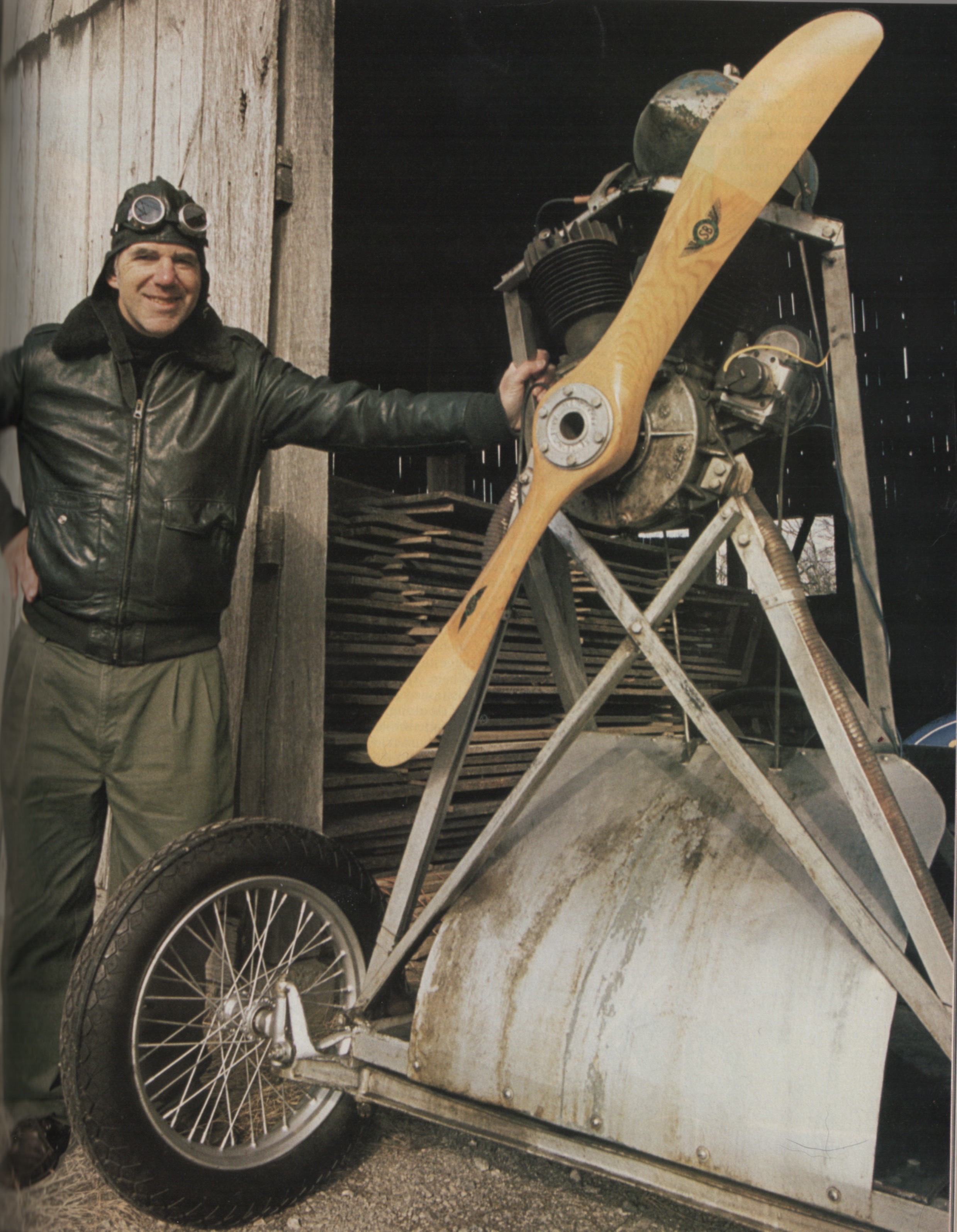
This and following images from R&T, April 2004.
“Like most early aircraft, the Wind Wagon projected an aura of danger, and Teddy added a second seat so that his daring and bravery could be witnessed first hand. Although it lacked torque and was slow to accelerate, its top speed, clocked on a flat Arizona highway, was 70 mph. The Wind Wagon did everything but take off.”
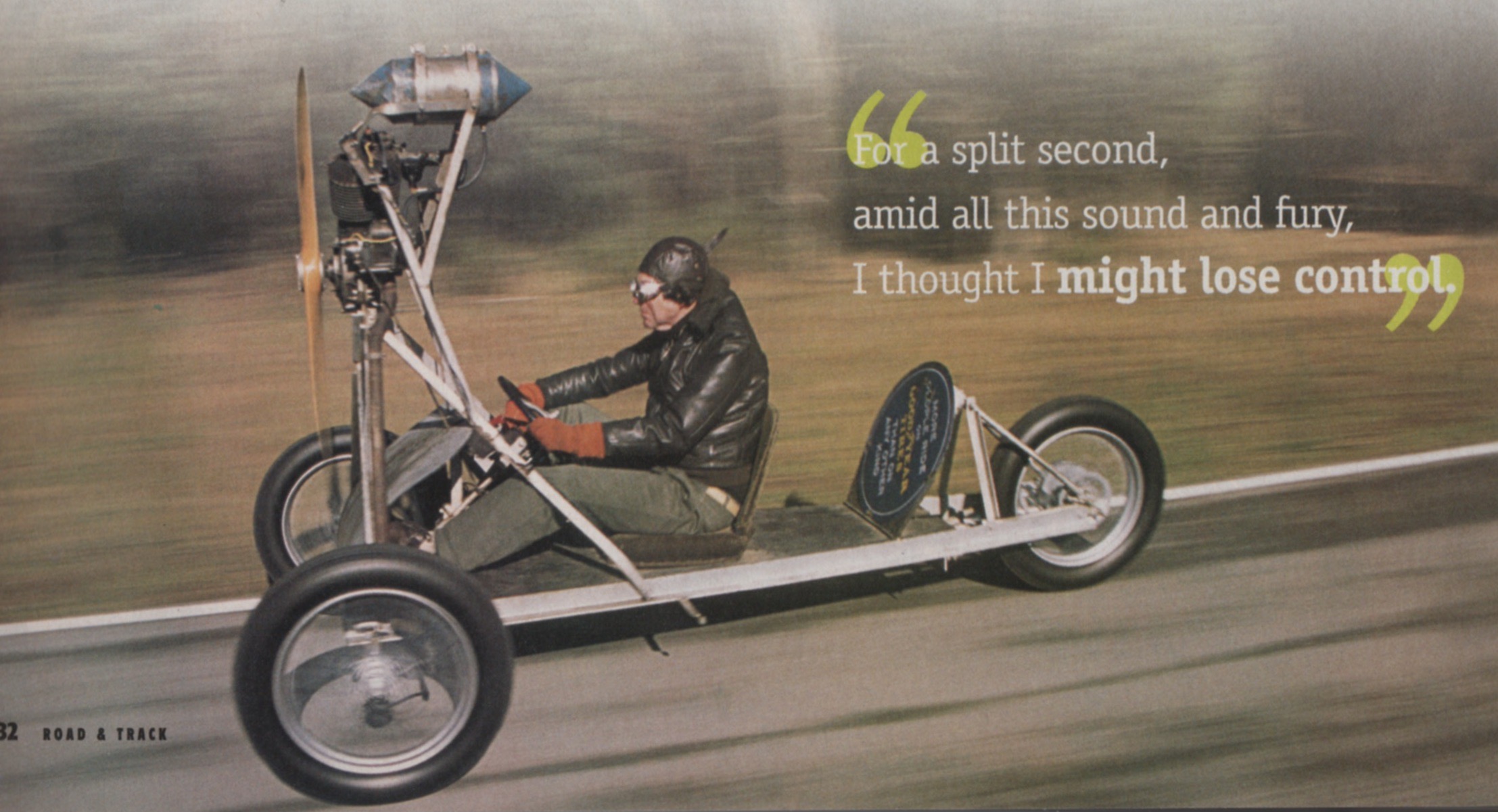
Sam’s Mom’s Adventure. “When Teddy left school, his strange contraption was shipped back to our family’s farm in Connecticut. Frustrated by its sluggish performance on dirt roads, he waited for winter, when he took it down to a nearby lake and ran it on the ice. He persuaded his younger sister—my mother—to crouch in the rudimentary back seat, providing ballast, and then he blasted away back and forth, the freezing prop wash numbing his face.”
“When it was time to go home, Teddy tackled the steep road at full revs, but his machine barely inched along, and he soon gave up and went to the house for hot chocolate. My mother and a friend were left to haul the machine the rest of the way.”
I suspect this only confirmed the Crazy Teddy nickname.
Sam, As a Kid. The Wind Wagon never ran again: “It was put in the storeroom of our old carriage house…. I would climb aboard the Wind Wagon, settle into the seat (olive-drab velvet possibly from a movie theater), and pretend to steer, feeling the cool, thick rim of the wheel in my hands and aching to be out on the ice, feeling the wind and noise and speed.”
“Later, in my racing years, I would come to regard the cars I drove merely as tools of the trade, some better than others, but when I was 6, the Wind Wagon exerted such a pull on my imagination that it might as well have been alive.”
Enter the Lane Motor Museum. “Teddy died two years ago, at the age of 89, and his collection was auctioned off. Jeff and Susan Lane of the Lane Motor Museum in Nashville, Tennessee, bought the Wind Wagon and soon afterward called me to ask if I would like to drive it. Of course, I said yes.”
A Cold, Clear Morning…. “The Wind Wagon had been trailered out, wraped in a tarp. R&T’s ace lensman Joe Rusz had his cameras warmed up and Road Test Editor Patrick Hong was unpacking instruments that would measure the wagon’s performance…. Comedian Bill Dana (who attended the test) called it a giant salami slicer.”
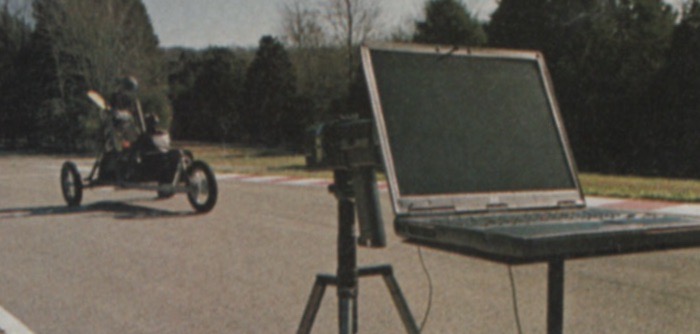
By 2004, no reason for er… a “fourth” wheel in testing. Patrick’s gadgets did their magic.
Wind Wagon Tech Analysis. “Seen from above, the main frame is a triangle, made of 2-in. angle iron, with an 18-in. diameter wheel at each corner. (Tire size is 4.50 x 18.) Fastened to the frame is a 3/8-in. plywood floor. The torsional rigidity of this assembly is roughly that of a Persian rug.”
“The engine is a stressed member positioned slightly off-center (to the right, looking from the front), which would counteract the modest torque (the prop rotates counterclockwise).”
“As for the suspension, there isn’t any.”
Driving Position. “The cockpit is a triumph of minimalism: The driver isn’t troubled by gauges or switches. Views are excellent in all directions—except, of course, forward.”
Sam, of course, is too polite to mention this view might be a useful one.
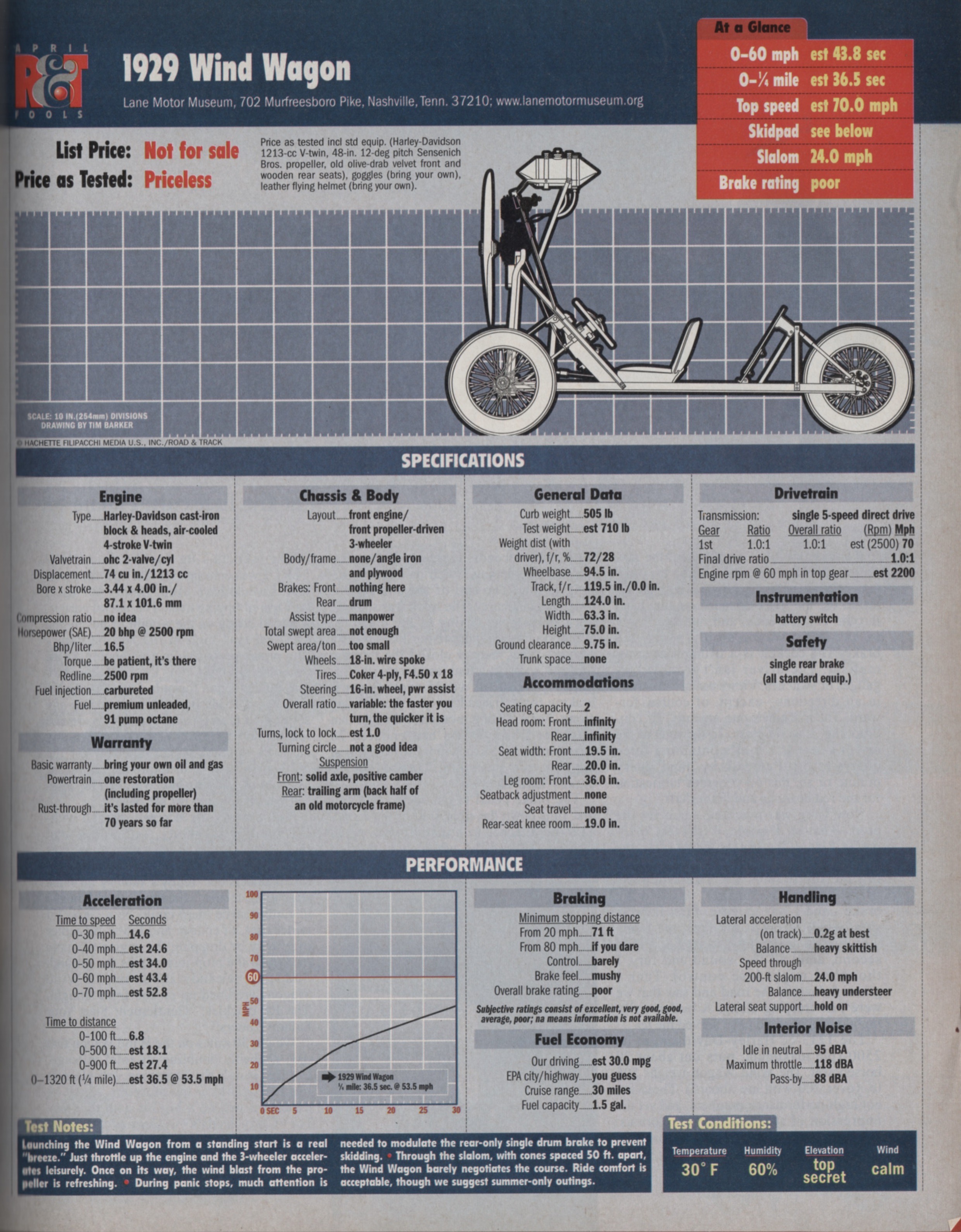
Performance Numbers: Modest But Glorious. “The 1213-cc Harley-Davidson, at its 2500-rpm maximum, puts out about 20 horsepower. The Wind Wagon weights 505 lb. (over 700 with me aboard). These are not high-performance numbers, and yet the impression of acceleration was glorious.”
“The track was smooth, but thanks to the flexing of the frame the Wind Wagon was porpoising like an early ground-effect racer.”
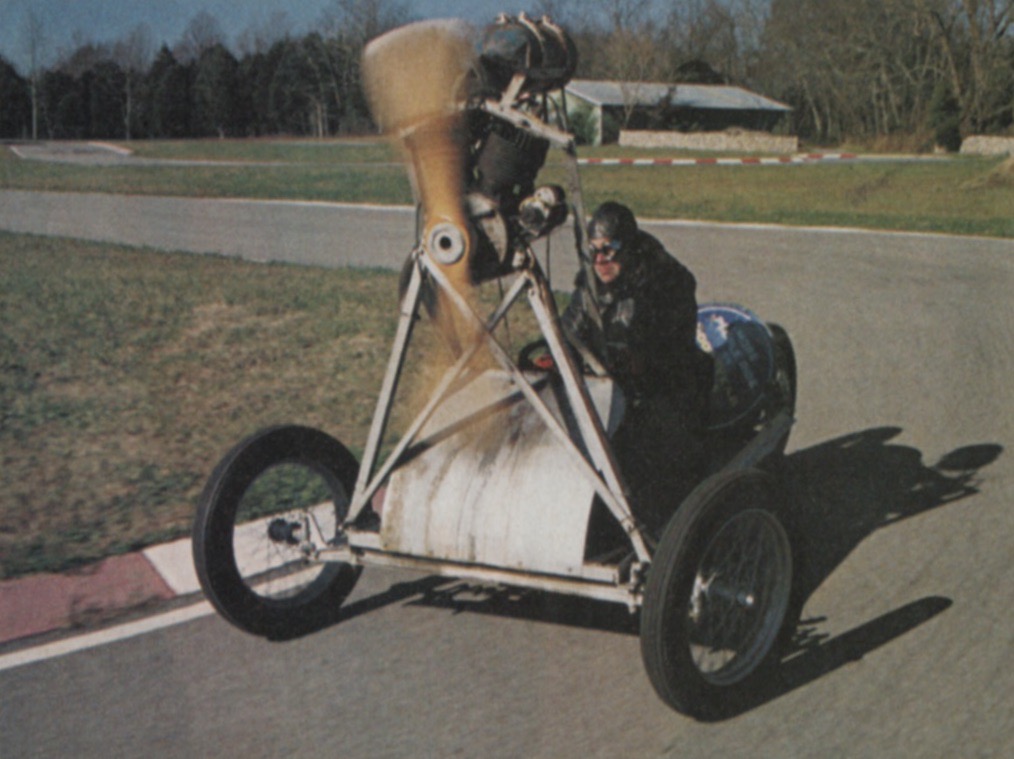
Handling?? “The lateral cornering load acting on the weight of the engine and fuel tank high in the superstructure (the prop’s centerline is a whopping 53 in. above the ground), plus the 3-wheeled layout, looked like a formula for a flip.”
Phew…. “Not to worry. We scooted through without a hint of instability. As the laps went by, I pushed harder in the turns, sometimes even riding the curbs, and all I felt was a bit of understeer.”
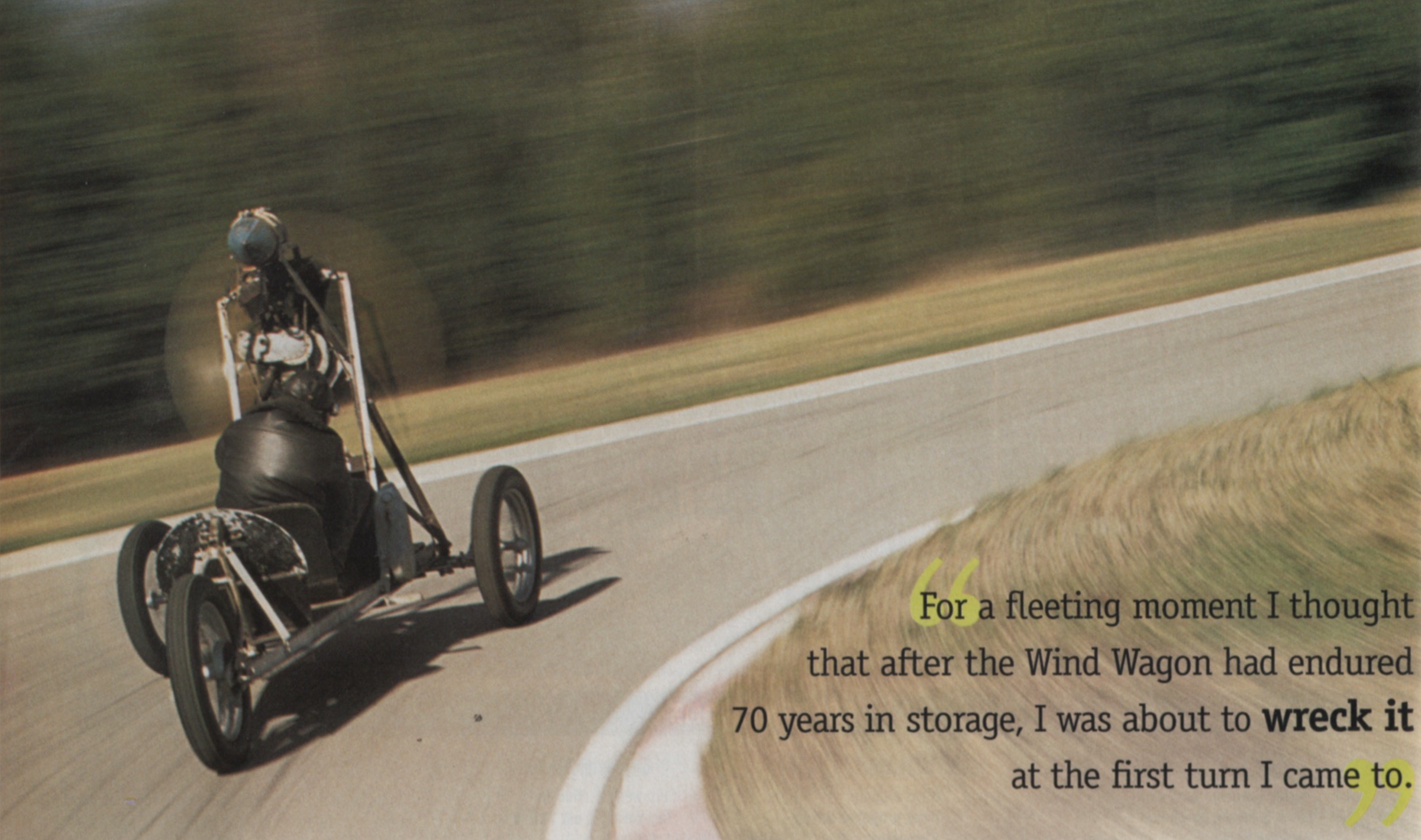
“Teddy’s fantasy airplane was being reborn as a road racer. I began to think maybe there could be a class…. Suddenly, it’s the Indy 2008, and 33 Wind Wagons are lined up on the front straight….”
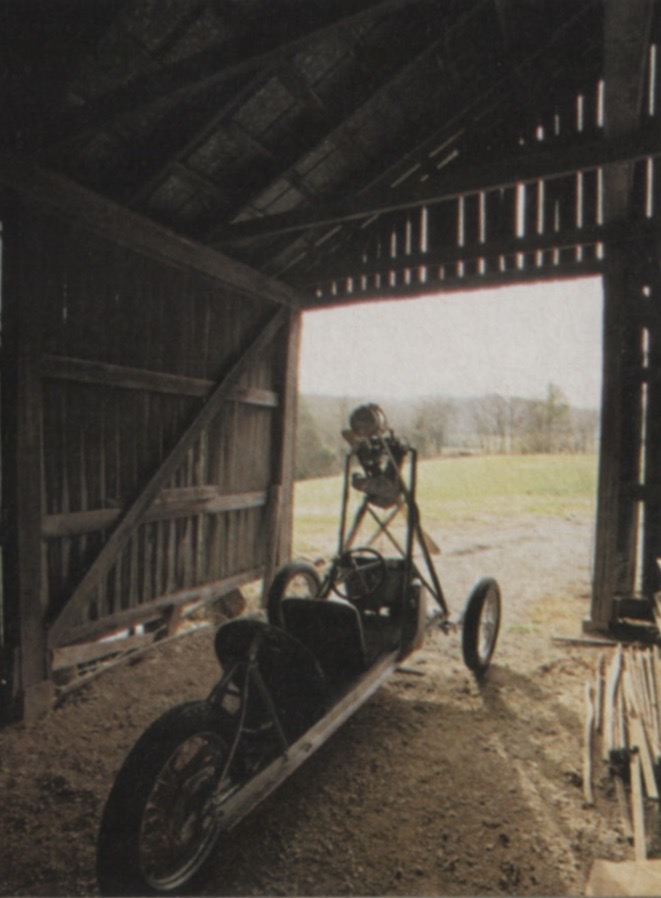
The obligatory arty shot, in memory of Joe Rusz, 1938-2025.
And you know that somewhere Uncle Teddy is smiling. ds
© Dennis Simanaitis, SimanaitisSays.com, 2026
 Simanaitis Says
Thanks for reminding me how much fun life was back when car magazines had a sense of humor!
Simply wonderful that it survived along with the Nephew .
-Nate