
Simanaitis Says
On cars, old, new and future; science & technology; vintage airplanes, computer flight simulation of them; Sherlockiana; our English language; travel; and other stuff
BOUBA-KIKI: EVEN CHICKS CAN PLAY PART 2
YESTERDAY IN PART 1, WE LEARNED ABOUT ASSOCIATING shapes with made-up words, briefly spiky ones linked to “kiki,” blobby ones to “bouba.” Surprisingly enough, people around the world speaking different tongues, even those sans written systems, share this bouba-kiki identification. What’s more, and even more surprising, researchers Maria Loconsole, Silva Benavides, and Lucia Regolin at the University of Padova reveal “Evidence of the Bouba-Kiki Effect in Naïve Baby Chicks,” Science, February 19, 2026.

Results With Chicks. Loconsole et al. recount in their Abstract, “To explore the origin of this association, and whether it is unique to humans, we tested the bouba-kiki effect in baby domestic chickens (Gallus gallus). As a precocial species, chicks can be tested shortly after hatching, allowing us to control their pretest experiences. Similar to humans, both 3-day-old (Exp. 1) and 1-day-old (Exp. 2) chicks spontaneously choose a spiky shape when hearing the ‘kiki’ sound and a round shape when hearing the ‘bouba’ sound. Results from naïve young animals suggest a predisposed mechanism for matching the dimensions of shape and sound, which may be widespread across species.”
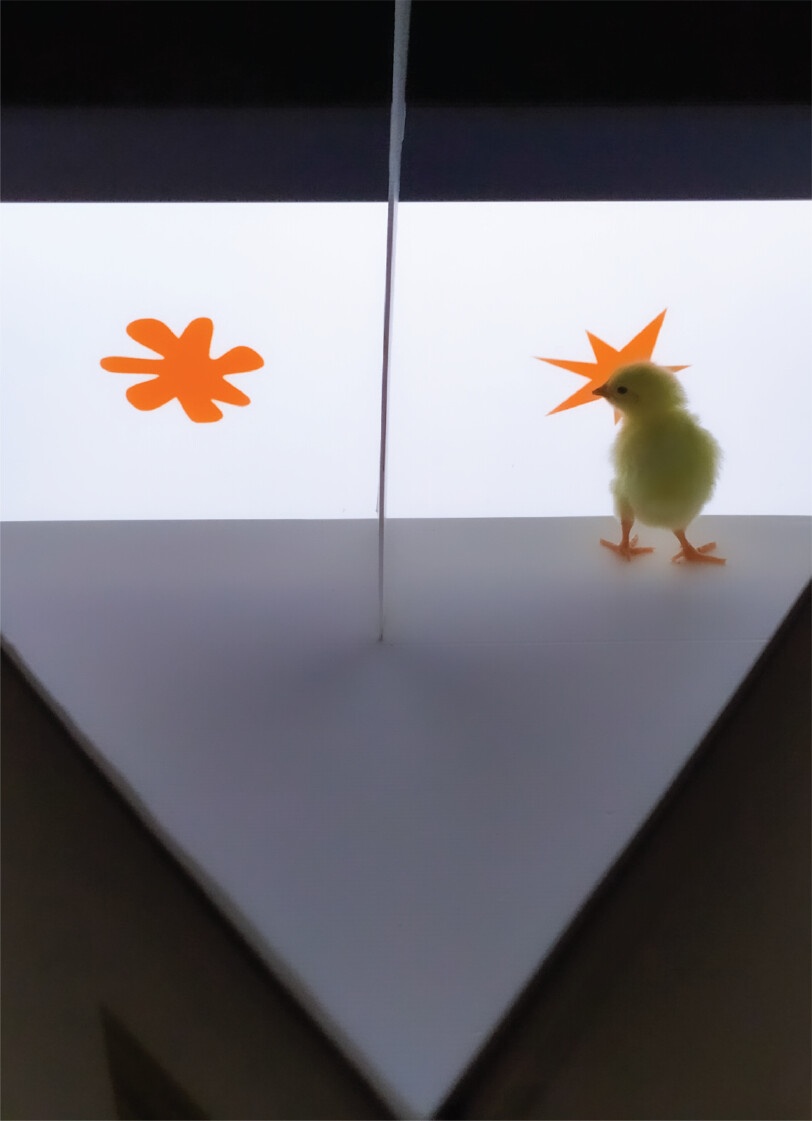
Image from Loconsole et al. via Science.
Methodology. The researchers devised two experiments “that differed regarding age of the chicks at testing and the procedures employed.”
Experiment 1. The researchers describe, “We trained 42 naïve 3-day-old chicks (17 females) to circumnavigate a panel depicting a shape with both round and spiky edges (Fig. 1A and movie S1). During the test, chicks underwent 24 trials in which they were presented with two panels, one depicting a spiky shape and one depicting a round shape, while either the sound ‘bouba’ or ‘kiki’ (pseudo-randomly alternated between trials) was played (Fig. 1B, movie S1, and audio S1 and S2).”
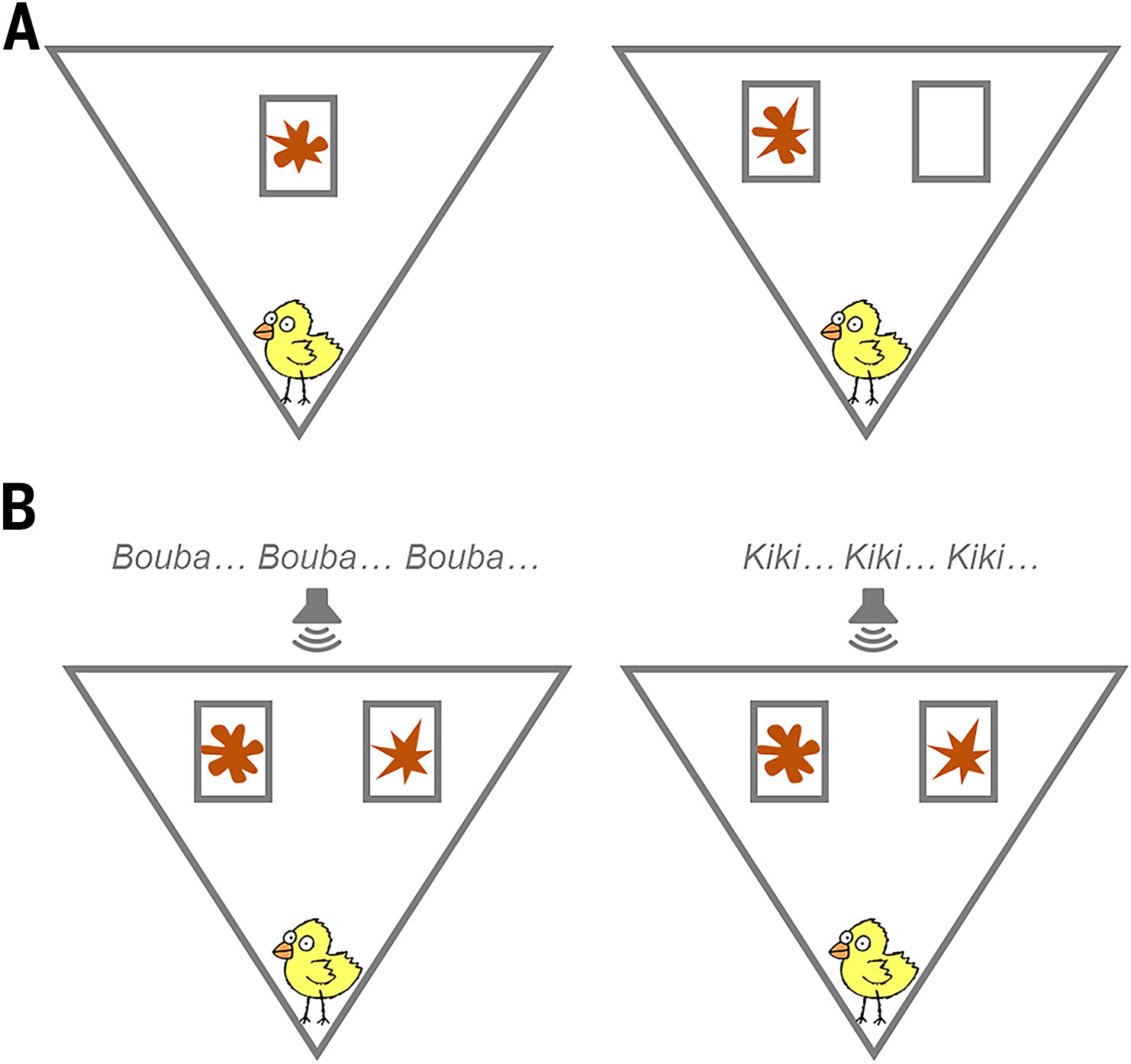
Researchers continue, “We hypothesized that, if chicks rely on human-like sound-shape associations, they will choose the panel with the spiky shape when hearing the ‘kiki’ sound and that with the round shape when hearing the ‘bouba’ sound.”
Experiment 2. Researchers describe, “In Exp. 2 (40 individuals, 20 females) we tightened control over three critical factors: maturation (the test took place within the first 24 hours after hatching rather than on the third day of life), social experience (individual housing rather than social groups), and trained associations (chicks were tested without any prior training or reward) (see supplementary text for a detailed description of the rearing environment).”
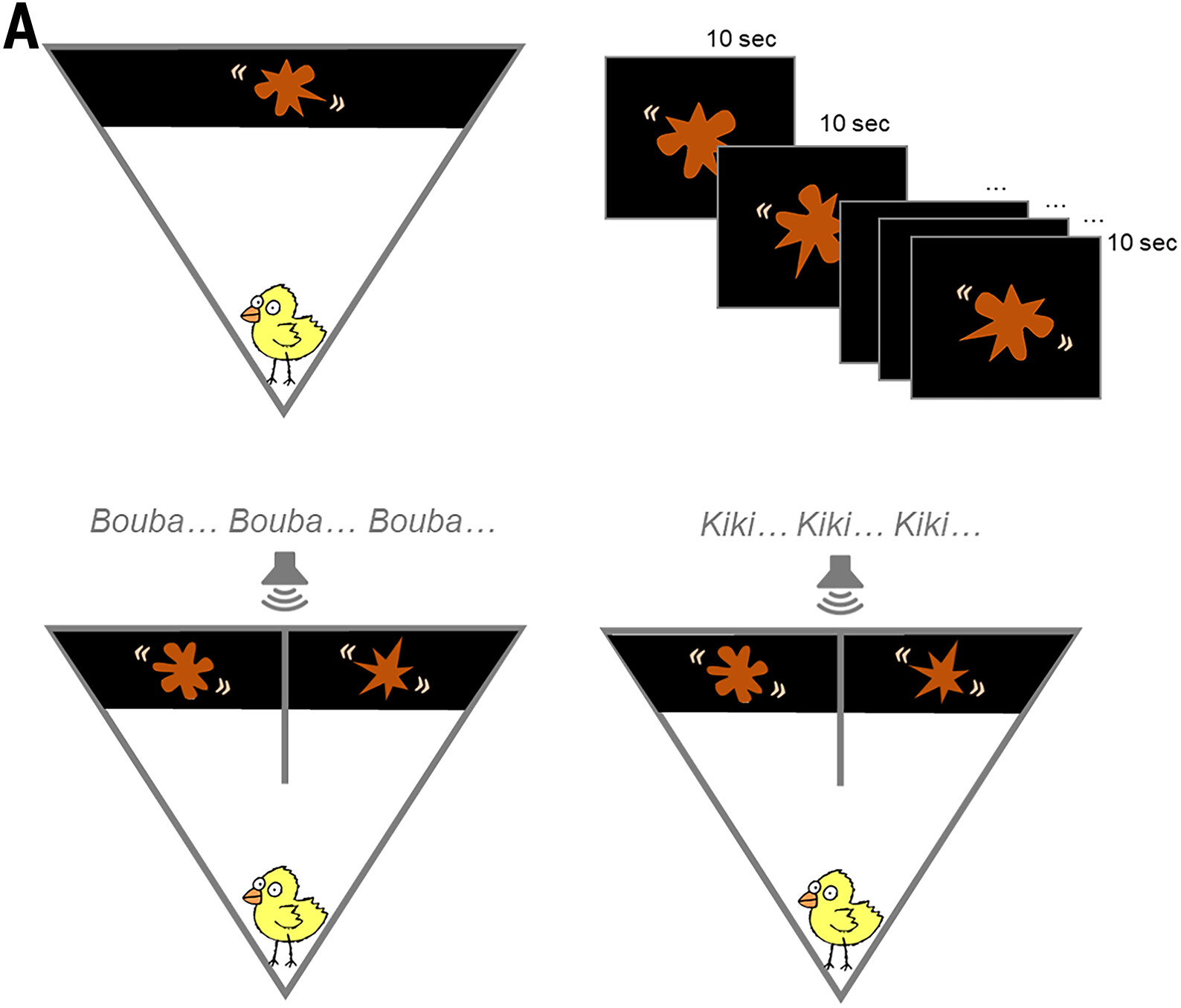
Exp. 2: Alternating ambiguous shapes. Then specific shapes with repeated audible choices.
Results. “We observed,” researchers relate, “a spontaneous tendency in 3- and 1-day-old chicks to associate a round shape with the ‘bouba’ sound and a spiky shape with the ‘kiki’ sound.… Data from other nonhuman species, including primates…, dogs…, and tortoises suggest that such a mechanism may be shared across different taxa and possibly reflects an old evolutionary organizing principle of the brain.”
By the way. They note, “Previous studies on nonhuman primates (chimpanzees, gorillas, and one bonobo) failed to observe the bouba-kiki association. We argue that this inconsistency likely stems from methodological differences as well as from key features such as age, level of prior expertise, and training of the subjects. For instance, at the time of testing, the bonobo Kanzi was already capable of associating sounds and shapes to the point that he could match up to 500 visual-auditory pairs. Thus, it is possible that the properties of his limited ‘lexical repertoire’ could have influenced or biased his responses.”
Hmm… Perhaps he had other things on his mind? ds
© Dennis Simanaitis, SimanaitisSays.com, 2026
 Simanaitis Says