
Simanaitis Says
On cars, old, new and future; science & technology; vintage airplanes, computer flight simulation of them; Sherlockiana; our English language; travel; and other stuff
THE KNOW NOTHING PARTY PART 2
HERE IN PART 2, WE CONTINUE WITH Wikipedia’s most informative history of this 19th-century political aberration. Or is it only of the 19th century?
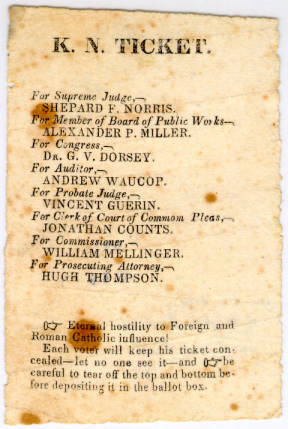
An 1855 Ohio Know Nothing Party ticket. At the bottom are voting instructions. Image from Wikipedia.
At the Ballot Box. Wikipedia relates, “The Know Nothing movement managed to elect congressman Nathaniel P. Banks of Massachusetts and several other individuals into office in the 1854 elections, and it subsequently coalesced into a new political party which was known as the American Party. Particularly in the South, the American Party served as a vehicle for politicians who opposed the Democrats. Many of the American Party’s members and supporters also hoped that it would stake out a middle ground between the pro-slavery positions of Democratic politicians and the radical anti-slavery positions of the rapidly emerging Republican Party.”
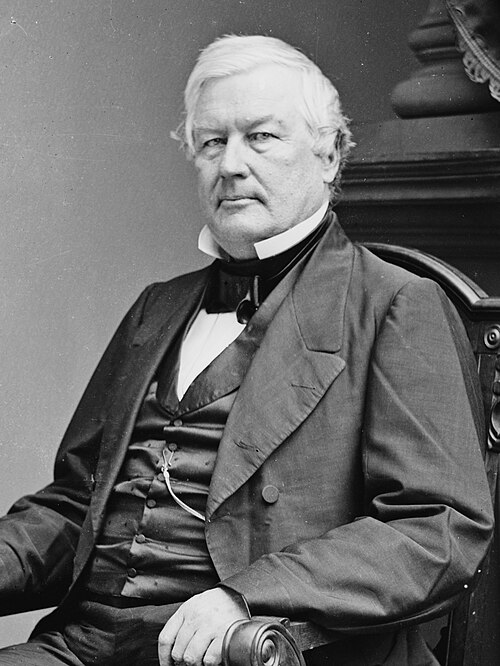
Millard Fillmore, 1800–1874, 13th president of the United States. Image by Matthew Brady, part of the Library of Congress Brady-Handy photograph collection.
Fillmore’s Second Campaign (as a Closet Know Nothing). Millard Fillmore served as president from 1850 (upon the death of Zach Taylor) to 1853 (he lost to Franklin Pierce in the 1852 election). The American Party selected him as its 1856 presidential choice, but according to Wikipedia he kept quiet about his membership in it.”
Fat lot of good it did him: Fillmore received 21.5% of the popular vote, finishing behind Democratic James Buchanan (45.3 %) and Republican John C. Frémont (33.1 %).
Historians Survey 2021. Neither Fillmore nor Buchanan is regarded as worthy of the office: The 2021 Historians Survey by c-span.org has Buchanan as worst of the 44 president at 227 points; Milliard Fillmore is seventh from the bottom, 38th at 378 points.
By the way, Donald J. Trump (first term) is 41st in the ranking with 312 points (a 42th-place Franklin Pierce and 43th Andrew Johnson separate him from Buchanan’s absolute pits).
The Better Ones. For the good of the country, Abraham Lincoln succeeded Buchanan in 1861. The Historian Survey set Lincoln as best president with 897 points; George Washington, second at 851; Franklin D. Roosevelt, third at 841. Scoring in the 700s were, in order, Theodore Roosevelt, Dwight D. Eisenhower, Harry S Truman, and Thomas Jefferson. Among those in my memory, John F. Kennedy, Ronald Reagan, Barack Obama, and Lyndon B. Johnson were ranked highest, respectively, in the 600s.
Back to the 1850s. Abraham Lincoln wrote to a close friend, “As a nation, we began by declaring that ‘all men are created equal.’ We now practically read it ‘all men are created equal, except negroes.’ When the Know-Nothings get control, it will read ‘all men are created equal, except negroes, and foreigners, and catholics.’ ”
Wikipedia recounts of the Know Nothings: “By the 1860 election they were no longer a serious national political movement.”
And good riddance, I say.
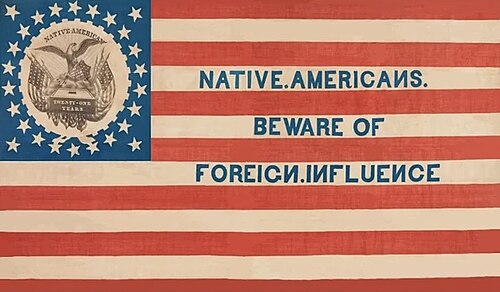
Flag of the American Party (1844–1860).
By the way, Wikipedia includes John Wilkes Booth among “Notable Know Nothings.” Samuel Morse, politician, painter and inventor of Morse Code and the telegraph, is another. So is Texas senator Sam Houston. And what can be learned from this is quite beyond me.
Neo-Know Nothings Today? Wikipedia recounts, “Some historians and journalists ‘have found parallels with the Birther and Tea Party movements, seeing the prejudices against Latino immigrants and hostility towards Islam as a similarity.’ ”
“In the 2016 U.S. presidential election,” Wikipedia observes, “a number of commentators and politicians compared candidate Donald Trump to the Know Nothings due to his anti-immigration policies.” It lists six references confirming this statement.
Count this as a seventh, if you like. ds
© Dennis Simanaitis, SimanaitisSays.com, 2026
 Simanaitis Says
7.