
Simanaitis Says
On cars, old, new and future; science & technology; vintage airplanes, computer flight simulation of them; Sherlockiana; our English language; travel; and other stuff
THE KNOW NOTHING PARTY PART 1
NO, PERHAPS NOT WHAT YOU THINK. This is an historical essay, not a collection of today’s headlines. Sorta and mainly, even as it expands into Parts 1 and 2 today and tomorrow.
Origins. Wikipedia describes (its boldface choices, not mine): “The American Party, known as the Native American Party before 1855 and colloquially referred to as the Know Nothing or the Know Nothing Party, was an nativist political movement in the United States from the 1840s through the 1850s. Members of the movement were required to say ‘I know nothing’ whenever they were asked about its specifics by outsiders, providing the group with its colloquial name.”
Its Ideology, Briefly. The Know Nothings were anti-Catholic, anti-Irish, anti-German, pro-Old Stock nativism, and pro-American nationalism. “Old Stock,” notes Wikipedia, aka Colonial Stock, Founding Stock, or Pioneer Stock, “is a colloquial name for Americans who are descended from the original settlers of the Thirteen Colonies. Historically, Old Stock Americans have been mainly Protestants from Northwestern Europe whose ancestors emigrated to British America in the 17th and 18th centuries.”
Wikipedia also cites a telling indication of the term: “In the statistical terminology of the U.S. Census Bureau, Americans from the third-, fourth-, and fifth-generations are labelled ‘Old Stock’ unless they are Afro-Americans, Asian Americans, or American Indians.”
Hmm….
The “Romanist” Conspiracy. Know Nothings believed in a “Romanist” conspiracy with Catholic priests and bishops controlling a large bloc of voters. If this sounds quaint to modern readers, recall that similar thoughts circulated as recently as the Kennedy-Nixon era. And, perhaps, to this day.
Wikipedia recounts of the earliest times, “Anti-Catholicism was widespread in colonial America, but it played a minor role in American politics until the arrival of large numbers of Irish and German Catholics surged in the 1840s. It appeared in New York City politics as early as 1843 under the banner of the American Republican Party. The movement quickly spread to nearby states using that name or Native American Party or variants of it.”

Image by political cartoonist John. H. Goater, c. 1850s.
Secret Orders. “In the early 1850s,” Wikipedia continues, “numerous secret orders grew up, of which the Order of United Americans and the Order of the Star Spangled Banner came to be the most important. They emerged in New York in the early 1850s as a secret order that quickly spread across the North, reaching non-Catholics, particularly those who were lower middle class or skilled workers.”
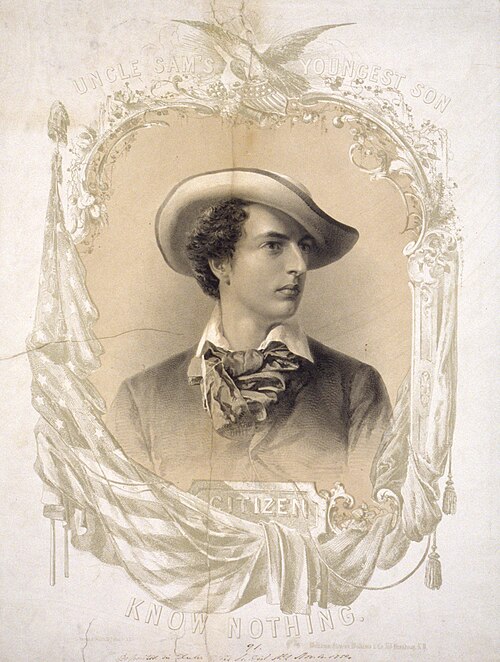
Uncle Sam’s youngest son, Citizen Know Nothing, an 1854 print. Image from Sarony & Co., lithographer—Library of Congress.
Somehow I am reminded of the European tradition of a blond-hair, blue-eyed Christ.
Tomorrow in Part 2, we discuss Know Nothings at the ballot box. ds
© Dennis Simanaitis, SimanaitisSays.com, 2026
 Simanaitis Says
I’m amazed the current crop of republicans aren’t rushing to accept this moniker .
-Nate