
Simanaitis Says
On cars, old, new and future; science & technology; vintage airplanes, computer flight simulation of them; Sherlockiana; our English language; travel; and other stuff
ELECTRIC CARS, R&T, AND ME—1992
WHAT DID I KNOW ABOUT EVS IN 1992? Was I smarter than Donald Trump is today? It’s no contest, I claim, and offer the following as proof.
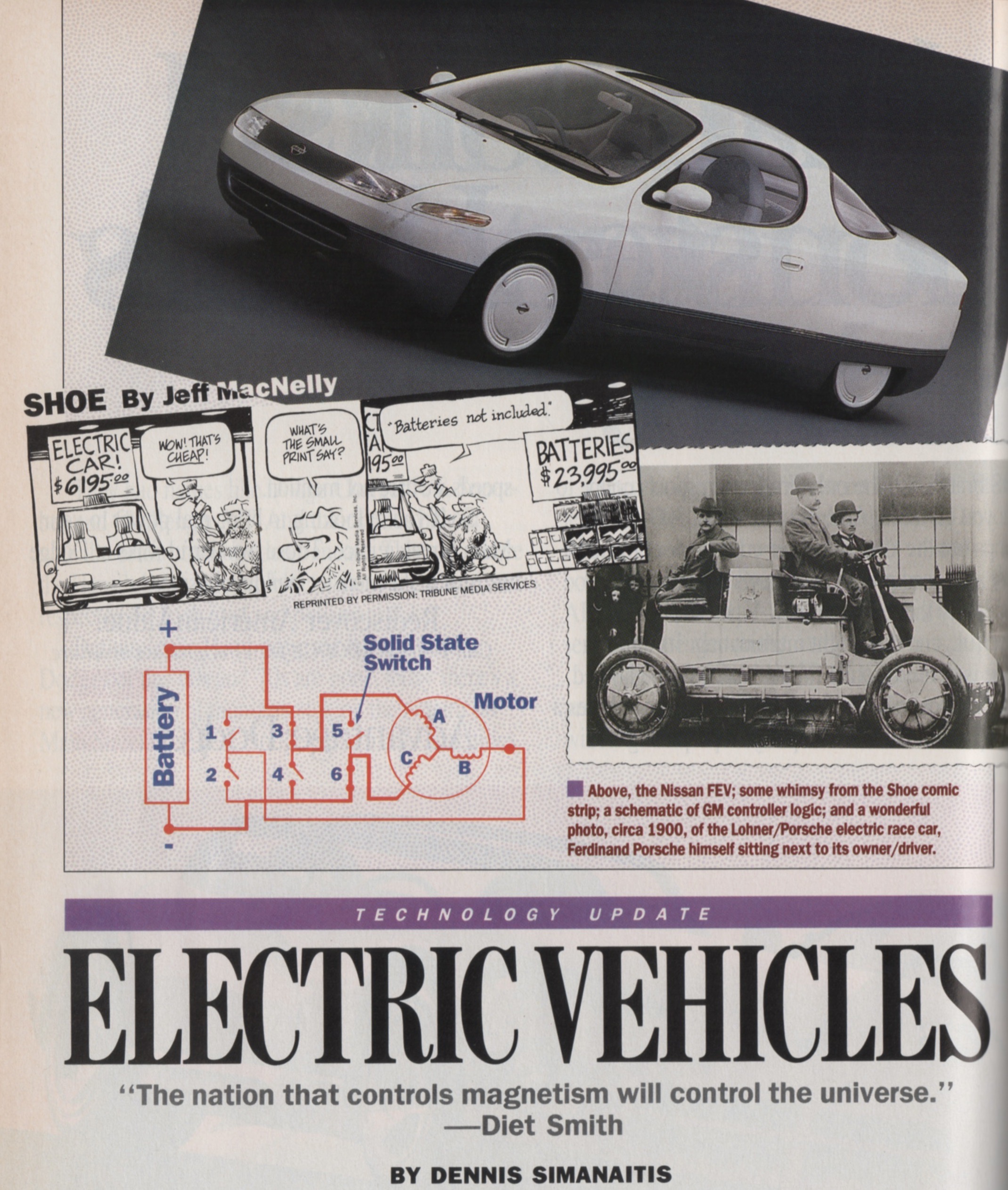
This and the following images are from R&T, May 1992.
My Diet Smith quote and the Jeff MacNelly cartoon suggested a certain skepticism at the time, though in retrospect I’d stand by my views today—more than a third of a century later. Here are tidbits gleaned from this article; quoted portions are taken directly from it.
Behind the EV ’98-Ball. “What with California (and maybe other portions of the country as well) requiring Zero Emissions Vehicles by 1998, electric vehicles—EVs, for short—are definitely on the way. Two months ago (see “California Dreamin’ ”), we had a brief overview of it all.”
Opening Puns (Honoring Previous Editor/Pal John Dinkel): “Here, let’s give a brief plug to this potentially shocking field of current technology.”
“And serious it is. There has always been a freako electric car fringe (typical bumpersticker: ‘I go 45 mph and I don’t pollute…’). But the coming regulations dictate significant numbers of EVs in hands perhaps as ordinary as yours and mine.”
Realism Won Out. Indeed, the original California ZEV (Zero-Emission Vehicle) directive, 2% of new cars by ’98, got repealed in ’96 as automakers argued that lead-acid batteries wouldn’t meet consumer demand. The resulting P (as in Partial) ZEV period gave rise to development of hybrids and of lithium batteries.
Meanwhile, Back in ’92. R&T (and I) examined “neat technology here from the likes of BMW, Clean Air Transport, Ford, General Motors, its Hughes Aircraft component, Honda, Mazda, Mitsubishi, Nissan, Solar Electric Engineering, Suzuki, Tokyo Electric, and Unique Mobility. What’s more, there may even be an EV for the enthusiast.”
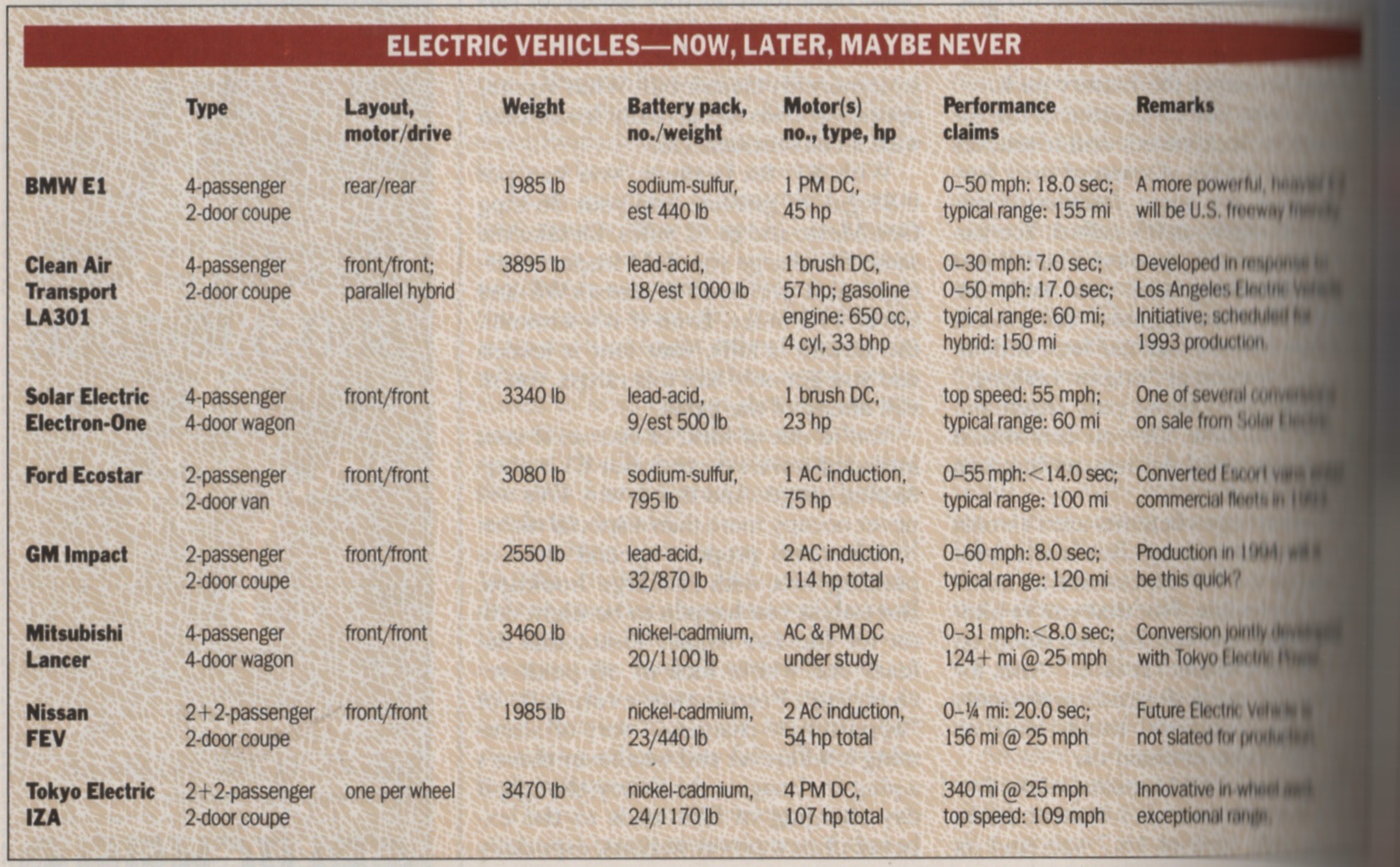
“The subject breaks down rather nicely into a pentad of batteries, motors, controllers, vehicles, and infrastructures.”
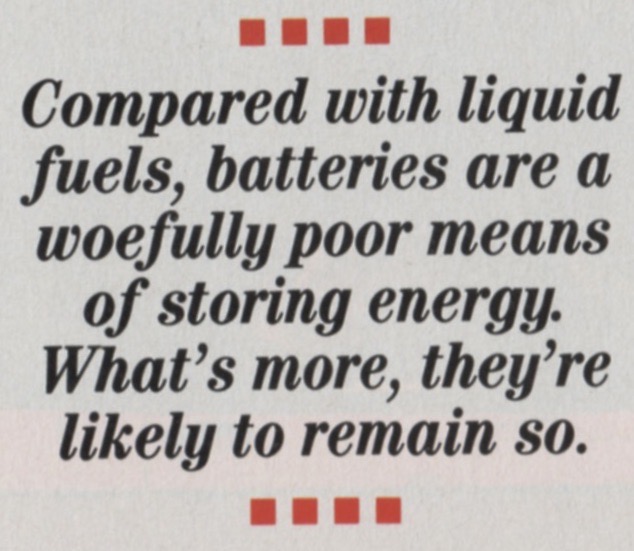
The first of three boldface callouts summed up batteries. A chart identified some of the contenders, as of 1992.
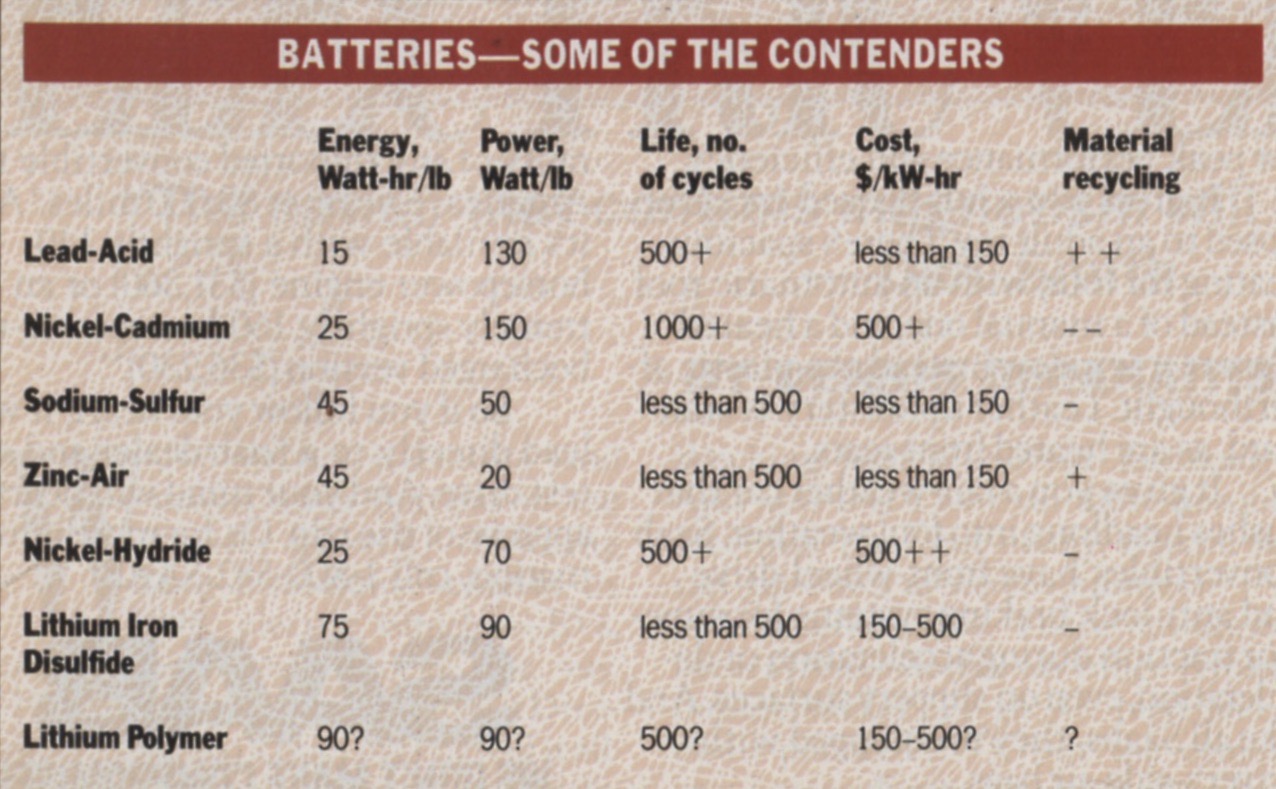
“The first on our list, lead-acid batteries are good for EV acceleration, mediocre for range, heavy as, er… lead, familiar to the infrastructure—and the only game in town in the near-near term.”
“Nickel-cadmium is the Japanese favorite, the choice of research vehicles shown by Mitsubishi, Nissan, and Toyota Electric. Scaled-up versions of premium drycells, NiCads provide really excellent power, better range than lead-acid and long life. But cadmium is scarce and highly toxic. And nickel isn’t cheap either.”
“Lithium polymer is the least mature of the bunch…. Specialists point to this one in the far term, say 2005 and beyond, though they also concede that hydrogen fuel cells may evolve every bit as quickly.”
Opps… Both the specialists and I gauged it wrong. Neither they nor I believed scoffers who said fuel cells “will always be best X years from now.” Pick an X, but not too small an X.
Our ’92 Sample. “One type is a ‘parallel’ hybrid, with a small gasoline engine driving the wheels independently under some optimal conditions. The Clean Air Transport LA301 is a parallel-hybrid EV.”
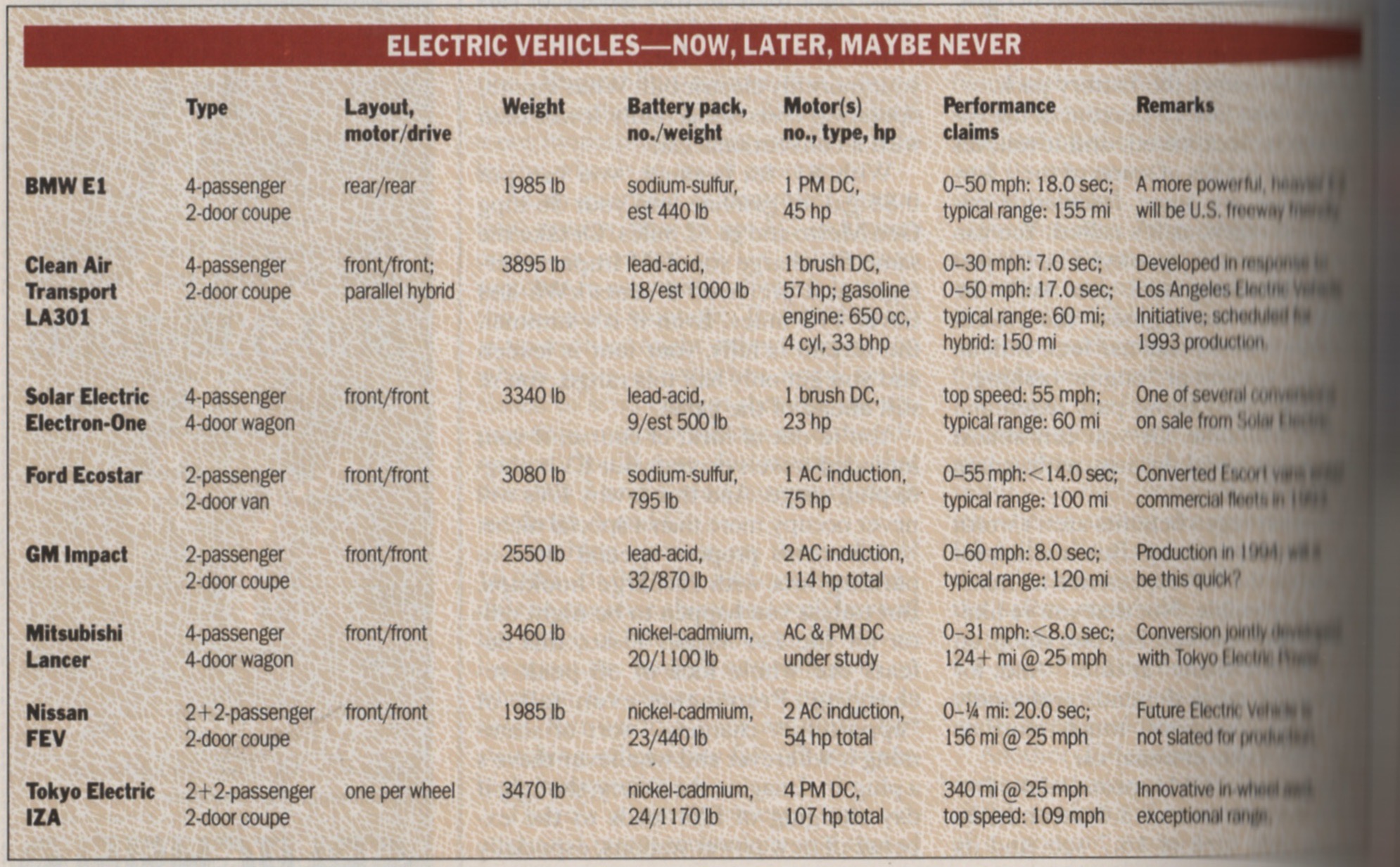
The other seven were BEVs, though this abbreviation of Battery Electric Vehicle didn’t come until later.
Overlooked Back Then. “Or the added powerplant can drive a generator charging the battery directly. Such a ‘series’ hybrid is less likely, though. Unless the generator is particularly large (and heavy), it can’t provide more than a trickle charge.”
By the way, that Lohner/Porsche electric in the lede photo montage was a series hybrid. Modern examples include the Chevrolet Volt, BMW i3 REx, Nissan e-Power models, and the Ram 1500 Ramcharger.
Also Overlooked. You’ll notice that Toyota wasn’t listed above in the 1992 list. Given development time, they were probably already optimizing their parallel hybrid to be introduced in 1997: the Prius, Latin meaning “first,” “superior,” or “to go before.”
Wikipedia notes, “In 1995, Toyota debuted a hybrid concept car at the Tokyo Motor Show, with testing following a year later. The first Prius, the NHW10, went on sale on 10 December 1997.” It was available only in Japan that first year; it arrived in the U.S. as a 2001 model in 2000.
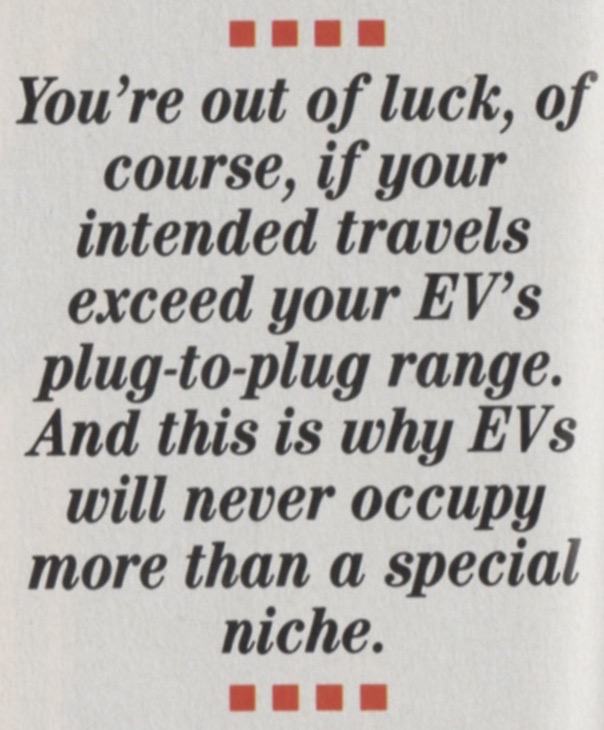
Our Second Callout. Its pessimism reflected everything from batteries to infrastructure. But it didn’t have much to say about environmental aspects. It wasn’t until April 2004 that R&T (and I) addressed “Global Warming is a Fact.” Now, of course, the term has evolved into Climate Change, something that some still persist is “a hoax.”
Back in ’92, I wrote, “EVers also see their cars given use of dedicated car-pool commuter lanes on freeways. The range/performance tradeoff will have to improve a great deal, however, just to get into these lanes.”
And, indeed, that tradeoff did improve, as did batteries, cars, and to some extent, infrastructure. Today, lots of hybrids join BEVs in these lanes. And plenty of parking lots have EV-charging stations.
The ’92 article also noodled some schemes that were not only ahead of their time, but maybe ahead of sense: “Utility companies and battery makers may move into the leasing business. It would be sort of like owning your GTO, but not its small block. Recycling of battery packs is relatively straight-forward, if lead-acid prevails. [Ha. A bad projection.] Otherwise a new infrastructure needs to be established, and quickly.” [Good save, that.]
“Europe and Japan have home-grown EV movements as well. Europeans think in terms of ring roads around cities, within which it would be EV-only…. Parallel hybrids may make sense there, what with minimal electric propulsion in the city and gasoline for the ring and beyond.”

A Third Callout. I concluded the ’92 article on a positive note: “But come 1998—and likely several years prior to this—I look forward to a healthy little niche of specialized EVs humming around. That’s when I’ll approach Detroit with the idea of a hybrid ultracapacitor feeding 100 hp to each of the four wheels of an enthusiast EV.”
Hmm… What about a 2025 Hyundai Ioniq 5 N doing 0-60 in 2.8 seconds? Or Trump putting the kobosh on EVs, fuel economy—and clean air? ds
© Dennis Simanaitis, SimanaitisSays.com, 2026
 Simanaitis Says
I am spending the winter going thru my old R&Ts. Really enjoying it. Today is 1959 & 60. Surprise people were trying electric cars then.John