
Simanaitis Says
On cars, old, new and future; science & technology; vintage airplanes, computer flight simulation of them; Sherlockiana; our English language; travel; and other stuff
’TIS A GIFT TO BE SIMPLE….
JULIE LASKY REPORTS, “THE SHAKERS’ UTOPIAN WORLD SEES A SURGE of Modern Interest,” The New York Times, January 31, 2026: “A show at ICA Philadelphia joins a surge of Shaker-inspired projects: films, dances, a museum’s expansion. Refracted through new interpreters, Shaker culture bends, and twists.”

Honoring the Shakers. Lasky describes, “ ‘A World in the Making: The Shakers,’ which opens Saturday at the Institute of Contemporary Art (ICA) at the University of Pennsylvania, is the latest museum show to honor the material culture of the Shakers, the utopian sect famous for their communal living, pacifism, celibacy and ecstatic worship.”

“A World in the Making: The Shakers” exhibit runs through Aug. 9 at the Institute of Contemporary Art at the University of Pennsylvania, 118 S. 36th Street, Philadelphia; icaphila.org.
Lasky continues, “The Shakers are celebrated for their austere domestic objects, which are widely viewed as precursors of modern design. Yet by highlighting Shakers’ technological and commercial skills, ‘A World in the Making’ pushes far beyond the popular view of the society as handy people who hung their chairs on peg rails and planted the seeds for home furnishings catalogs promoting ‘Shaker style.’ ”
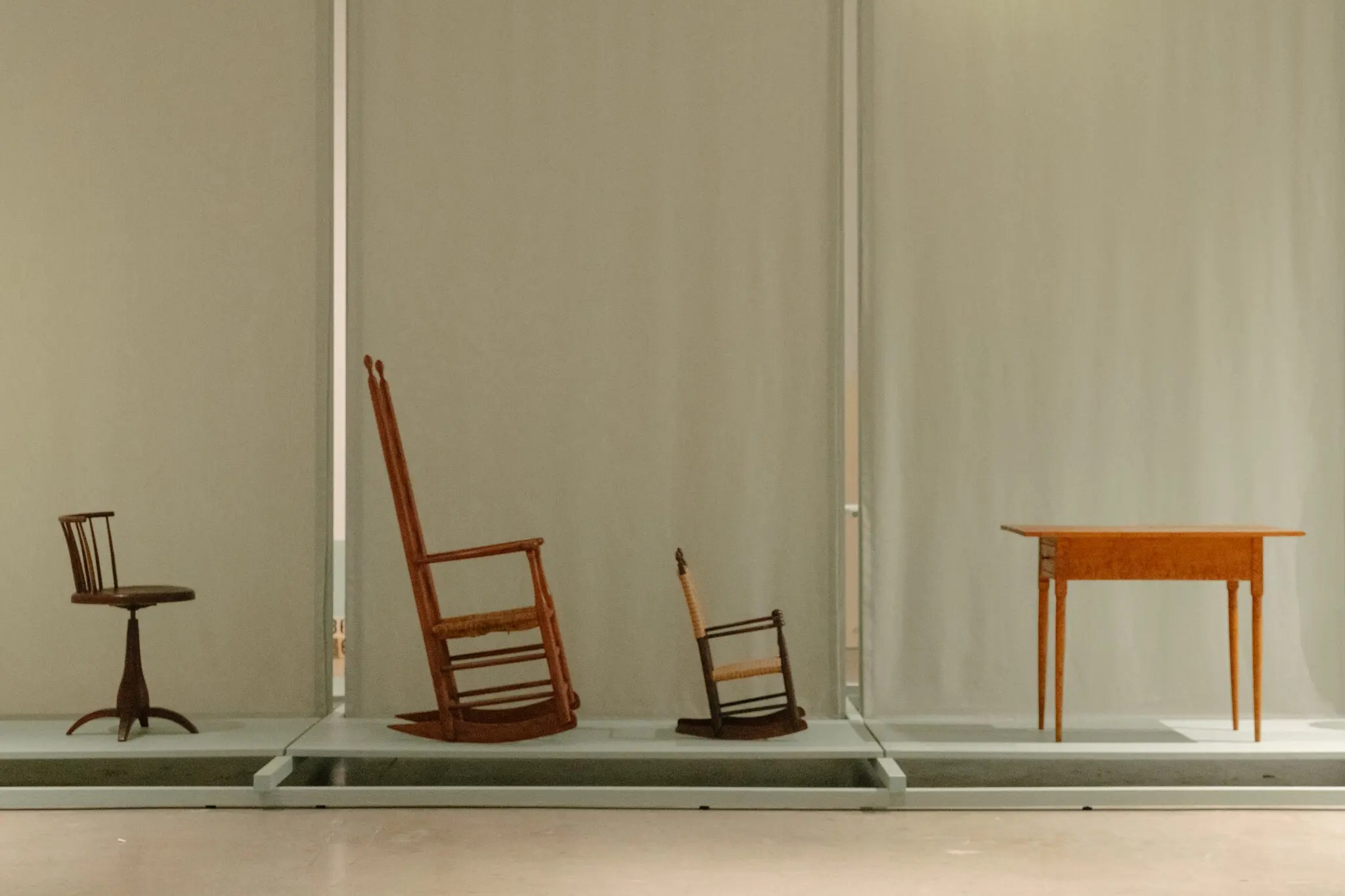
This and following images by Caroline Gutman for The New York Times.
Contemporary Pieces As Well. “ ‘A World in the Making,’ ” Lasky relates, “is part of the surge of Shaker-inspired projects that go well beyond the oval box, with some refracted through modern interpretations that can be challenging. The traveling exhibition, a joint undertaking with the Vitra Design Museum [see also “Walk Right In, Sit Right Down”] in Germany where it originated last summer, and the Milwaukee Art Museum, also presents works by seven contemporary artists, including a walk-in cardboard meetinghouse by Amie Cunat, funerary objects woven by Christien Meindertsma in the manner of Indigenous and Shaker baskets and a short film of dancers swaying to the choreography of Reggie Wilson, who was inspired by the ecstatic dancing of the early Shakers as well as the movement traditions of Black churches.”
“ ’Tis a Gift to be Simple.” The musical reference, of course, calls to mind Aaron Copland’s Appalachian Spring and its theme of the Shaker folk song ’Tis a Gift to be Simple.’ There’s a particularly moving version of this, done with ASL rendering, accessible at YouTube.
Shakers’ Utopianism. Lasky quotes Hallie Ringle, chief curator at the ICA, who speaks on Shaker utopianism: “What does it mean to build tomorrow for today? That is the question that the Shakers have been asking since their inception, but it feels more contemporary than ever.”
Lasky also cites Sarah Margolis-Pineo, former curator at the Hancock Shaker Village museum in Pittsfield, Massachusetts, who wrote an essay for this show’s catalog: “We become interested in world building when the world is crumbling around us. In this very last gasp of late-stage capitalism, I think people are interested in different forms of how we can live and be productive and find meaning together.”
Heady thoughts indeed, but certainly finding meaning together is an admirable goal.
Shaker Attributes. Lasky recounts, “The Shakers typically provided a safe harbor for anyone in need — enslaved people, hungry people, single mothers, orphans. Having reasoned that a god that created humankind in its image would have aspects that were both male and female, the group showed an extraordinary respect for gender equality from the beginning. Ann Lee, the Manchester, England-born visionary who founded the first Shaker settlement, near Albany, N.Y., in 1776, set an example that would be echoed by Rebecca Cox Jackson, a Black seamstress who established an African American Shaker community in Philadelphia in 1858.”
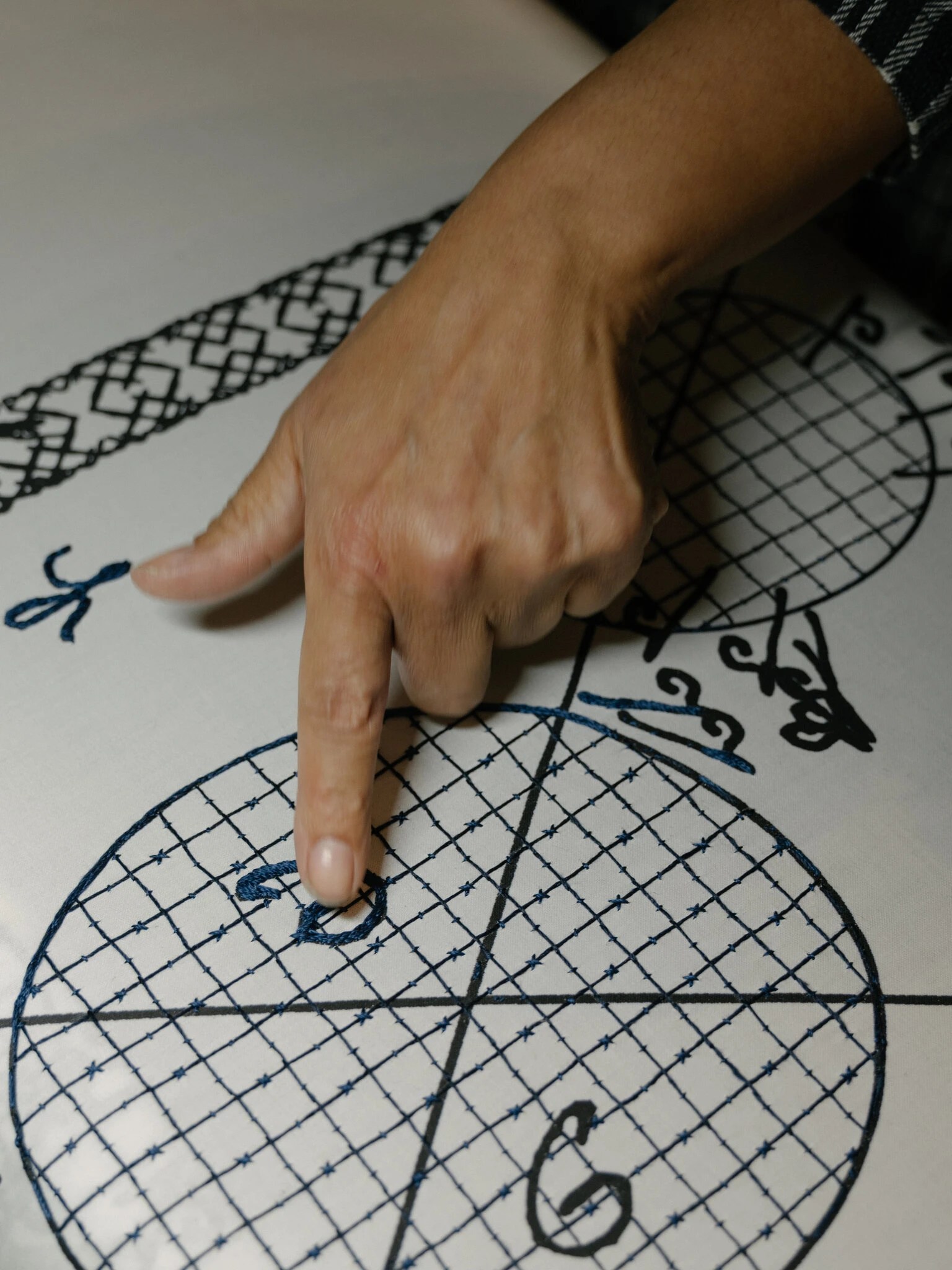
Lasky observes, “ ‘A World in the Making” includes two embroidered textiles designed by the artist Kameelah Janan Rasheed. The pieces refer abstractly to the writings of Jackson, who said that she learned to read in a swoop of divine intervention.”
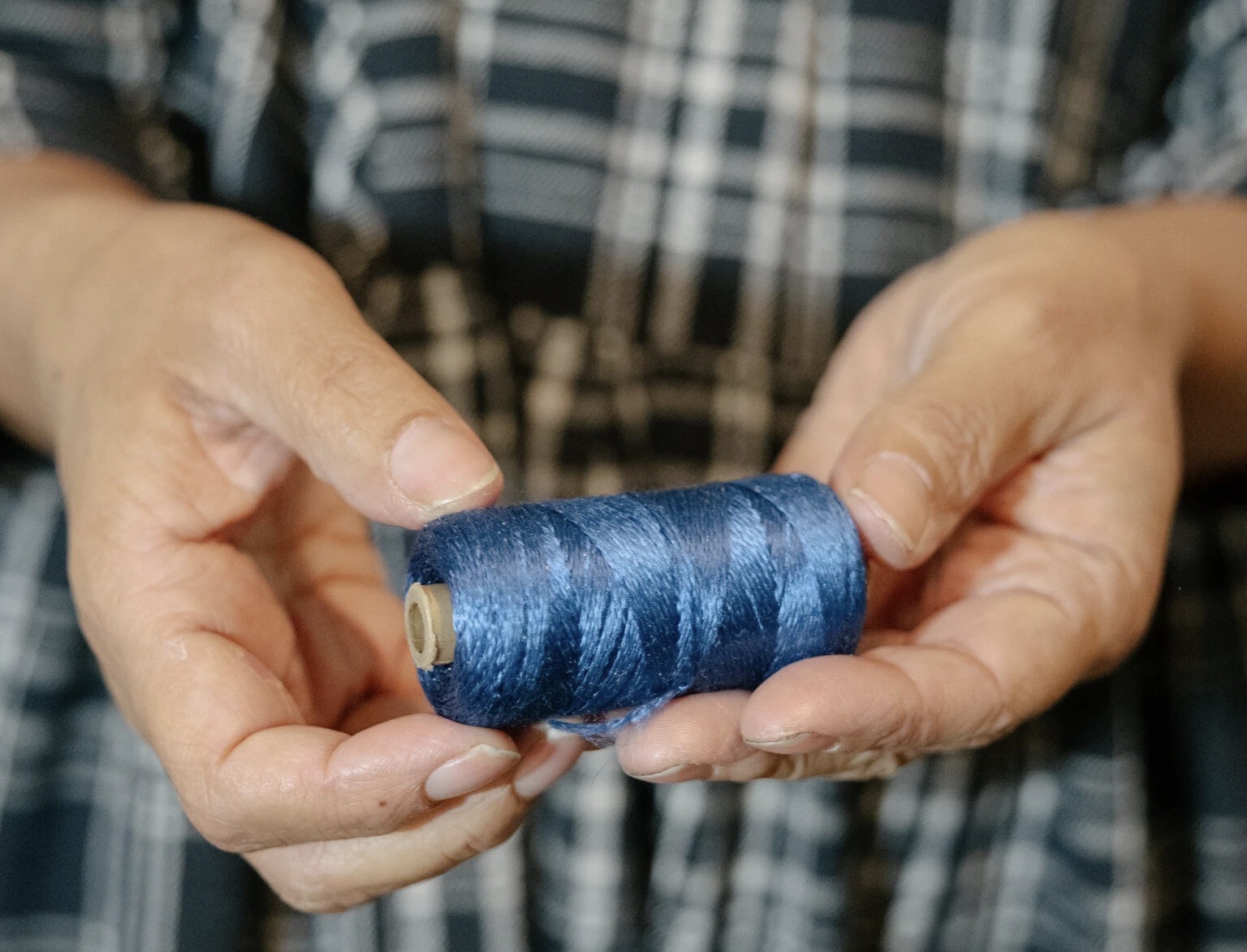
Silk embroidery thread is used in Kameelah Janan Rasheed’s tapestries interpreting the writings of Rebecca Cox Jackson.
An Adult Cradle. “The Shaker Museum in Chatham,” Lasky notes, “has been actively encouraging contemporary artists to creatively mine the collection.” She cites “an adult cradle, underscoring the tenderness with which the Shakers historically treated their elderly and infirm. (The cradle is now displayed in ‘A World in the Making.’)”
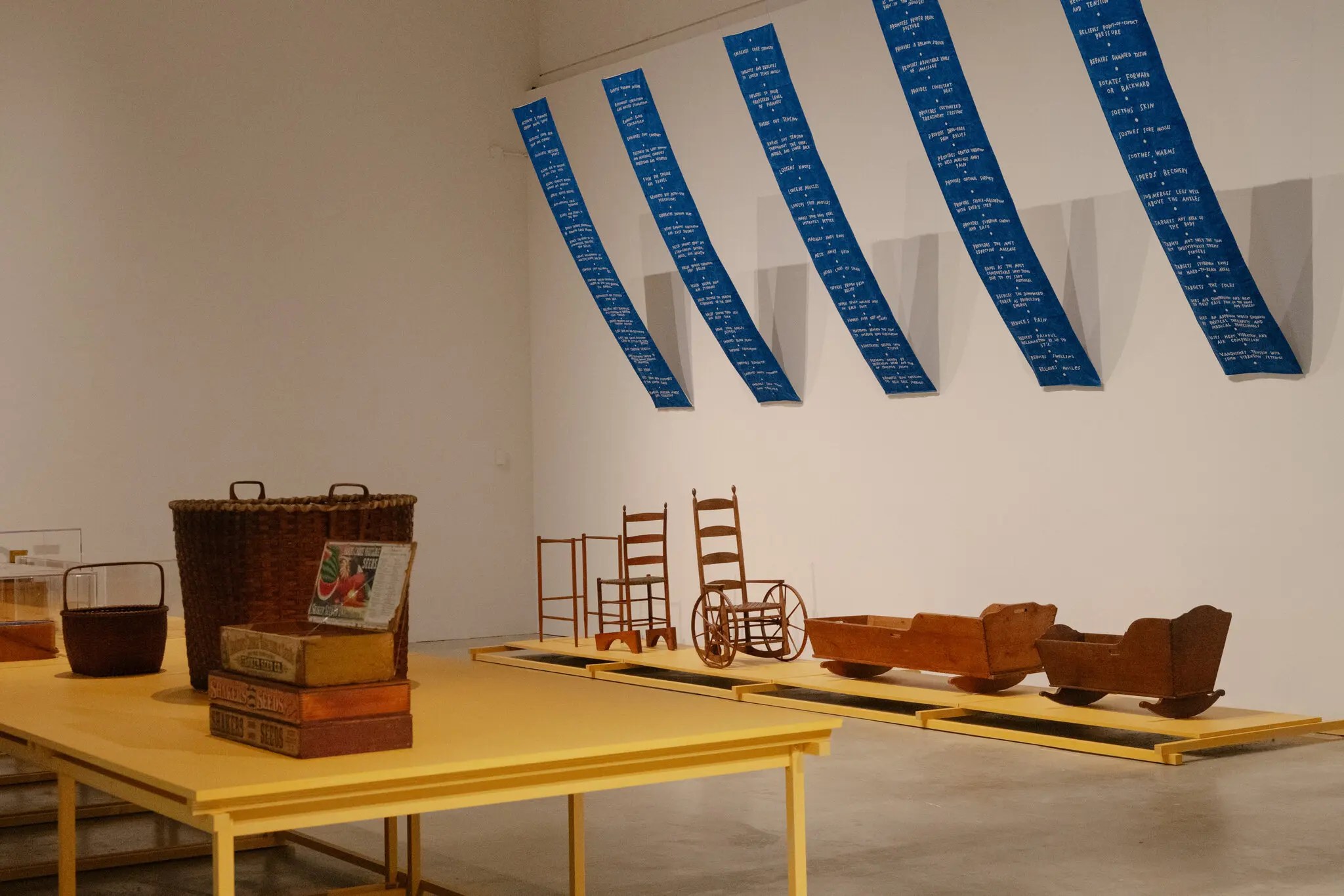
An adult cradle resides between a child’s counterpart and a Shaker wheelchair.
The Shaker Heritage. Lasky recounts, “Before planning the ICA show with the Vitra Museum, Ringle, the curator, informally polled her family members and was startled to find most had not heard of the Shakers: ‘I’m really excited to have people come in and understand who they were,’ she said.”
And I’m pleased The Times’ Julie Lasky encourages us in this as well. ds
© Dennis Simanaitis, SimanaitisSays.com, 2026
 Simanaitis Says