
Simanaitis Says
On cars, old, new and future; science & technology; vintage airplanes, computer flight simulation of them; Sherlockiana; our English language; travel; and other stuff
THORNTON WILDER’S WORKS
I PERUSED A GOODLY NUMBER OF HOLIDAY READINGS, several of the “Putting Up With Uncle MAGA/Woke at Dinner” variety, one of schadenfreud (“Kennedy Center’s Christmas Eve Jazz Show Canceled After Trump Name Added to Building,”) and another of lasting value: “The One-Act Play Your Family Should Read Together at Christmas,” by Jeremy McCarter in The New York Times, December 25, 2025. Here are tidbits gleaned from his Guest Essay about a Thornton Wilder play, together with comments of mine about other Wilder favorites.

Jeremy McCarter is the literary executor of Thornton Wilder and contributed to the book Our Town and Cosmic One-Acts (of which anon). He writes, “Things being what they are in the world today, get-togethers with the relatives are often fraught with pick-your-side political debates. Sometimes it might feel as if your family dinner would last forever.”
“If only we could be so lucky,” he observes.
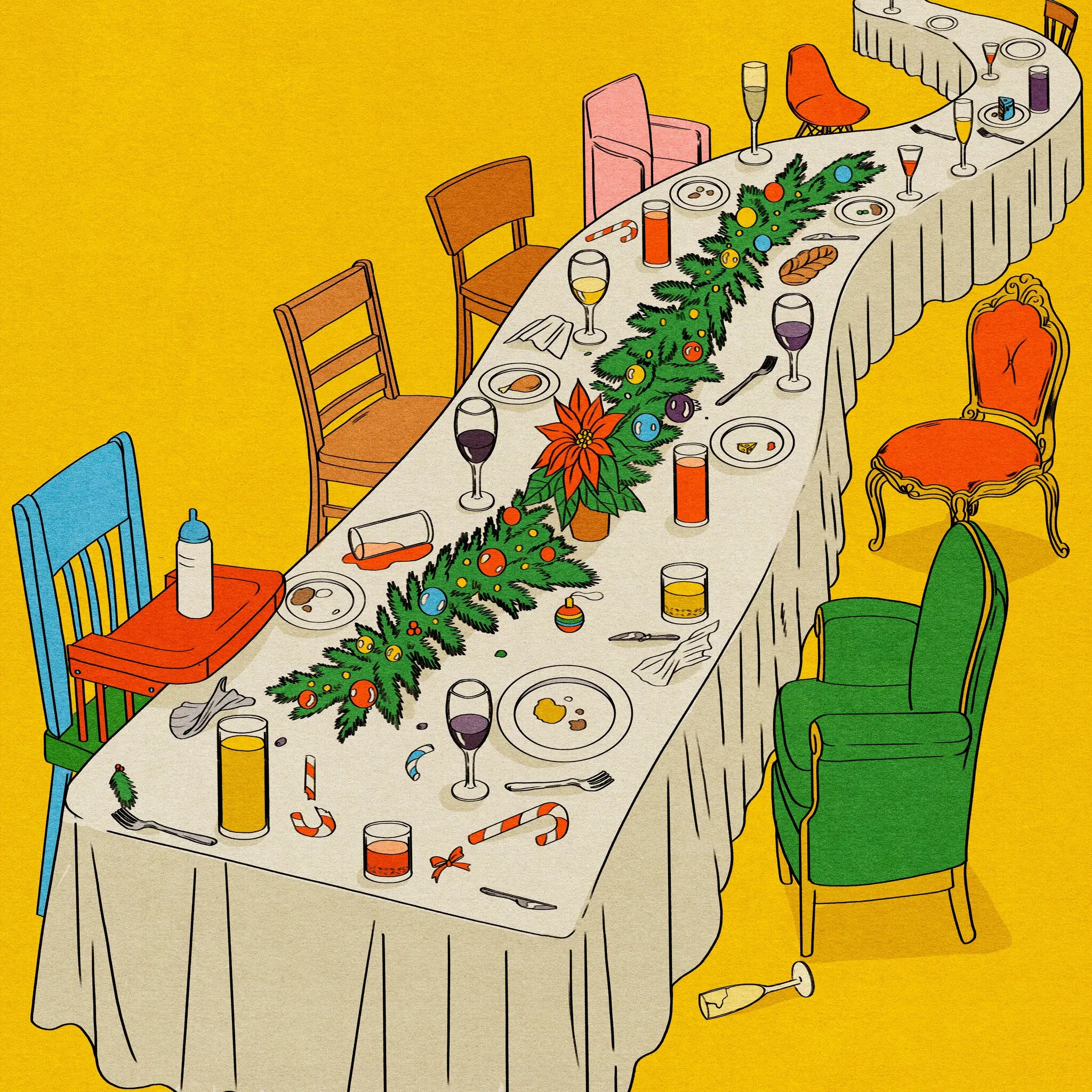
Image by Maria Jesús Contreras in The New York Times.
McCarter continues, “That unexpected viewpoint—that the best family dinner might be one that lasts a lifetime or even longer—comes from the great American novelist and playwright Thornton Wilder.”
The Long Christmas Dinner, 1931. McCarter describes what he calls, “a seemingly mundane premise, in which a bunch of characters sit down at center stage to share a meal. In less than 40 minutes of stage time—in the course of a single, unbroken Christmas dinner—90 years of a family’s history fly by. Older characters carry the past, with its lessons and regrets, while youngsters carry the future, with all its hopes and unanswered questions. All of the family members are bound by traditions that endure through the trivialities of the present.”
Twin Arches. McCarter recounts as an example, “Wilder, using ingeniously simple means, lets the dinner setting represent the entire architecture of life and death. On one side of the stage, there’s an arch, wreathed in flowers, representing birth; on the other, there’s an arch, draped in black, where older characters make their final exits (and, tragically, a few younger characters, too).”
“Between those arches,” McCarter describes, “at a long table, four successive generations of the family eat their dinners (with invisible props and food, per the stage directions) while keeping up a constant and highly relatable stream of conversation. They bicker, joke, pray, reminisce and, very frequently, resort to talking about the weather — you know, just like a typical family dinner.”
Time With a Capital T. “But the true subject of Wilder’s play,” McCarter observes, “is more sweeping than the dynamics of one family or even of all families. It’s really about time with a capital T. By compressing 90 years of history into a play that lasts less than half as many minutes, Wilder lets us see with astonishing clarity the way that time works both on us and through us, mostly without our realizing it. The result is revelatory: Imagine fish starting to grasp that there’s such a thing as water.”
I like the fish metaphor. It reminds me of Emily in Wilder’s Our Town, when she comes to recognize the simple activities of life: “It goes so fast. We don’t have time to look at one another.”
McCarter recommends that the Wilder one-act makes for especially fine family reading. He most appropriately includes a link to Sarah Ruhl’s Our Town and the Cosmic One-Acts.
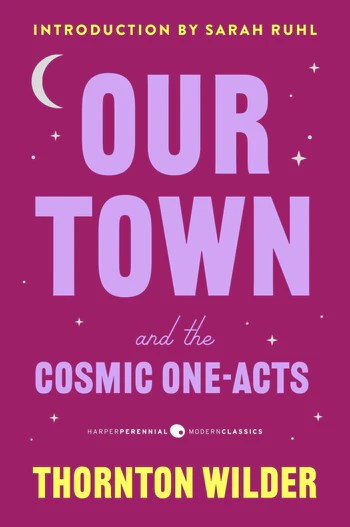
Other Wilder Works. He also recounts that Wilder may be remembered best for his 1938 play Our Town or his novel The Bridge of San Luis Rey.

I revere Our Town for two reasons: Firstly, in contrast to my dear parents seeing the 1940 movie, and mom being distinctly put off by the cemetery scene where Emily converses with passed spirits. (Mom would have liked the original play even less: Emily doesn’t recover in 1938).
Secondly, I love the film’s music, composed by Aaron Copland.
The Skin Of Our Teeth. I also delight in another Wilder work, The Skin Of Our Teeth, “memorable as a cosmic comedy of mankind’s history.” To this day, I remember the maid Sabrina saying, “The whole world’s at sixes and sevens, and why the house hasn’t fallen down about our ears long ago is a miracle to me.” Script note: A fragment of the left wall, Flat ‘A,’ leans precariously over the stage.
And Sabrina relates, “If you want to know anything more about Mrs. Antrobus, just go and look at a tigress, and look hard.”

Concluding Act III Sabrina says, “This is where you came in. We have to go on for ages and ages yet. You go home. The end of this play isn’t written yet. Mr. and Mrs. Antrobus! Their heads are full of plans and they’re as confident as the first day they began—and they told me to tell you good night.”
Alas, I’m too young to have seen Tallulah Bankhead portraying Sabrina in the original 1942 production. ds
© Dennis Simanaitis, SimanaitisSays.com, 2025
 Simanaitis Says