
Simanaitis Says
On cars, old, new and future; science & technology; vintage airplanes, computer flight simulation of them; Sherlockiana; our English language; travel; and other stuff
SMART DUMMIES PART 1
AUTOMOTIVE CRASH TEST DUMMIES ARE SMARTER than their real-life counterparts. Unlike humans, their memories retain scads of data from sensors throughout their bodies. Their materials and contours are engineered to mimic human reactions to the dynamics of a variety of car crashes at different speeds.

Camila Domonoske recently visited Humanetics ATD, as in Anthropomorphic Test Devices, in Huron, Ohio. She reports on “Built to Spill: The Life of a Crash Test Dummy,” NPR, December 16, 2025. Here, in Parts 1 and 2 today and tomorrow, are tidbits gleaned from her report and from the Humanetics ATD website, together with my usual Internet sleuthing.

Crash Test History. Andrew Sheldon recounts in “The History of Crash Test Dummies,” Your AAA Today, March 8, 2022: “In 1934, General Motors became the first car maker to crash test its vehicles when it collided an unoccupied car into a concrete barrier. By the 1950s, universities including Cornell, UCLA and Wayne State began conducting their own crash tests, which proved the effectiveness of vehicle safety features, most notably the seat belt…. In 1968, The National Traffic and Motor Vehicle Safety Act went into effect, mandating seat belts in all new cars.”
Compliance wasn’t (and still isn’t) an easy sell. To wit: my opening comment about human smarts.
Sheldon continues, “The National Highway Transportation Safety Administration was established just two years later. In 1978, the government agency conducted its first crash test, a 35-mph frontal collision. The NHTSA began side impact testing nearly two decades later, and eventually added rollover resistance tests in 2000.”
Cadavers were once used to assess how crashes affected the human body, albeit only imprecisely in their dynamic reactions. In 1968, Alderson Research Laboratories offered the first crash test dummy designed specifically for automotive testing. During the 1970s, GM’s Hybrids I, II, and III improved on the concept (for example, III had 41 data channels; II had only 8). In the 1980s, Hybrid III evolved to include large male and small female shapes; child versions came in 1994.
All of these were designed for testing frontal impacts. Over the next 30 years, side- and rear-impact dummies followed.
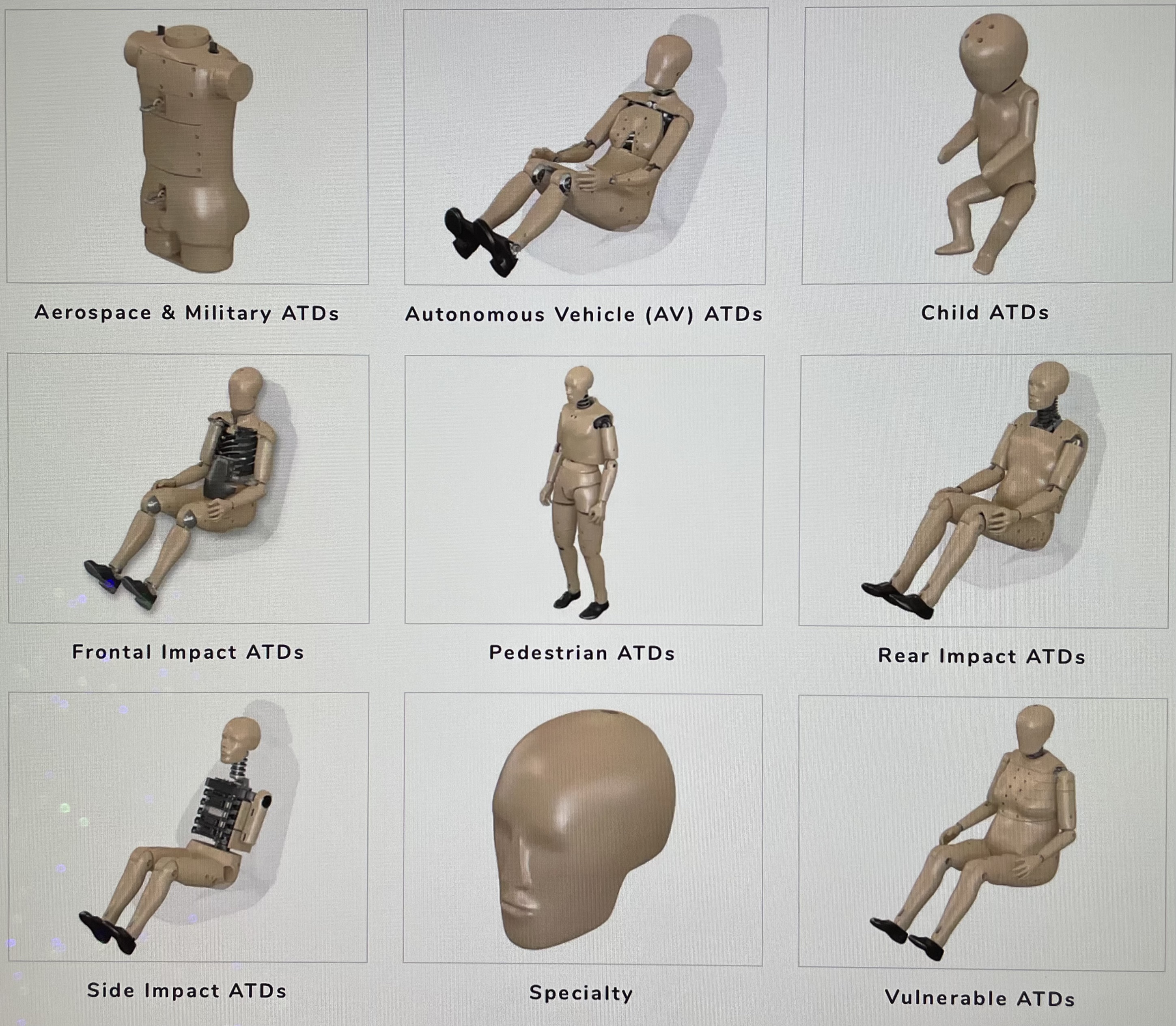
This and following image from Humanetics ATD.
Today, for example, Humanetics offers a variety of ATDs, including those with Aerospace and Military, Autonomous Vehicle, and Pedestrian applications. There are also Elderly Vulnerable, Obese, and Powered Two-Wheeler Dummies.

Veritably, an extended ATD family.
A Dummy That’s Smart Indeed. Humanetics describes, “Crash test dummies simulate human response to impacts, accelerations, deflections, forces and moments of inertia generated during a crash. Each dummy is designed to model the form, weight and articulation of a human body. Hundreds of sensors and transducers located within the dummy provide life-saving data to safety test engineers, measuring the precise physical forces exerted on each body part in a crash event.”
The company continues, “We develop special sensors to measure the forces that break bones and cause soft-tissue injuries. These readings are controlled and repeatable, providing vehicle designers with reliable data to enhance and refine product safety.”
Tomorrow in Part 2, NPR’s Camila Domonoske tours Humanetics. ds
© Dennis Simanaitis, SimanaitisSays.com, 2025
 Simanaitis Says