
Simanaitis Says
On cars, old, new and future; science & technology; vintage airplanes, computer flight simulation of them; Sherlockiana; our English language; travel; and other stuff
OUT OF AFRICA, KITTY-STYLE PART 2
Yesterday we began tidbits gleaned from Jonathan B. Losos’ “The Cat Diaspora Out Of Africa” and “The Dispersal of Domestic Cats from North Africa to Europe around 2000 Years Ago,” by M. De Martino et al., both from AAAS Science, November 27, 2025. Part 2 today picks up with methodology of searching out both ancient and modern evidence on feline “semidomestication” during its diaspora. (Don’t you love that term!)

Modern Evidence. Jonathan B. Losos describes, “De Martino et al. took two approaches to map the domestic cat diaspora. Using nuclear DNA from modern-day samples, they conducted a phylogenetic analysis to determine the evolutionary affinities of domestic cats to Near Eastern wildcats from northern Africa and Asia. Single-nucleotide polymorphisms (SNPs) from mid- and high-range–coverage genomes revealed that all domestic cats are more closely related to each other than they are to wildcats (i.e., they form a clade). In turn, this domestic cat clade is more closely related to Near Eastern wildcats from northern Africa than they are to Near Eastern wildcats of the Levant. This finding supports the out-of-Africa hypothesis of cat domestication.”
A Window to the Past. “But historical inferences drawn from only contemporary specimens can be misleading,” Losos notes, “which is where the archaeological and fossil records come in, providing a direct window to the past. De Martino et al. were able to retrieve DNA from some of these remains.”
“These cats,” Losos describes, “ranged in provenance from Stone Age sites in the 9th millennium BCE to nearly contemporary cats of the 19th century CE, spanning localities across Europe and Turkey. Examination of this ancient DNA supported the conclusion that domestic cats are derived from wildcat populations in northern Africa rather than the Levant and suggests that domestication may have occurred in just the past few thousand years.”
As I noted early on, isn’t it just like a cat to show up on his own time.
A Commonly Held View Challenged. M. De Martino and his colleagues recount, “Our findings challenge the commonly held view of a Neolithic introduction of domestic cats to Europe, instead placing their arrival several millennia later. We redefine the timing of cat dispersal by identifying at least two waves of introduction to Europe. The first dispersal most likely featured wildcats from Northwest Africa that were introduced to Sardinia and founded the island’s present-day wild population. A distinct and yet-unknown population in North Africa sourced a second dispersal not later than 2000 years ago that established the gene pool of modern domestic cats in Europe.”
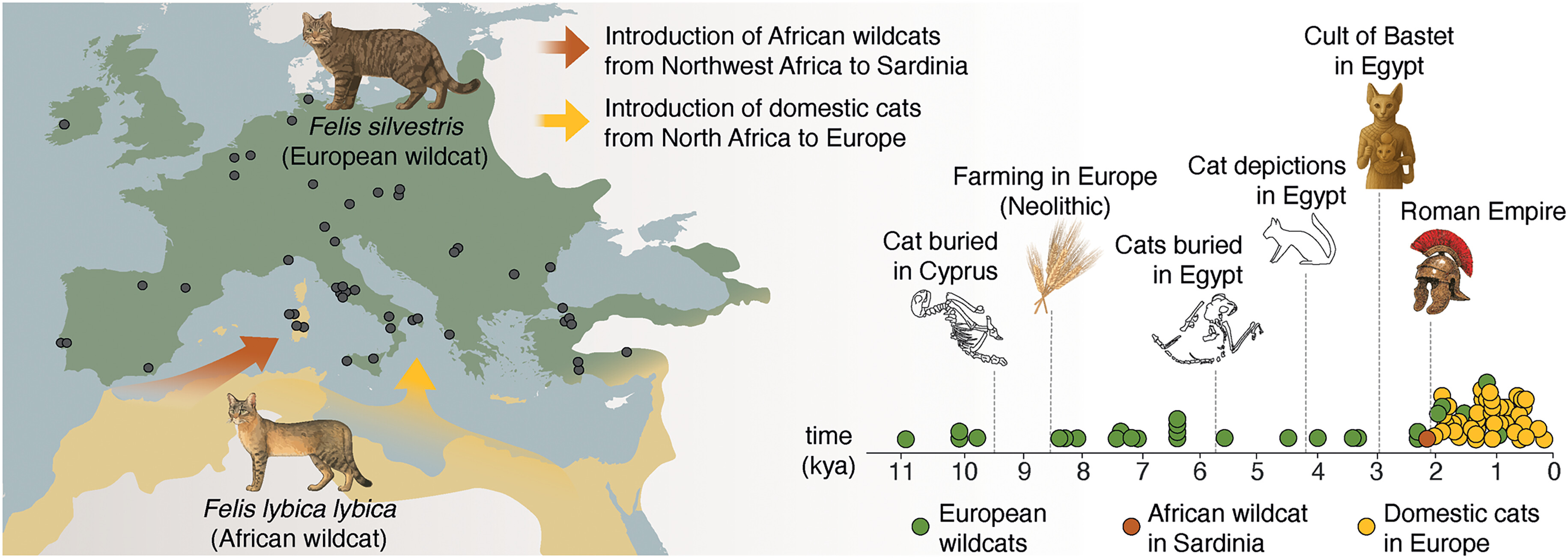
The introduction of domestic cats to Europe. Image from De Martino et al. in Science.
Their caption: “The genomes of ancient cats from archaeological sites across Europe and Anatolia (dark circles in the map) revealed that domestic cats were introduced to Europe from North Africa starting at ~2 thousand years ago (kya), several millennia after the onset of the Neolithic in Europe. African wildcats in Sardinia originate from a distinct wildcat population in Northwest Africa.”
Wildcat to Housecat vs Wolf to Dog. Losos also observes, “The study by De Martino et al. is part of an ongoing project, FELIX, which also aims to tackle other outstanding questions concerning cat domestication. Just like the limited number of phenotypic changes, few genes evolved owing to selection during the transition from wildcat to housecat—only about a third as many as those that distinguish dogs from wolves—but it is not known whether these changes occurred in a short interval or were acquired sequentially over an extended period.”
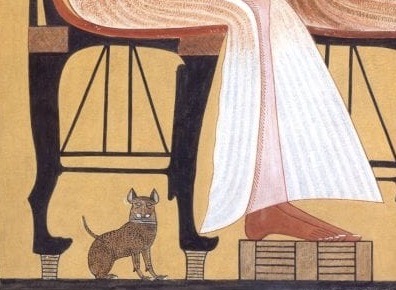
Sphinxlike. “Moreover,” Losos asks, “was the land of the pharaohs truly the place where the entire domestication process occurred, or was it simply the finishing school where mouse-catchers that adapted elsewhere to living around humans evolved into household companions? Indeed, De Martino et al. propose that northwestern Africa, the vicinity of Morocco and Tunisia, may have played a previously unappreciated role in cat domestication. Ever sphinxlike, cats give up their secrets grudgingly.” ds
© Dennis Simanaitis, SimanaitisSays.com, 2025
 Simanaitis Says