
Simanaitis Says
On cars, old, new and future; science & technology; vintage airplanes, computer flight simulation of them; Sherlockiana; our English language; travel; and other stuff
SCIENCE AND OUR WORLD
ONE HUNDRED YEARS AGO, ENGLISH MATHEMATICIAN ALFRED NORTH WHITEHEAD delivered a series of Lowell Lectures titled Science and the Modern World. In a “Classics Revisited” essay, Science, October 16, 2025, Àlex Gómez-Marin reviews this seminal work in “A Radically Organic Worldview Turns 100.” Here are tidbits gleaned from this article, together with my usual Internet sleuthing.

A Wide-Range Thinker Indeed. Wikipedia notes that Whitehead “created the philosophical school known as process philosophy, which has been applied in a wide variety of disciplines, including ecology, theology, education, physics, biology, economics, and psychology.”

Alfred North Whitehead, 1861–1947, English mathematician and philosopher. Image, c. 1924, from Wikipedia.
With former student Bertrand Russell, Whitehead also wrote the three-volume Principia Mathematica (1910–1913), considered one of the 20th century’s most important works in mathematical logic. (Along similar themes, but not to be confused with Sir Isaac Newton’s Philosophiæ Naturalis Principia Mathematica.)
Of process philosophy Whitehead posits, “There is urgency in coming to see the world as a web of interrelated processes of which we are integral parts, so that all of our choices and actions have consequences for the world around us.”
How much more crucial this seems a century after it was written.
A Modern Perspective. Àlex Gómez-Marin writes, “In an extraordinarily comprehensive effort, Whitehead explains the key conceptual movements of science from Galileo to Einstein. Century after century, he masterfully highlights a living history of world-shaping ideas, revealing the deep habits and unfolding trends of the scientific mentality.”
Gómez-Marin recounts, “Science was born in the 17th century as a reaction to medieval thought that nevertheless embraced its belief in a natural order. Its forerunners admirably blended rationality and empiricism, balancing powerful abstractions with attention to concrete facts. Mathematical refinements and mechanical insights propelled science’s success throughout the 18th and 19th centuries, led by pioneering French mathematicians such as Pierre-Simon Laplace and Joseph-Louis Lagrange and Italian physiologists including Luigi Galvani and Alessandro Volta.”
Indeed, practitioners of what we now call “science” were known as “natural philosophers.”
Science Professionalized, And Opposed. “The 19th century,” Gómez-Marin observes, “was marked by what Whitehead calls ‘the invention of the method of invention,’ together with the professionalization of science. These advances were met with the ‘Romantic reaction,’ opposing the mechanical view of life and affirming the intrinsic reality of value.”
Counterintuitive 20th-Century Science. Gómez-Marin continues, “He then turns to the 20th-century revolutions in modern physics and their counterintuitive nature, which his ‘organic philosophy’ seeks to accommodate. His take on quantum physics and relativity is original and profound but remains obscure and untrodden.”
Conquerers and Thinkers. Gómez-Marin notes of Whitehead’s views on science: “More than its ‘method,’ it is the scientific ‘mentality’ that has profoundly influenced our lives and morphed societies for generations. He compares the acts of ‘great conquerors’ with the ideas of thinkers, ‘individually powerless, but ultimately the rulers of the world.’”
But Abstractions Can Go Too Far: “Whitehead celebrates science’s great accomplishments,” Gómez-Marin relates, “but critiques its abstractions when they go too far, especially when they are mistaken as concrete. The most pervasive and pernicious scientific abstraction of all, he argues, is ‘simple location’: the idea that there is merely motion of material in a mechanical universe, namely, a world made of independent bits of matter distinctly located in space and time.”
“The notion of mass,” Gómez-Marin continues, “is actually the great pearl in the crown of scientific materialism but also its Achilles’ heel, as it afforded science with the basis for measurable and regular laws at the price of adopting an ‘unbelievable’ idea, writes Whitehead, one that does violence against the very facts of our immediate experience and also leads to the mechanization and, ultimately, the destruction of the natural world.”
Gómez-Marin’s Summary: “Whitehead’s thought is a century old,” Gómez-Marin says, “and yet it still seems to stream in from the future. His ideas are finally being caught up to in cutting-edge biology, which is currently enjoying an organicist renaissance…. A similar subtle revolution is also going on in the cognitive sciences, where mind and life interpenetrate, and in consciousness studies, where the gulf between mind and matter is also being bridged and dissolved. Back to theoretical physics, Whitehead offers a path forward for a field stalled and captured by ‘theories of everything’ so disconnected from facts and concrete human experience that they seem to have abandoned the realm of science altogether.”
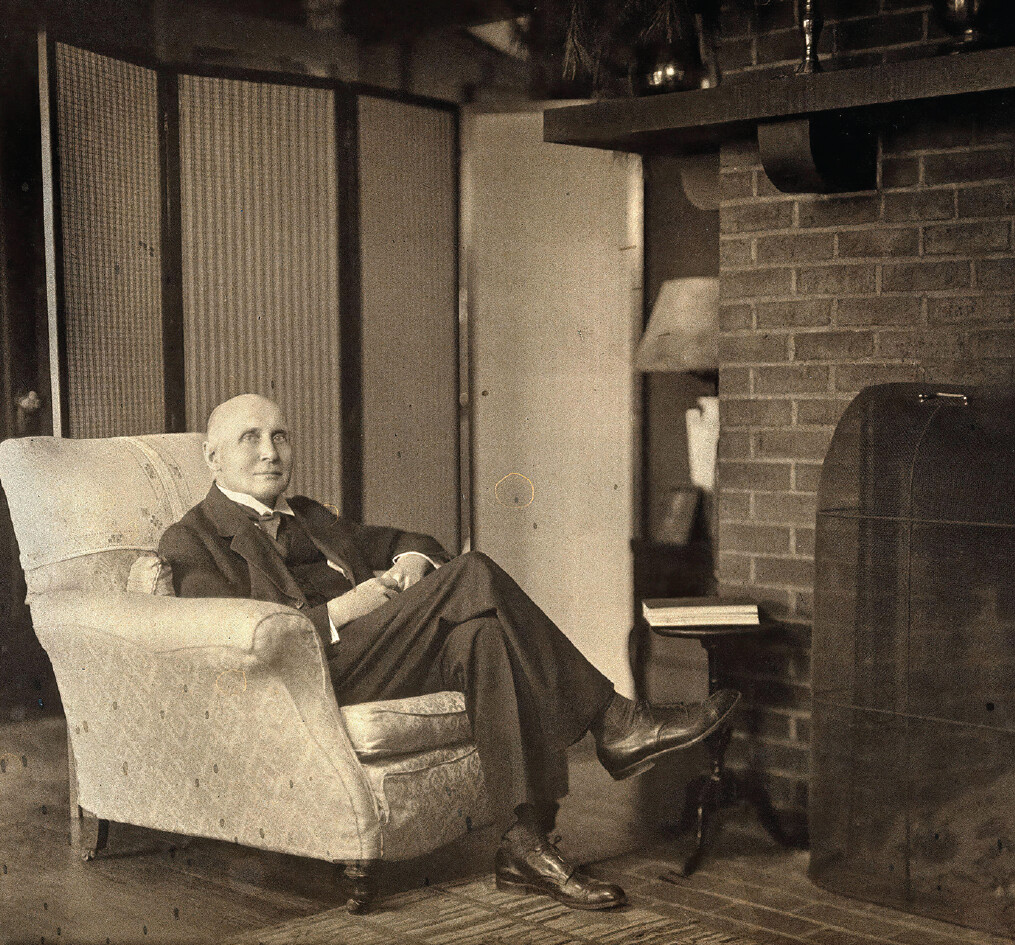
English mathematician and philosopher Alfred North Whitehead traced key conceptual movements in science in his influential work. Image and caption from Science.
“Thinking along with Whitehead,” Gómez-Marin concludes, “we can escape our ideological ‘groove.’ Nothing seems more urgent in our polarized, postmodern, artificial intelligence–seized age.”
Amen to this. ds
© Dennis Simanaitis, SimanaitisSays.com, 2025
 Simanaitis Says