
Simanaitis Says
On cars, old, new and future; science & technology; vintage airplanes, computer flight simulation of them; Sherlockiana; our English language; travel; and other stuff
SEEKING A LIFE’S PHILOSOPHY
I’VE NEVER BEEN MUCH INTO PHILOSOPHY: I admire the wit of St. Augustine’s comment: “Oh, Master, make me chaste and celibate—but not yet.” And as for Bishop Berkeley’s Esse est percipi (“to be is to be perceived”), how come he doesn’t just fall on his butt when he’s not thinking of that chair?
Professors of philosophy have warned that I’m not deep.
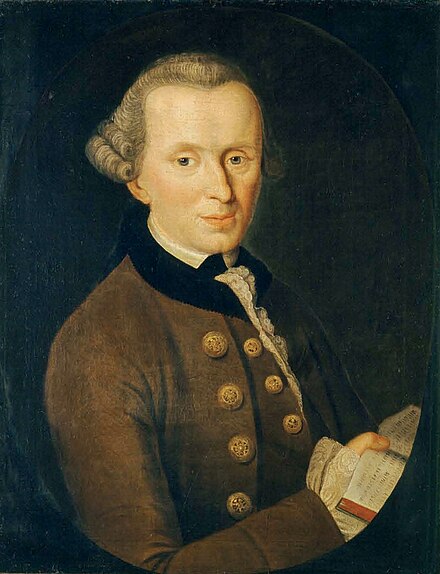
Immanuel Kant, 1724–1804, German philosopher and one of the central Enlightenment thinkers. Portrait of Kant, 1768, by Johann Gottlieb Becker.
The Kantian Categorical Imperative. But I have long respected the Kantian Categorical Imperative: “We should act in a way that could be a universal rule of conduct.” It’s sorta a fancied-up Golden Rule, “Do unto others as you would have them do unto you.” Or the Confucian version: “What you do not want done to yourself, do not do to others.”
An Individual’s View Versus a Universal. The principal difference is the Golden Rule(s) being based on individual’s possibly skewed perceptions. By contrast, the Kantian Categorical Imperative is to apply universally.

There’s an interesting discussion of this at the PhilosophyStackExchange.

A New Book on the Matter. In “Categorical Revolution,” The New Yorker, November 3, 2025, poet/critic Adam Kirsch reviews Marcus Willaschek’s Kant: A Revolution in Thinking. Kirsch recounts “Why Kant still has more to teach us.”
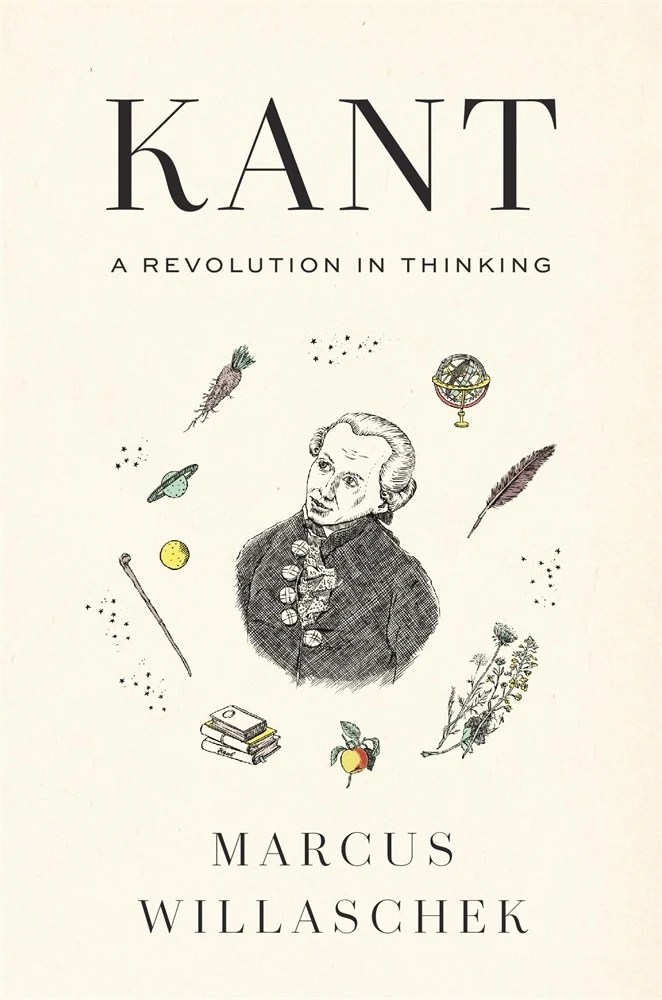
Kant: A Revolution in Thinking, by Markus Willaschek, translated by Peter Lewis, Belknap Press, 2025.
IndeBound notes, “Marcus Willaschek is Professor of Philosophy at Goethe University, Frankfurt, and a member of the Berlin-Brandenburg Academy of Science, where he is responsible for the German standard edition of Kant’s works.”
Kirsch says the book “argues that what made Kant revolutionary was his contention that to understand anything—science, justice, freedom, God—we first have to understand ourselves…. As Willaschek demonstrates, Kant believed that his ideas would change humanity’s understanding of its place in the world as profoundly as the Copernican revolution had changed our sense of Earth’s place in the cosmos.”
Facing a Moral Choice. Kirsch notes, “Every time we face a moral choice, Kant argues, we should think as if we were lawmakers, drawing up a rule, or ‘maxim,’ for all of humanity to follow…. This is Kant’s famous ‘categorical imperative,’ which he considers the essence of morality: ‘I ought never to act except in such a way that I can also will that my maxim should become a universal law.’ ”
Universality. “Although Kant’s definition of morality isn’t derived from religion,” Kirsch observes, “it makes the same kind of demand as many faiths: It urges us to forget our selves. Indeed, he compares this idea to ‘the passages from Scripture in which we are commanded to love our neighbor and even our enemy.’ ”
“For Kant,” Kirsch says, “putting ‘the human at the center of his thought’ was, as Willaschek writes, an act of faith in our ability to live according to reason.”

Illustration by Jan Robert Dünnweller in The New Yorker.
Our Own Times. Kirsch observes, “This faith is all the more moving at a time like our own, when the ideal of human reason is under attack both politically and technologically…. In Europe, and especially in Germany, Kant has long served as a symbol and patron saint of the postwar liberal order. In the seventeen-nineties, he argued for democracy, cosmopolitanism, and the settlement of international disputes through ‘a permanent congress of nations’ instead of war. Two centuries later, the West, after destroying itself with irrational hatreds, finally seemed ready to put those ideals into practice, in the form of the United Nations and the European Union.”
A Crumbling Kantian Consensus? Kirsch notes, “But now the Kantian consensus seems to be crumbling. Democratic countries are embracing authoritarian leaders; anti-immigration movements are insisting on exclusive national identities; and the Russian invasion of Ukraine brought war back to a continent that had grown used to what Kant called ‘perpetual peace.’ ”
And Then There’s A.I. “At the same time,” Kirsch observes, “the rise of artificial intelligence is posing a quieter but even more profound challenge to Kantian humanism…. If computers can think, does that mean that they are also free moral agents, worthy of dignity and rights? Or does it mean, on the contrary, that human minds were never as free as Kant believed—that we are just biological machines that flatter ourselves by thinking we are something more? And if fundamental features of the world like time and space are creations of the human mind, as Kant argued, could artificial minds inhabit entirely different realities, built on different principles, that we will never fully understand?”
Heady thoughts indeed.
A Summary. “Of course,” Kirsch writes, “it is impossible to draw a straight line from the eighteenth century to the twenty-first, or to say with certainty what Kant would have thought about Ukraine or ChatGPT. As Willaschek writes, ‘Kant does not offer any ready-made solutions to the questions of our age.’ But what makes a philosopher great isn’t that they have all the answers; it is that they help us formulate our most important questions, even ones that they could never have anticipated.”
“Perhaps,” says Kirsch, “the Kantian idea hardest to accept today is his confidence that humanity is able to do such difficult things, and wants to.” Let us hope his confidence is warranted. ds
© Dennis Simanaitis, SimanaitisSays.com, 2025
 Simanaitis Says