
Simanaitis Says
On cars, old, new and future; science & technology; vintage airplanes, computer flight simulation of them; Sherlockiana; our English language; travel; and other stuff
REMEMBERING THE GROUND OBSERVER CORPS PART 2
YESTERDAY, MY AEROBIBLIOGRAPHIC RECOLLECTIONS encountered Bruce Callander’s “The Ground Observer Corps,” Air & Space Forces Magazine. Today in Part 2, we continue gleaning tidbits from it, together with my (barely trivial) involvement.
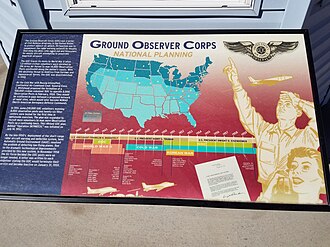
Map of Ground Observer Corps stations. Image by Jurisdicta from Wikipedia.
Cold War Responses. Bruce Callander described, “It was the era when the Soviets acquired nuclear weapons. Like us, the Soviets had captured German scientists and had them working on intercontinental delivery systems. And who knew what kind of long-range aircraft the USSR had in operation.”
He continued, “There was also Red China, about which we knew even less. By the end of June 1950, we were at war in Korea, and, not long after that, Mao Zedong’s China plunged into the war on the side of North Korea.”
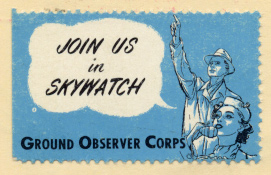
Skywatch recruiting sticker from the 1950s.
“The U.S. government and public took the threat seriously,” Callander wrote. “Many built bomb shelters. Others stocked up on canned goods and checked out which local buildings were designated as public shelters. School children practiced the ‘duck and cover’ technique and were warned to stay away from windows during an attack.”
SimanaitisSays recounted this in “Ah, Those ‘Good Old Days’….” Of “duck and cover,” I wrote, “We didn’t ponder, I forget why now, the potentially collapsing four stories of brick schoolhouse above us. I do recall imagining what neat little piles of cinders would be discovered years later, once our Cleveland neighborhood (near major industry) wasn’t still hot radioactively.”

Image by Caltrop from Wikipedia.
GOC, Before My Time, Sorta. In truth, I was a bit young to participate actively in the Ground Observer Corps, though somehow I did acquire its manual. In my mind’s eye, this government-issued document was a spiral-bound horizontal format, maybe 12 x 8 in., with a dark blue cover and b/w illustrations.
I don’t recall how many aircraft per page, but each entry had a description of its mission, brief specifications, small three-view silhouettes—and did it have multiple aerial views at different altitudes?
I forget how I acquired the manual. Perhaps my dad gifted me with it in one of his inspired attempts of keeping me off the streets and outta the pool halls. I specifically remember he bought me my first R&T, May 1954; the magazine was seven years old; I was 11.
Callander recounted, “By the late 1950s, the need for volunteer sky watchers was diminishing. In July 1957, the main Distant Early Warning (DEW) Line was declared technically ready. (See “A Line in the Ice,” February 2004, p. 64.) That September, the North American Aerospace Defense Command (NORAD) was established.”
“By then,” Callander observed, “both the U.S. and the Soviets had ICBMs capable of delivering atomic warheads to their adversaries’ homelands. Volunteer sky watchers, trained to spot aircraft when there still was time to intercept them, would be of little use against such weapons. In January 1958, the Ground Observer Corps was reduced from 24-hour to ready-reserve status. A year later, it was inactivated.”
“Fifty years later,” Callander related, “the wings and badges of the GOC observers and the airplane models used to train them in recognition are collector’s items enshrined in museums or sold on eBay.” Or at ABEBooks.

Image from ABEBooks.
And there’s likely a Ground Observer Corps Manual nestled somewhere in my garage. ds
© Dennis Simanaitis, SimanaitisSays.com, 2025
 Simanaitis Says