
Simanaitis Says
On cars, old, new and future; science & technology; vintage airplanes, computer flight simulation of them; Sherlockiana; our English language; travel; and other stuff
A.I. PRIMERS
HERE I MEAN “PRIMERS” in the short-i sense; Merriam-Webster: small books for teaching children to read. And, in the fast-developing world of artificial intelligence, we’re all children needing to learn its intricacies, its strengths, and its weaknesses.

Stephen Marche offers reviews of three such books in “A.I. Bots or Us: Who Will End Humanity First?,” The New York Times Book Review, August 27, 2025.

“In the future,” Stephen Marche writes, “if there is a future, the current moment of artificial intelligence will be remembered as a thick penumbra, a pea-soup fog of confusion and mystery and fraud and silliness.”
Fear or Promise? Marche recounts, “It’s been nearly three years since the arrival of ChatGPT, the fastest-growing consumer application in history; everybody who has access to a computer has almost certainly tried it. Yet public familiarity has not lessened the grandeur and emptiness of the claims about A.I. The feared and promised advent of superintelligent robot overlords who will destroy humanity remains just around the corner—as it was last year, and the year before that.”
Marche claims, “It turns out that A.I. may not be the end of the world; it may only be the end of interns at law firms. [A good line. Add: pupil essays at schools.] Whatever the case, in the public consciousness artificial intelligence can never be just another tool. It is either the gold rush or the apocalypse.”
Marche proceeds to review three books from which the following tidbits are gleaned.
If Anyone Builds It, Everyone Dies: Why Superhuman AI Would Kill Us All. With regard to the title, Marche recounts, “The authors cannot be faulted for indirectness. Critics of A.I. doomerism maintain that the mind-set suffers from several interlocking conceptual flaws, including that it fails to define the terms of its discussion—words like ‘intelligence’ or ‘superintelligence’ or ‘will’— and that it becomes vacuous and unspecific at key moments and thus belongs more properly to the realm of science fiction than to serious debates over technology and its impacts. ”
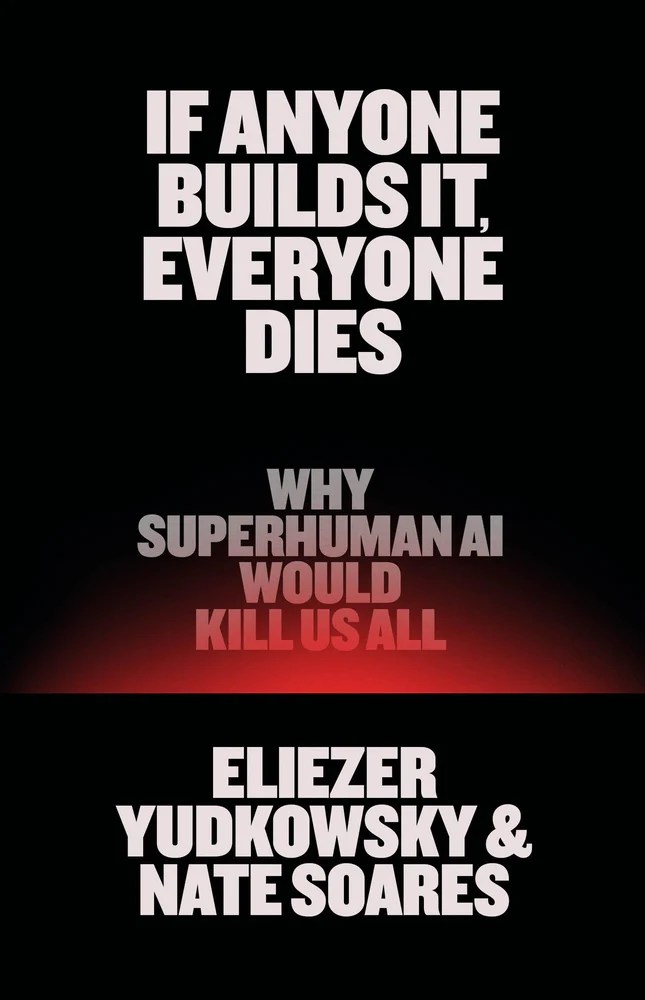
If Anyone Builds It, Everyone Dies: Why Superhuman AI Would Kill Us All, by Eliezer Yudkowsky and Nate Soares, Little, Brown, 2025.
Marche’s review is hardly laudatory: “The book reads like a Scientology manual, the text interspersed with weird, unhelpful parables and extra notes available via QR codes…. Following their unspooling tangents evokes the feeling of being locked in a room with the most annoying students you met in college while they try mushrooms for the first time.”
I love Marche’s way with words; I believe I’ll pass on this particular primer.
The AI Con: How to Fight Big Tech’s Hype and Create the Future We Want. “Bender, a computational linguist, and Hanna, a tech sociologist,” Marche describes, “look at artificial intelligence and see not a force for destruction or creation, but a colossal scam. They have found a rich lode to mine; the hype machine around artificial intelligence has entered its rococo period.”

The AI Con: How to Fight Big Tech’s Hype and Create the Future We Want, by Emily M. Bender and Alex Hanna, Harper, 2025.
Marche recounts, “The authors carefully peek behind the claims of self-driving cars to see just how much human supervision they require. (A lot.) They delve into the upsetting and macabre history of using A.I. in social services. They gleefully dissect, in detail, the numerous debacles of early attempts to automate processes in law and politics that cannot be automated. They point out what everybody knows by now: that the use of A.I. in education doesn’t lead to better or more efficient instruction; it leads to the performance of educational tasks without the fulfillment of their original purpose: learning.”
Hmm… This one sounds like preaching to my particular choir: See “Rethinking A.I.” and “Grok Goes Bonkers” here at SimanaitisSays.
How To Think About AI: A Guide for the Perplexed. “The shelf of general guides to artificial intelligence is crowded by now,” observes Marche, but this book “is one of the best, filled with real insight and common sense, and refusing to engage in either fear-mongering or a casual dismissal of other, more opinionated takes. Susskind, a prolific British writer on A.I., has been studying the subject since the 1980s, and both fear and loathing diminish with perspective.”
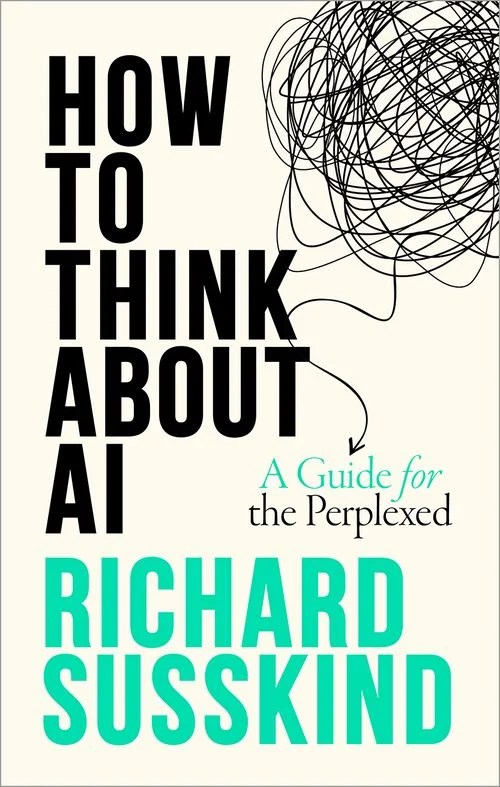
How To Think About AI: A Guide for the Perplexed, by Richard Susskind, Oxford University Press, 2025.
Marche continues, “Susskind is honest and clear, but at this juncture in the history of artificial intelligence, honesty and clarity are unfortunately deeply unsatisfying. ‘We do not have the vocabulary and concepts to capture and discuss the way that our increasingly capable systems work,’ Susskind writes. ‘Instead, we root our debate in language that relates to humans.’ He is absolutely correct. I have been waiting for somebody to say this in a book for years.”
Marche posits, “The truth is that when you turn a decent and informed mind like Susskind’s on to the state of artificial intelligence, the most perceptive thing he has to say is that we don’t know much.”
I’m never too old to learn. This one is on my to-read list. ds
© Dennis Simanaitis, SimanaitisSays.com, 2025
 Simanaitis Says
Another good Simanaitis Says. “The hits just keep on coming.” Given the decline in our K-12, sci-fi more accessible than the wonder and hope of science, so AI the latest pop concern. A computer is a computer is a calculating machine. Yes, AI will eliminate scores of middle management cubical jobs, the sort of endeavors once dismissed as “paper shuffling.”
But those fearing a computer would otherwise be fearing something else. Garbage in, garbage out, remember?
Our concern should be students using AI to write papers, with the resulting generations of glib dullards.
A computer might emulate Chopin or Shakespeare, but will never be another Chopin or Shakespeare.
Sorry, Mike.No more freebies. I’ve got my own typos to correct.—d
Sent from the all new AOL app for iOS