
Simanaitis Says
On cars, old, new and future; science & technology; vintage airplanes, computer flight simulation of them; Sherlockiana; our English language; travel; and other stuff
OPERA AND COLONIALISM PART 2
YESTERDAY, WE BEGAN WITH TIDBITS OF SIMON BANK’S ARTICLE “Terra (In)Cognita” gleaned from Opera with Opera News, the latter a part of my Metropolitan Opera membership. Today in Part 2, we continue operatic developments with the serial colonialist Napoleon.
1809, Paris, Napoleon Encourages Violent Foreign Conquest. Banks recounts, “Half a century after Frederick the Great had portrayed Cortés as a villain, Napoleon Bonaparte presented him as a man of destiny bringing civilization to backward nations. Napoleon wanted Spontini’s 1809 Fernand Cortés to fire the French with enthusiasm for his 1808 invasion of Spain”

An engraving from the first edition of Spontini’s Ferand Cortez. This and other images from Opera With Opera News.
Another mixed message, I’d say, along with many others of an arrogant kid from Corsica.
1845, Naples. Another Noble Savage, But This Time He Really Plans to End Despotism. Banks describes how “Verdi’s music for the opera Alzira, based on the Voltaire play, in 1845 is very different from Graun’s music for Frederick’s Montezuma back in 1755. In those 90 years the politics of Europe had changed utterly.”
“Zamoro in Verdi’s Alzira,” Banks relates, “bursts into life in the vigorous rhythms—the jaunty rum-ti-tum of a republican composer intent on radical change, soon.”
1864, Paris. Questioning European Assumptions of Racial Superiority. Meyerbeer and his librettist Eugene Scribe in Vasco de Gama (staged under the title L’Africaine) suggests that dark forces are at work in the heart of the colonial project.
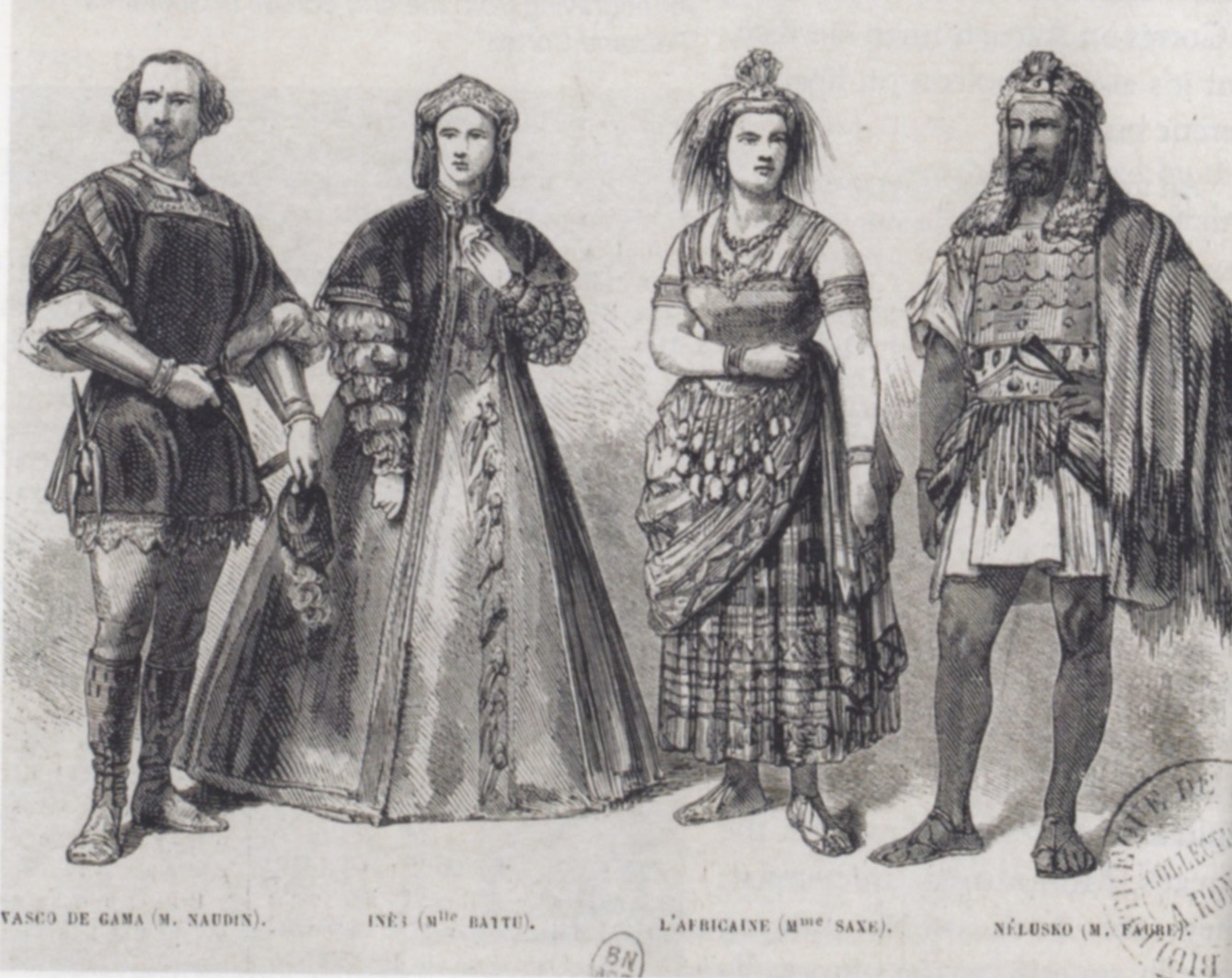
The leading roles in Meyerbeer’s L’Africaine, 1864.
Banks observes, “… Scribe goes out of his way not to present the story as an encounter between sophisticated Europeans and primitive exotic natives. On the contrary, Indian civilization is a deliberate mirror of Western civilization. The opera is symmetrical: In Acts 1 and 2 Indians are imprisoned in Europe, Act 3 takes place on board ship, and in Acts 4 and 5 Europeans are imprisoned in India.”
Hmm….
1964, West Berlin. A New Post-Colonial Liberal Consensus. Yet another Montezuma, this time by American composer Roger Sessions, “was the product of the anti-fascist international consensus at the end of World War II, the mindset that created the United Nations,” writes Banks. “Montezuma attempted to give authentic voice to the Native Americans whose indigenous communities had been decimated in the 16th century, and included passages sung in the Aztec language Nahuatl.”

The premiere of Roger Sessions’ Montezuma at the Deutsche Oper Berlin in 1964.
1992, New York. Rediscovering the Excitement of Exploration. “Opera composers,” Banks recounts, “had been condemning the conquistadors for centuries, and in 1992 Philip Glass explored the subject from fresh angles.”
In Prologue to The Voyage, “A scientist in a wheelchair, resembling Stephen Hawking, contrasts the vulnerability of the human body with the vastness of the mind and the universe. The chorus fires off a series of imponderable cosmological questions.”

The premiere of Philip Glass’s The Voyage at the Metropolitan Opera in 1992.
“The Voyage,” Banks writes, “alternates scenes set in 1492 with preparations for a voyage to other parts of the universe in 2092. In David Henry Hwang’s libretto Columbus on his deathbed sings: ‘From the first amoeba/ Who fought to break free of itself/ To Ulysses, to Ibn Battuta, to Marco Polo/ To Einstein, and beyond/ All that we seek to know is to know ourselves.’ ”
Thanks, Simon Banks and Opera With Opera News, for this. ds
© Dennis Simanaitis, SimanaitisSays.com, 2025
 Simanaitis Says