
Simanaitis Says
On cars, old, new and future; science & technology; vintage airplanes, computer flight simulation of them; Sherlockiana; our English language; travel; and other stuff
IS THAT OCTOPUS A RIGHTY OR A LEFTY? NEITHER; SORTA OMNIDEXTROUS.
NICOLE DAVIS WRITES “Octopuses Prefer To Use Different Arms For Different Tasks, Scientists Find,” The Guardian, September 11, 2025.

The creatures, Davis recounts, favor front arms for most tasks, though all eight arms are capable of all actions.
Etymological Fun. To invent a new word, the octopus is sorta omnidextrous. And the etymology of its related “ambidextrous” is an interesting one: The Latin root ambi means “both,” as in “ambivalence. And Latin dexter, akin to Greek δεξιά dexia literally means “on the right,’ as in heraldry.
But on the other hand (ha! a pun, kinda), Merriam-Webster notes, “Since most people are right-handed, and therefore do things more easily with their right hand, dexter developed the additional sense of “skillful.”
So ambidextrous means “both skillful.” And my invented omnidextrous means “all skillful.”

Image by blickwinkel/Alamy via The Guardian.
Back to Nicole Davis: “While some humans find they have two left feet on the dancefloor, octopuses manage to coordinate eight highly flexible arms across a host of behaviours, from foraging to den-building, or moving around the seafloor. Now researchers say they have completed the most comprehensive study of its kind, not only identifying the actions and small motions involved in different types of movements, but revealing that – like primates, rodents and fish – the cephalopods prefer to use particular limbs for certain tasks.”

Davis cites Kendra Buresch, a co-author of the study who is based at the Marine Biological Laboratory, Woods Hole, in the U.S.: “In general, we did see that for most actions the octopuses used their front arms more often than their back arms.” However, Buresch noted there were exceptions.
Methodology. David recounts, “Writing in the journal Scientific Reports, Buresch and colleagues reveal how they analysed 25 one-minute video clips of 25 wild octopuses across three species. These were filmed between 2007 and 2015 at six sites ranging from Vigo in Spain to the Cayman Islands, each with a different habitat.”

Shortening, Elongating, Bending, Twisting. “For each clip,” Davis relates, “the researchers classified the behaviour of the octopus, such as fetching an object or walking, then classified the arm actions involved—such as curling the limb or reaching it away from the body. The team also explored which of the four ways octopus arms can deform—shortening, elongating, bending and twisting—was involved in each action.”
“Overall,” Davis continues, “the team identified 15 different octopus behaviours and 12 different arm actions, with some—such as crawling or parachute attack— requiring more arm actions than others, such as backward swimming. The team found multiple arm actions could occur at the same time on the same or adjacent arms, and that all eight arms were capable of all actions and deformations.”
As one who marvels that musicians use two hands differently, I find all of this utterly amazing. I particularly like the image of the “parachute attack.”

“It was an immense cuttle-fish….” Image from The Annotated Jules Verne: Twenty Thousand Leagues Under the Sea, an engraving from the original 1870 edition.
Righty/Lefty? No, Fronty/Backy. Davis recounts, “While the researchers did not find the octopuses had a preference for using their right or left arms, the cephalopods did favour using their front arms over their rear arms, with a split of 61% to 39% respectively when all 12 actions were considered together.”
“Delving deeper,” she relates, “they found the creatures used their two front pairs of arms more often for reach, raise, lower and curl actions. By contrast, the study suggests they prefer to use their rear two pairs of arms for the stilt action—where the body sits upright on the arms—and for the roll action, where the arm moves like a conveyor belt, both of which are used in locomotion.”
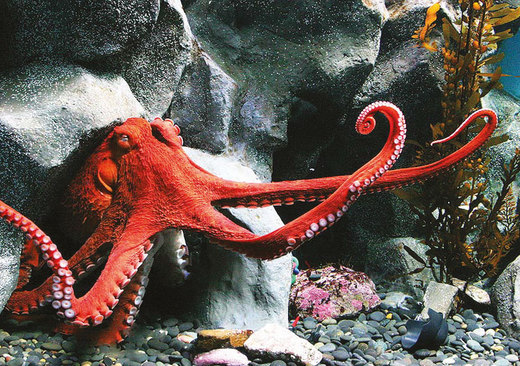
A Giant Pacific octopus, the largest of its kind, with an arm span as great as 20 ft. Image from London Review of Books, September 7, 2017.
SimanaitisSays has long admired the intelligence of cephalopods (literally, “head-feet”), citing “The octopus is as near to intelligent alien life as anything found on this planet.”

Die Krake Paul, Paul the Octopus, was renowned for his 2010 World Cup predictions. Image from soccerblog.com.
New Insights; New Applications. Nicole Davis observes, “The team say the results provide new insights into how octopuses coordinate their eight flexible arms to carry out complex behaviours and multitask, while the findings could also be useful beyond marine science: Such demonstrations of flexibility may help inform ethologists, sensory ecologists, neuroscientists and engineers designing soft robotic appendages.” ds
© Dennis Simanaitis, SimanaitisSays.com, 2025
 Simanaitis Says
Not to take away from your invention of the word “omnidextrous”, but it seems to have been coined earlier: https://slangdefine.org/o/omnidextrous-1b1c.html
It appears I’ve extended the term cephalopodally.—ds
It would make sense that the octopus would favour the front two pairs of arms as these would be within visual range of their eyes allowing monitoring of what they are trying to pick up. Rear pairs would be less easily monitored.
An excellent point. Which reminds me: I wonder if they point at things and how? (Consider “parachute attack.”)—ds